Quick answer: Buy the quiet infrastructure once and buy it properly: a stainless spirit lamp with a snuffer cap and weighted base, a 152 mm and 203 mm plaster spatula pair, an adjustable saw frame for 63.5 mm blades, and 165 mm plaster shears kept for plaster only. These are career purchases, so quality matters more than price.
A dental technician's wax carvers get replaced when they wear out; the rest of the bench kit tends to get bought once and used for a career. Spirit lamps, plaster spatulas, saw frames and shears are the quiet infrastructure around every wax-up and model — and because they are bought rarely, they are worth buying properly. Here is what to look for.
The spirit lamp: controlled heat, no bottle
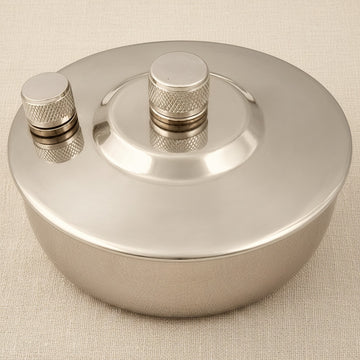
An alcohol spirit lamp is still the standard heat source for warming carvers, flowing wax and smoothing a margin, and for good reason: a small, steady, soot-free flame you can hold an instrument in without changing its temper. Ours is polished stainless with a snuffer cap — the detail that matters most, since it both extinguishes the flame safely and stops the fuel evaporating between sessions. Look for a stable, weighted base (a knocked-over spirit lamp is a genuine hazard), a replaceable wick, and a cap that seats properly rather than merely resting on top.
Plaster spatulas: two lengths, two jobs
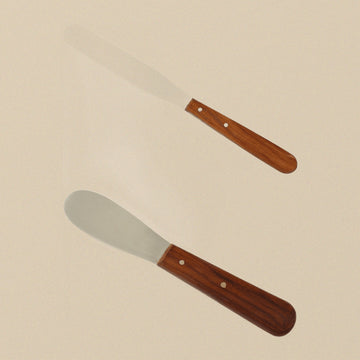
Mixing stone and plaster is done with a stiff, flexible-tipped spatula, and the pairing to own is a short and a long — ours are 152 mm and 203 mm. The shorter blade gives control for small mixes and for loading a die; the longer reaches the bottom of a full bowl and scrapes the walls without you tipping it. Stainless throughout, and the blade should flex under pressure then return dead flat — a spatula with a permanent bend never mixes cleanly again.
Saw frames for model work
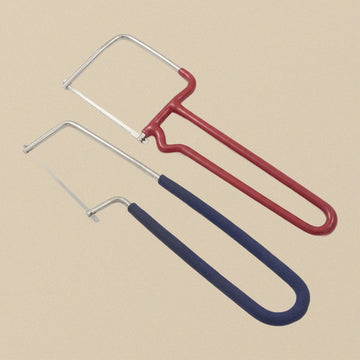
A dental laboratory saw frame takes fine piercing blades — ours is adjustable for 63.5 mm blades — for sectioning models, separating dies and trimming. Adjustability is the feature to insist on: it lets you re-tension a blade, use a shortened blade after a break, and set the tension high enough that the blade tracks straight instead of wandering. A blade under proper tension cuts a narrower, more accurate kerf, which on a sectioned model is the difference between a die that seats and one that does not.
Plaster shears
Plaster shears — a stout 165 mm (6.5-inch) surgical-steel scissor — trim set plaster and stone quickly where a saw would be overkill and a trimmer too aggressive. They earn their place on removing flash and bulk before finishing. Keep them for plaster only: the abrasive dust that dulls them will ruin any blade you also use for wax or foil.
The carving side of the bench
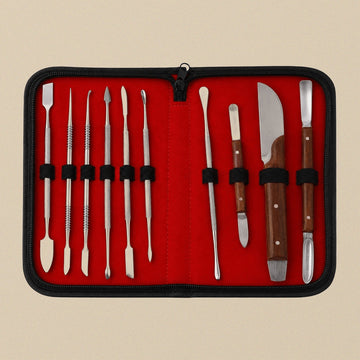
Alongside the infrastructure sit the shaping tools themselves — 10-piece double-ended wax carving and modelling kits in surgical steel, 6-piece sculpting sets with titanium-coated non-stick tips (worth the upgrade if you work a lot of soft wax that clings), and wax and clay sculpting sets supplied in a roll pouch. Our dedicated guides below go deeper on tip geometry and which carver does what.
Care that actually extends life
- Wipe carvers and spatulas warm, before wax or plaster sets hard on them.
- Never soak wooden-handled or wick-fed items; wipe and dry instead.
- Store saw blades tensioned-off and keep spares — blades are the consumable, frames are not.
- Refill spirit lamps cold, cap them between sessions, and keep them away from the edge of the bench.
Everything above ships from UK stock with same-day dispatch before 2pm — browse the wax carving and lab range below.
Related guides
- Shop Wax Carving & Lab Modelling →
- Dental Wax Carving Tools: A UK Professional's Working Kit
- Dental Wax Carvers: Tip Geometries Explained
- Lost-Wax Casting for Beginners: A UK Buying Guide
Frequently asked questions
What basic bench kit do I need for dental lab modelling work?
Four quiet essentials sit around every wax-up and model: an alcohol spirit lamp for controlled, soot-free heat; short and long plaster spatulas (152 mm and 203 mm) for mixing stone; an adjustable saw frame taking 63.5 mm blades for sectioning models; and stout plaster shears for trimming set plaster. Wax carvers are the shaping tools on top.
What should I look for in a dental spirit lamp?
Three things: a snuffer cap that seats properly, since it extinguishes the flame safely and stops fuel evaporating between sessions; a stable, weighted base, because a knocked-over spirit lamp is a genuine hazard; and a replaceable wick. Refill the lamp cold, cap it between sessions and keep it away from the edge of the bench.
Why does adjustability matter in a dental lab saw frame?
An adjustable frame lets you re-tension a blade, keep using a shortened blade after a break, and set tension high enough that the blade tracks straight rather than wandering. A properly tensioned blade cuts a narrower, more accurate kerf — on a sectioned model, that is the difference between a die that seats and one that does not.