Quick answer: Start with the Ash 49 / Le Cron as your all-purpose carver, add a PKT 1–5 set if you do anatomical wax-ups to clinical standard, and cover the Hollenbach, discoid-cleoid and spatula geometries with a 10-piece stainless set. Stainless is fine for students — upgrade to tungsten-carbide only on your most-used carvers. A full starter set runs roughly £150–£350.
Dental wax carvers look almost identical from a distance — a thin steel shaft with a shaped tip at each end. In practice, each tip geometry has a specific job, and using the wrong tip for the wrong job is the single biggest slow-down in early dental-lab training. This guide explains what each common carver tip does, in plain UK English.
This is written for dental technicians, ceramist-in-training, and dental-lab students learning the wax-up workflow. It's not a clinical guide — it's a tool identification and selection reference.
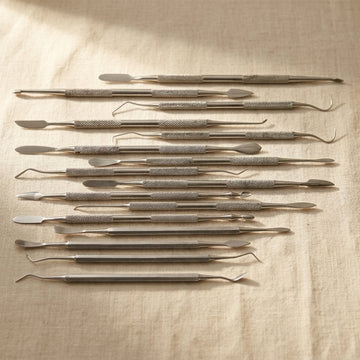
The core carver tip geometries
Ash 49 / Le Cron carver
The all-purpose wax carver. Long, slightly curved blade at one end; pointed tapered tip at the other. Main use: gross wax removal, trimming excess around the margin, roughing in contours. This is the first carver out of the kit and the last one back in it.
PKT (Peter K. Thomas) carvers
A numbered set (PKT 1 through PKT 5) designed by Dr. Peter Thomas specifically for anatomical wax-ups. Each one has a dedicated job:
- PKT 1: placing wax cones for cusp tips — pointed pyramidal tip on one end, thin spatula on the other.
- PKT 2: similar shape, heavier bulk — for larger cone placement.
- PKT 3: the carver used for cusp slopes and triangular ridges. One of the most-used in a PKT wax-up.
- PKT 4: wider blade for developing marginal ridges and occlusal anatomy.
- PKT 5: the largest of the set, used for inter-proximal areas and broad anatomical shaping.
If you're doing anatomical wax-ups to any clinical standard, a full PKT 1–5 set is non-optional.
Hollenbach carver (3, 1/2, 3S)
Spoon-shaped blade on both ends, one larger than the other. Main use: forming cusp inclines and carving marginal ridges. The curved concave face of the spoon follows natural tooth anatomy more easily than a flat blade.
Discoid-cleoid carver
Disc shape at one end, claw shape at the other. Main use: carving occlusal grooves and developing fossae. The claw end is used for pulling wax toward you; the disc for smoothing and finalising the shaped surface.
Beavertail carver / Ward's carver
Flat paddle-shaped blade, wider and thinner than a standard spatula. Main use: flat-surface smoothing, proximal contact wax adjustment, denture base work.
Half-Hollenbach (HHB)
Smaller version of the Hollenbach for fine anatomical detail. Same spoon geometry but scaled down for tight interproximal and posterior work.
Wax spatulas vs wax carvers — don't confuse them
A spatula is for applying and adding wax (usually with heat from an alcohol lamp or electric wax pen). A carver is for subtracting and shaping already-placed wax. Good dental wax-up workflow alternates between the two. Each technician should have both.
Ceramist brushes — the quiet workhorse
For final surface finish and porcelain-build work, ceramist brushes in graded sizes (0, 2, 4, 6, 8) are the tool that transforms a competent wax-up into a clinical-grade one. They don't get the glory but they get the final pass.
Materials: stainless vs tungsten
- Stainless steel tips are standard, hold a good edge, easy to sharpen in-lab on a ceramic stone.
- Tungsten-carbide tipped carvers hold an edge significantly longer and resist wear on the hard investment waxes, but cost two to three times more.
For a dental-lab student, stainless is fine — learn the geometry first, then upgrade to tungsten on the two or three carvers you use most heavily.
Electric wax pens
Temperature-controlled electric wax pens have largely replaced alcohol-lamp-heated spatulas in modern UK dental labs. They're faster, more precise, and don't carbonise the wax. Budget £80–£200 for a lab-grade dual-tip electric wax pen with interchangeable tips.
Recommended starter set for a dental-lab student (2026)
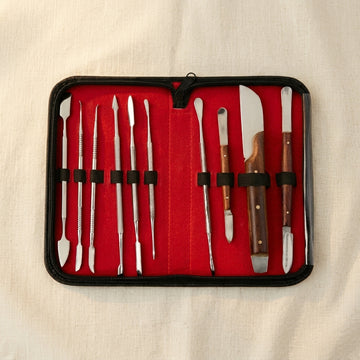
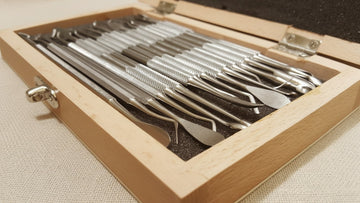
- Professional 10-piece dental lab stainless steel wax carving set with storage case — covers Ash/Le Cron, Hollenbach, discoid-cleoid and spatula geometries in a single box.
- PKT 1–5 dedicated wax-up carver set.
- Electric wax pen (dual-tip with temperature control).
- Ceramist brush set (sizes 0, 2, 4, 6, 8).
- Rubber investment mixing bowl (4" × 5") — for lost-wax crossover work with lab partners.
Total outlay for the four-piece core: roughly £150–£350 depending on electric wax pen choice. That's a permanent lab investment with correct care.
Where to buy in the UK
Toolsmith stocks dental wax carvers, investment bowls and related lab tools in the Wax Carving & Lab Modelling, Dental Instruments and Wax Carving Tools collections — the same wax-carving toolset is used in both dental lab and jewellery lost-wax workflows, so we stock it once and stock it properly. UK-warehoused, same-day dispatch before 2pm on weekdays, free UK delivery.
For dental colleges and training centres, email info@toolsmithltd.co.uk for trade and education pricing on bulk orders.
Related guides
- Dental Wax Carving Tools: A UK Professional's Working Kit
- Lost-Wax Casting for Beginners - UK Buying Guide 2026
- Dental Burs for Lab Technicians: Carbide vs Diamond vs Tungsten
- Dental Lab Modelling Kit: Spirit Lamps, Plaster Spatulas & Saw Frames
Frequently asked questions
Which dental wax carvers do I need as a lab student?
A professional 10-piece stainless wax carving set covering the Ash/Le Cron, Hollenbach, discoid-cleoid and spatula geometries, plus a dedicated PKT 1–5 set for anatomical wax-ups, an electric wax pen with temperature control, and ceramist brushes in sizes 0 to 8. Total outlay for the core is roughly £150–£350 depending on your wax pen choice.
What are PKT carvers used for?
PKT 1–5 is a numbered set designed by Dr Peter Thomas specifically for anatomical wax-ups. PKT 1 and 2 place wax cones for cusp tips, PKT 3 carves cusp slopes and triangular ridges, PKT 4's wider blade develops marginal ridges and occlusal anatomy, and PKT 5 handles interproximal areas and broad anatomical shaping.
Should I buy stainless steel or tungsten-carbide wax carvers?
Stainless for students: it holds a good edge, sharpens easily in-lab on a ceramic stone, and costs far less. Tungsten-carbide tips hold an edge significantly longer and resist wear on hard investment waxes, but cost two to three times more — learn the geometries on stainless first, then upgrade only the two or three carvers you use most heavily.