Quick answer: Match the bur to the material: carbide for acrylic, plaster and wax; diamond for porcelain, zirconia and other ceramics; tungsten carbide for chrome-cobalt and hard alloys. Buy HP-shank (2.35mm straight) burs almost exclusively for lab handpieces, and invest in premium brands — Komet, Edenta, Busch — for critical work. A first lab bur drawer costs £45–£90.
Key difference: soft materials take carbide, hard brittle ceramics take diamond, and hard tough metals take tungsten carbide.
| Bur | How it cuts | Use on |
|---|---|---|
| Carbide | Multiple sharp flutes that shave or chip material away | Acrylic, plaster, wax and soft metals |
| Diamond | Diamond particles bonded to a stainless steel blank; grinds | Ceramics: porcelain, zirconia, E.max and other glass-ceramics |
| Tungsten carbide | Harder, tougher flutes (often cross-cut) that chip tough metal without grabbing | Chrome-cobalt frameworks and other hard alloys |
Open any experienced dental technician's bur drawer and you'll find a carefully chosen collection, not a random jumble. That drawer holds three core materials—carbide, diamond, and tungsten carbide—and each is a specialist, engineered to perform tasks the others simply cannot. To a trainee, they might all look like small, spiky tools. To a seasoned RDT, they are the difference between a perfectly seated crown and a costly remake. Using the wrong bur is a cardinal sin in the lab; substitute a coarse carbide for a fine diamond on a ceramic margin and you'll burn the porcelain edge in an instant. Try to cut a chrome-cobalt sprue with a standard acrylic bur and you'll achieve little more than a shower of sparks and a ruined tool. Understanding which bur to use, and when, is a foundational skill for every UK dental technician.
The three bur materials, what each one cuts
The choice of bur material is dictated entirely by the material you are working on. It’s a simple case of matching the hardness and cutting action of the bur to the properties of the workpiece. Let's break down the three main players you'll find in every UK dental lab.
- Carbide (HSS-grade): Think of carbide burs as planes or chisels with multiple sharp flutes. They don't grind; they shave or chip away material. This makes them exceptionally efficient for bulk reduction of softer materials. Their primary role is in the prosthetics department, where they excel at shaping and trimming acrylic for dentures, custom trays, and bite blocks. They are also the go-to for adjusting plaster models, trimming wax patterns without melting them, and working on soft metals like non-precious alloys before the final sintering or heat-treatment process hardens them. They cut quickly and can leave a relatively smooth finish if the correct shape and speed are used.
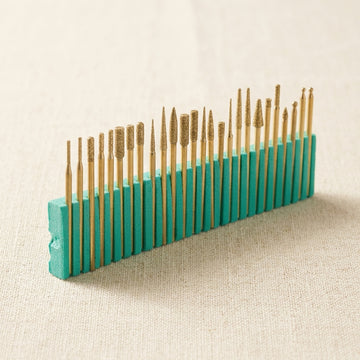
- Diamond: Diamond burs are grinders. They consist of a stainless steel blank onto which diamond particles are bonded, typically through electroplating. As the hardest known natural material, diamond is essential for shaping hard, brittle substances. Their entire purpose in the dental lab is to cut materials that would instantly dull or destroy a carbide bur. This includes all forms of dental ceramics: porcelain, zirconia, E.max (lithium disilicate), and other glass-ceramics. They are used for everything from gross reduction of a zirconia block post-milling to the delicate task of refining a porcelain margin or removing a glaze coat for an adjustment.
- Tungsten Carbide: This is where some confusion can arise. Whilst standard burs are made of 'carbide' (often High-Speed Steel carbide), 'tungsten carbide' burs are a different beast altogether. They are significantly harder, tougher, and more wear-resistant. Tungsten carbide is the material of choice for cutting hard, dense metals. In the dental lab, this means one thing above all: chrome-cobalt (Co-Cr) frameworks. They are also used for other hard non-precious and precious alloys. Their unique flute geometry (often a cross-cut or diamond-cut pattern) is designed to chip away at tough metals without grabbing or chattering, providing controlled, efficient reduction where a standard carbide bur would simply wear down.
The simple shorthand to remember:
- Soft materials (acrylic, plaster, wax, soft metal) = Carbide
- Hard, brittle ceramics (porcelain, zirconia) = Diamond
- Hard, tough metals (chrome-cobalt) = Tungsten Carbide
Shank standards: FG, RA, HP
The shank is the part of the bur that fits into the handpiece. Whilst there are dozens of specialist variations, lab work almost exclusively revolves around three main standards. Using the wrong shank is not just inconvenient; it’s impossible, as it simply won’t fit in the handpiece.
- FG (Friction Grip): This is the clinical standard. With a diameter of just 1.6mm, these shanks are designed for the ultra-high-speed, air-turbine handpieces used by dentists chairside. They are held in place by a friction-grip chuck. You will rarely, if ever, use an FG bur in a typical lab setting unless you are doing chairside adjustments or have a specific high-speed lab turbine.
- RA (Right Angle): This shank has a diameter of 2.35mm and is distinguished by a notch at the end. This notch engages with a 'latch-grip' mechanism in the handpiece head. RA burs are used in slow-speed contra-angle handpieces, common in both clinical and some lab applications, particularly for polishing or intricate work where the angle of the handpiece head is an advantage.
- HP (Handpiece): This is the undisputed king of the dental lab. The HP shank is 2.35mm in diameter (the same as RA) but is longer and has a straight, smooth shank with no latch. It is designed to fit directly into the chuck of a straight lab handpiece, powered by a benchtop micromotor (from brands like Kavo, NSK, or Marathon). The vast majority of work a UK lab technician performs—from trimming dentures to cutting sprues and shaping crowns—will be done with an HP shank bur. The straight handpiece provides superior torque, control, and ergonomics for the extended periods of use common in lab work.
When stocking your bench, unless you have a specific contra-angle handpiece, you should be purchasing HP shank burs almost exclusively. They are the default for the workhorse tool of the UK dental laboratory.
Shape vocabulary
The shape of the bur, or its 'head geometry', defines how it cuts and what it can be used for. A well-stocked drawer contains a variety of shapes to handle different tasks with precision and efficiency. Here is a quick reference for the most common shapes and their lab applications:
- Round / Ball: The most versatile shape. Used for initial material removal, creating concave surfaces, 'spotting' high spots on internal surfaces of crowns, and defining the finishing line angles on denture setups. Available in every material type.
- Pear: As the name suggests, this shape is ideal for shaping and contouring. Its primary use is in creating natural occlusal anatomy in acrylic, composite, or wax. The rounded form allows for the smooth carving of fossae and developmental grooves.
- Tapered Fissure: A workhorse for general reduction. The parallel or slightly tapered sides are perfect for reducing flat surfaces or preparing abutments. In diamond form, it's used for adjusting the axial walls of ceramic crowns. In carbide, it’s used for bulk trimming of acrylic flanges.
- Flame: A more delicate, pointed shape used for fine contouring and access. It’s excellent for finishing line angles, shaping the embrasures between teeth, and for fine adjustment of porcelain anatomy, especially in the interproximal areas.
- Inverted Cone: This shape is wider at the tip than at the neck. Its sole purpose is to create undercuts. This is essential for providing mechanical retention for fillings, denture teeth, or repairs in acrylic work.
- Wheel: A thin, disc-like shape. In the lab, its primary use is for cutting sprues from cast metal or pressed ceramic frameworks and for gross reduction of material where access allows.
- End-cutting: A flat-tipped fissure bur with no cutting flutes on its sides. It is a highly specialised bur used for creating a precise, flat gingival floor or shoulder on a preparation without accidentally modifying the axial walls. Essential for high-precision margin work.
Diamond grit grades
Not all diamond burs are created equal. The size of the diamond particles bonded to the shank determines how aggressively it cuts and the smoothness of the resulting surface. This is known as the 'grit'. Thankfully, there is an international colour-coding standard, indicated by a coloured band on the shank, which makes identification simple.
- Super-Coarse (Black band) / Coarse (Green band): With a particle size around 150 microns, these burs are designed for rapid, bulk reduction of ceramic material. They cut very aggressively and leave a very rough surface that requires subsequent finishing with finer grits. Use these for major reshaping or removing large amounts of material quickly.
- Standard / Medium (Blue band): This is the general-purpose, all-rounder grit, typically around 100 microns. It offers a good balance between cutting efficiency and surface finish. Most general shaping of porcelain and zirconia is done with a blue-banded bur.
- Fine (Red band): With a particle size of approximately 40 microns, red-banded burs are for finishing and pre-polishing. They are used to smooth surfaces prepared by coarser burs and are the go-to tool for refining margins on ceramic crowns before glazing. They remove less material but leave a much smoother surface.
- Extra-Fine (Yellow band): These burs have a very small particle size, around 15 microns. They are not for material reduction but for final finishing and creating a super-smooth surface on ceramics just before the final glaze and fire. Using a yellow-band bur can reduce the amount of manual polishing required post-glaze.
A common workflow is to start with a blue-band bur for initial shaping, move to a red-band for margin refinement and smoothing, and finish with a yellow-band bur to prepare the surface for a perfect glaze.
RPM and water-cooling
The speed of your handpiece (Revolutions Per Minute, or RPM) is not a case of 'faster is better'. The correct RPM depends on the bur material, the workpiece material, and the task at hand. Using the wrong speed can, at best, be inefficient and, at worst, destroy both the bur and your work.
- Carbide on Acrylic/Plaster: Carbide burs work best at medium to high speeds, typically in the 5,000-25,000 RPM range. The goal is to allow the flutes to 'shave' the material cleanly. Too slow, and the bur may snag or jump. Too fast, and you risk melting the acrylic due to friction, which will clog the flutes and render the bur useless until cleaned. You learn to listen for the clean cutting sound.
- Diamond on Porcelain/Zirconia: This is critically important. When grinding ceramics, you must avoid generating excessive heat. Heat creates micro-cracks in the ceramic structure, compromising its integrity and leading to potential fractures later on. The recommended speed is generally lower, around 8,000-15,000 RPM, and it must be done with a water spray or coolant. If you are dry-grinding porcelain and see it glow red, you have already caused irreparable damage. The water not only cools the workpiece but also washes away debris, improving cutting efficiency. No water results in a 'glazed' surface on the bur, where debris has melted onto the diamonds, and a weakened restoration.
- Tungsten on Chrome-Cobalt: Cutting hard metal is about torque, not speed. Tungsten carbide burs should be run at a much lower RPM, typically 3,000-8,000 RPM. The technique is to use firm, steady pressure and let the bur's hardness do the work. If you run a tungsten bur too fast on chrome, you will hear a high-pitched scream, generate excessive heat, and see the bur tip glow. This will instantly burn out the cutting edges and can even work-harden the metal surface, making it even more difficult to cut. Slow and steady wins the race with chrome.
Brand reality: Komet vs Edenta vs Busch vs Microcopy vs budget burs
In the world of dental burs, you absolutely get what you pay for. The price difference between a premium German bur and a budget bur is not just marketing; it reflects the quality of the steel, the precision of the engineering, the concentricity of the shank, and the quality of the diamond bonding. This is where the voice of experience in the lab becomes crucial.
- Komet (German): Widely regarded as the gold standard, particularly for their diamond and tungsten carbide lab burs. A Komet diamond bur (£3-£12) will have perfectly uniform grit, excellent bonding, and a perfectly concentric shank, meaning it runs true with no vibration. This precision is vital for delicate margin work. Their tungsten cutters for chrome are legendary for their longevity and cutting efficiency.
- Edenta (Swiss): Another premium European brand, Edenta has a particularly strong reputation for its carbide burs for acrylics and plaster. Their shaping and finishing burs (£1.50-£6) are known for their sharp, durable flutes that resist clogging. Many labs will pair Komet diamonds with Edenta carbides.
- Busch (German): Busch is a giant in the world of rotary tools, producing exceptional quality burs. Whilst hugely popular in the jewellery trade, their dental range is just as good, with excellent carbides and a comprehensive range of shapes. They are a solid, reliable choice often on par with Komet and Edenta.
- Microcopy (US): This brand has gained significant popularity, especially in the clinical setting, for their single-use diamond burs. The concept is a sterile, perfectly sharp bur for every patient. Whilst less common in the lab's reusable workflow, their quality is excellent and some labs use them for specific, contamination-sensitive cases.
- Budget burs: These are the burs you'll find on auction sites and from budget suppliers, often costing as little as £0.40-£1.50 each. For non-critical tasks like trimming a plaster model or roughing out a special tray, they can represent good value. However, using an £0.80 diamond bur on a £200 zirconia crown is a false economy. The risks—poorly bonded grit contaminating the porcelain, an eccentric shank shattering a fine margin, or a dull edge burning the ceramic—are simply too high. Most experienced technicians reserve these for student practice or for tasks where precision is not the primary concern. Toolsmith does not currently sell dental lab burs; our only bur set is a 30-piece diamond bur set with a 1/8-inch shank for jewellery and engraving work, made in Pakistan.
The consensus in most quality-conscious UK labs is to invest in premium brands for critical tasks. A Komet diamond for all ceramic work and a high-quality tungsten cutter for chrome are non-negotiable. For acrylic and plaster work, a quality carbide from a brand like Edenta or Busch provides the best balance of performance and cost.
Single-use vs reusable
The clinical dental world is increasingly moving towards single-use burs to guarantee sterility and eliminate any risk of cross-contamination between patients. For the dental lab, however, the economic and practical landscape is different. Lab work is generally performed on inanimate models and restorations for a single patient case at a time, significantly lowering the cross-contamination risk profile.
Consequently, the lab environment has remained firmly in the camp of reusable burs. A high-quality Komet or Edenta bur is designed to be used multiple times, provided it is cared for properly. The cost-per-use of a £6 reusable bur over its lifespan is far lower than using a new £2 single-use bur for every task. The key is proper cleaning and sterilisation. Most quality diamond and tungsten carbide burs are designed to withstand standard autoclave cycles (134°C). Some cheaper, electroplated carbide burs, however, may not be, as the high temperatures can compromise the plating. Always check the manufacturer's instructions for sterilisation compatibility.
The £45-90 first lab bur drawer
For a trainee starting out or a lab manager stocking a new technician's bench, knowing what to buy can be daunting. Here is a practical, essential starter kit that will cover around 80% of daily tasks, with a typical cost between £45 and £90 depending on the brands chosen.
- 3 x Carbide Round Burs (HP Shank): Sizes 014 (1.4mm), 018 (1.8mm), and 023 (2.3mm). These are your workhorses for bulk acrylic reduction, adjusting denture peripheries, and relieving the internal aspects of special trays.
- 2 x Carbide Pear Burs (HP Shank): One small and one medium size. Essential for carving occlusal anatomy into wax-ups and acrylic teeth.
- 2 x Diamond Tapered Fissure Burs (HP Shank): One medium grit (blue band) for general shaping of ceramics and one fine grit (red band) for margin refinement. These are for your crown and bridge work.
- 1 x Carbide or Diamond Wheel (HP Shank): Primarily for cutting sprues off cast or pressed restorations. A diamond wheel is more versatile if you work with ceramics.
- 1 x Tungsten Carbide Round Bur (HP Shank): A size 023 is a good starting point. This is your dedicated tool for adjusting chrome-cobalt frameworks and clasps. Do not use it on acrylic.
- 1 x Carbide Inverted Cone Bur (HP Shank): A small size for creating mechanical undercuts for denture repairs or adding teeth to an existing plate.
This small selection provides the specific tool for each major material group, preventing cross-contamination (e.g., using an acrylic bur on metal) and ensuring you have the right geometry for the most common jobs.
Bur care and disposal
Your burs are precision cutting instruments. Treating them as such will extend their life, improve the quality of your work, and save you money. Follow a strict care protocol.
- Cleaning: Immediately after use, clean debris from the bur. A brass wire brush is effective for carbides, whilst a dedicated diamond-cleaning stone works best for diamond burs. An ultrasonic bath with a suitable enzymatic solution is the most effective way to remove biological and hardened debris. Never soak burs in harsh acids or cold sterilisation fluids for extended periods, as this can corrode the shank and weaken diamond bonding.
- Sterilisation: After cleaning, burs should be sterilised. The standard protocol is an autoclave cycle at 134°C. Ensure burs are completely dry before autoclaving to prevent corrosion. Refer to the manufacturer's guidelines, as some burs may have specific limitations.
- Disposal: A bur is a sharp, and it must be disposed of correctly. Worn-out burs, especially hard and brittle tungsten carbide burs, should be placed in a designated sharps bin. Do not throw them in the regular waste bin where they pose a risk of injury.
- When to Bin a Bur: A bur's life is finite. It's time to dispose of it when you notice a 'glazed' or shiny appearance on the cutting edges, a visible chip on a flute or diamond surface, or when you have to apply significantly more pressure to get it to cut. Using a dull bur generates more heat, produces a poor surface finish, and increases the risk of damaging your work.
UK-stocked: fast dispatch
Everything we sell ships from UK stock, and we aim to dispatch orders placed before 2pm UK time, Monday to Friday, the same working day. The related rotary and dental tools we stock are shown below.
Related guides
- Dental Lab Sterilisation: A UK Practice Guide
- Dental Wax Carvers: Tip Geometries Explained
- Flex Shaft vs Micromotor: Rotary Power Compared
- Dental Examination Instruments: Mirrors, Probes & Explorers
- Orthodontic & Wire-Bending Pliers: A UK Dental Guide
- Dental Extraction Forceps & Luxation Elevators: A UK Guide
- Tofflemire Matrix Retainers & Aspirating Syringes: A UK Restorative Guide
- Sterilisation Cassettes & Instrument Trays: A UK Practice Buying Guide
- Dental Implant Surgical Kits: Trephines, Osteotomes & Sinus-Lift Instruments
- Dental Lab Modelling Kit: Spirit Lamps, Plaster Spatulas & Saw Frames
- Shop all Dental Instruments
Frequently asked questions
Which dental burs do I need to start in a UK lab?
A £45–£90 starter drawer covering each material group: three carbide round burs (sizes 014, 018 and 023), two carbide pears for occlusal anatomy, two diamond tapered fissures (blue and red band) for ceramic work, a wheel for sprue cutting, one tungsten carbide round for chrome-cobalt, and a small carbide inverted cone for undercuts — all HP shank.
What do the coloured bands on diamond burs mean?
They show grit size to an international colour code. Black or green bands are coarse (around 150 microns) for rapid bulk reduction; blue is the general-purpose medium (around 100 microns); red is fine (around 40 microns) for margin refinement; yellow is extra-fine (around 15 microns) for final smoothing before glaze. A common workflow runs blue, then red, then yellow.
What speed should I run lab burs at?
Carbide on acrylic or plaster: 5,000–25,000 RPM, letting the flutes shave cleanly — too fast melts the acrylic. Diamond on porcelain or zirconia: 8,000–15,000 RPM with water coolant, because dry grinding creates micro-cracks that weaken the restoration. Tungsten carbide on chrome-cobalt: just 3,000–8,000 RPM with firm, steady pressure — torque, not speed, cuts hard metal.