Quick answer: Insist on the kidney shape, then buy both materials: stainless steel for the sterile field and reusable set-ups (it autoclaves indefinitely), plastic for waste, spillage and mobile work. For a first set, two 8-inch dishes plus one 10-inch covers more situations than three of the same size; add a lidded stainless box for stored kits.
The kidney dish is one of those designs that has outlasted every attempt to improve it. Curved to sit against a body or the edge of a trolley, deep enough to hold fluid, shallow enough to reach into, and shaped so nothing rolls out of the corner — it has been standard clinical ware for well over a century. Here is how to choose dishes, trays and boxes for a UK practice, clinic or first-aid room.
Why the shape survives
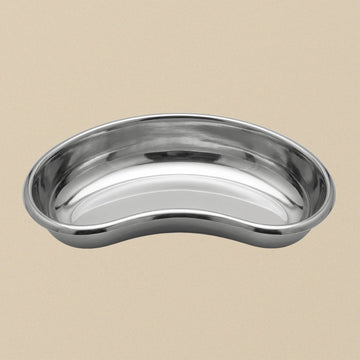
The reniform (kidney) shape does three things at once: the concave side tucks against a patient or a trolley edge so it can be held close, the rounded ends stop instruments and swabs collecting in a corner you cannot reach, and the depth holds irrigation fluid or waste without slopping. It is why the dish still appears on every trolley layout — and why the shape is worth insisting on rather than substituting a rectangular tray.
Stainless or plastic?
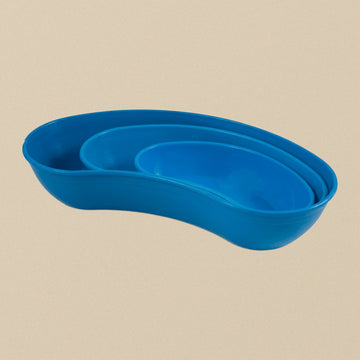
Stainless steel is the choice where the dish is reused: it autoclaves indefinitely, does not stain or absorb odour, and survives being dropped. Ours run to a 12-inch (300 mm) CE-marked surgical dish for major set-ups. Plastic dishes — our set covers 6, 8 and 10 inch — are lighter, quieter on a trolley, cheaper to hold in numbers and easy to dedicate to a single patient or a single dirty task. Most clinics end up with both: stainless for the sterile field, plastic for waste, spillage and mobile work.
Sizing by task
- 6 inch: single-procedure receiver — sutures, swabs, a used blade, dressings.
- 8 inch: the everyday dish; comfortably holds a small instrument set-up.
- 10 inch: irrigation, larger dressing changes, multi-instrument work.
- 12 inch stainless: theatre and major set-ups where volume matters.
If you are buying a first set, two 8-inch and one 10-inch covers more situations than three of the same size.
Instrument boxes and storage
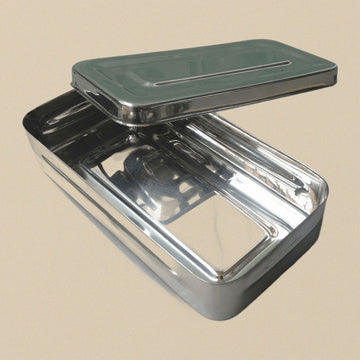
A lidded stainless instrument storage and sterilisation box does a different job from a dish: it keeps a defined set together, protected and identifiable through storage as well as processing. That matters most for kits that are used occasionally — an emergency set, a suture kit, a specific procedure tray — where the risk is not contamination so much as a missing instrument discovered at the worst moment. For high-turnover chairside sets, a cassette (see our dedicated guide below) is the better tool; for stored sets, a box wins.
Clean-to-dirty, in practice
The point of having several dishes is that they let you keep a direction of travel: clean instruments presented from one, used items received into another, sharps never into either. Colour or size can carry that convention — many clinics use plastic for the receiving dish and stainless for the sterile field precisely because you can tell at a glance. Whatever the convention, make it consistent enough that a locum can read it.
Care and processing
Stainless ware is effectively permanent if it is rinsed promptly (blood and saline are what pit steel, not use), processed per your decontamination policy, and stored dry. Check rims occasionally for burrs, especially on dishes that get stacked — a raised edge is both a glove hazard and a sign the dish has been dropped. Plastic dishes are consumables with a long life: replace them once the surface goes matt and scratched, since a roughened surface is harder to clean reliably.
Everything above ships from UK stock with same-day dispatch before 2pm — browse the trays, dishes and sterilisation range below.
Related guides
- Shop Trays, Dishes & Sterilisation →
- Sterilisation Cassettes & Instrument Trays: A UK Practice Buying Guide
- Dental Sterilisation Workflow: Beyond the Autoclave
- Surgical Scalpels, Gigli Saws & Bone Instruments: A UK Guide
Frequently asked questions
What size kidney dishes do I need for a UK clinic?
Start with two 8-inch and one 10-inch: 8-inch is the everyday dish that comfortably holds a small instrument set-up, while 10-inch handles irrigation and larger dressing changes. Add 6-inch receivers for single procedures — sutures, swabs, a used blade — and a 12-inch stainless dish for theatre and major set-ups where volume matters.
Are stainless steel or plastic kidney dishes better?
Both have a job. Stainless autoclaves indefinitely, does not stain or hold odour, and survives being dropped, so it suits reuse and the sterile field. Plastic is lighter, quieter on a trolley, cheap enough to hold in numbers and easy to dedicate to dirty tasks. Most clinics run stainless for clean work and plastic for waste and mobile use.
When should I use an instrument box instead of a cassette?
Use a lidded stainless instrument box for sets stored between occasional uses — an emergency kit, a suture kit, a specific procedure tray — where the real risk is a missing instrument rather than contamination. For high-turnover chairside sets, a sterilisation cassette is the better tool; it carries instruments through processing and back as one unit.