Quick answer: Buy cassettes sized around your most common procedure, not your biggest — three 5-instrument cassettes cycling beats one 20-instrument doing everything. A cassette holds instruments in procedure order through the whole ultrasonic-to-autoclave loop, cutting handling steps and sharps risk. Check your autoclave chamber and ultrasonic bath dimensions against the cassette footprint before ordering.
Instrument reprocessing is where a practice either hums or haemorrhages minutes. The humble sterilisation cassette — a hinged, perforated stainless frame that holds a procedure's instruments from chairside to autoclave to the next patient — is the single cheapest upgrade to that loop. This guide covers capacities, cassettes versus open trays, and the workflow gains that justify the drawer space, whether you run a dental surgery, a hygiene column or a veterinary dental list.
What a cassette actually changes
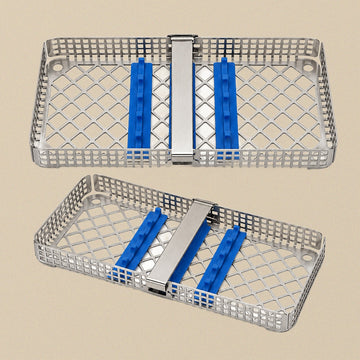
Loose instruments get handled at least four times per cycle: gathered, scrubbed or ultrasonically cleaned, laid out to dry and wrap, then unloaded. Each handling step is a sharps-injury opportunity and a re-sorting delay. In a cassette, the instruments sit in silicone or stainless rails in procedure order and never leave the frame: the whole cassette goes through ultrasonic cleaning, rinsing, drying, wrapping and the autoclave as one unit, and arrives chairside already laid out. Practices that switch rarely switch back — the gain is measured in minutes per patient and in gloves that never reach into a pile of loose sharps.
Capacities: 5, 7, 10 and 20 instruments
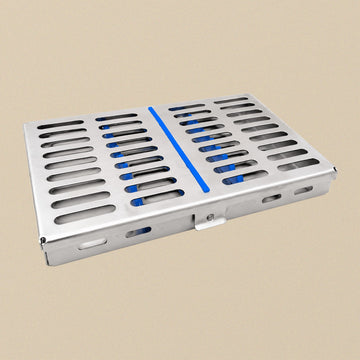
- 5-instrument (180–200 mm): the examination-kit cassette — mirror, probe, explorer, tweezers and one more. One per surgery per session slot is the classic setup.
- 7-instrument (approx. 18 × 11 cm): hygiene and small restorative set-ups with a couple of hand scalers added.
- 10-instrument (approx. 18 × 18.5 cm): full restorative or extraction set-ups — forceps and elevators sit comfortably.
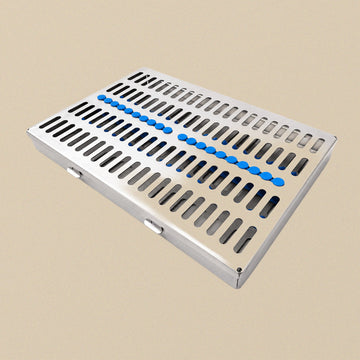
- 20-instrument (280 × 185 mm): surgical and multi-stage procedures, or a whole session's exam kits consolidated.
Buy around your most common procedure, not your biggest: three 5-instrument cassettes cycling beats one 20 doing everything.
Cassettes vs open trays
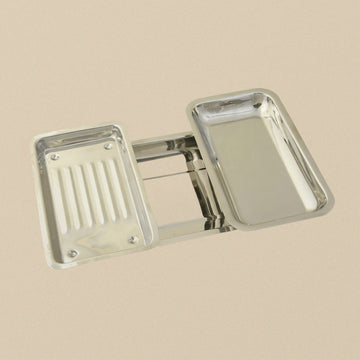
Perforated instrument trays — like our autoclavable scaler trays — still earn a place: they are cheaper, take odd-shaped items cassettes cannot rail, and work well as transport and lay-up trays inside a cabinet. The distinction is that a tray organises instruments while a cassette contains them through the whole decontamination cycle. Most practices end up with both: cassettes for the repeatable kits, trays for overflow and lab-side work.
Fit, loading and care
Before ordering, check your autoclave chamber and ultrasonic bath dimensions against the cassette footprint — the 280 mm surgical size wants a medium chamber or larger. Load instruments hinged-open so steam reaches every face, don't overfill past the rail count, and leave space around cassettes in the chamber for circulation. Stainless cassettes themselves are effectively permanent: rinse after each cycle, check hinges occasionally, and they will outlast the autoclave. As always, follow current UK decontamination guidance for your setting on wrapping, storage times and logging.
All cassette sizes and trays above ship from UK stock — browse the sterilisation range below.
Related guides
- Dental Implant Surgical Kits: Trephines, Osteotomes & Sinus-Lift Instruments
- Kidney Dishes, Trays & Instrument Boxes: A UK Clinic Guide
- Shop Sterilisation Cassettes & Racks →
- Dental Sterilisation Workflow: Beyond the Autoclave
- Dental Autoclave Maintenance: A UK Practice Guide
- Dental Burs: Lab, Carbide, Diamond & Tungsten — a UK Guide
Frequently asked questions
What size sterilisation cassette do I need?
Match your most common procedure: 5-instrument (180–200 mm) for examination kits, 7-instrument for hygiene and small restorative set-ups, 10-instrument for full restorative or extraction work with forceps and elevators, and 20-instrument (280 × 185 mm) for surgical and multi-stage procedures. Several small cassettes cycling usually beats one big cassette doing everything.
Are sterilisation cassettes better than open instrument trays?
They do different jobs. A cassette contains instruments through the entire decontamination cycle — ultrasonic, rinse, dry, wrap, autoclave — so gloves never reach into a pile of loose sharps. A perforated tray is cheaper, takes odd-shaped items and works well for transport and lay-up. Most practices end up with both: cassettes for repeatable kits, trays for overflow.
Will a sterilisation cassette fit my autoclave?
Check the autoclave chamber and ultrasonic bath dimensions against the cassette footprint before ordering — the 280 mm surgical size wants a medium chamber or larger. Load instruments hinged-open so steam reaches every face, do not overfill past the rail count, and leave circulation space around cassettes. The stainless frames themselves are effectively permanent.