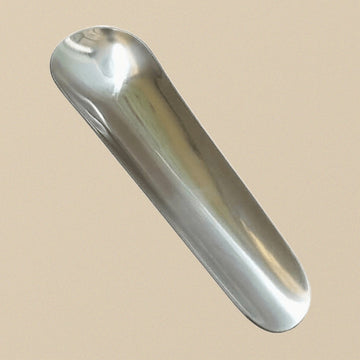
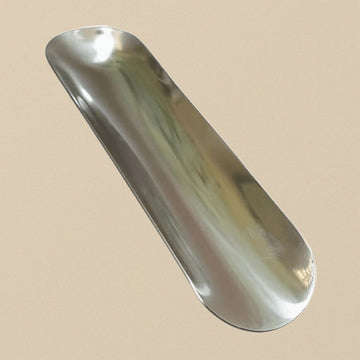
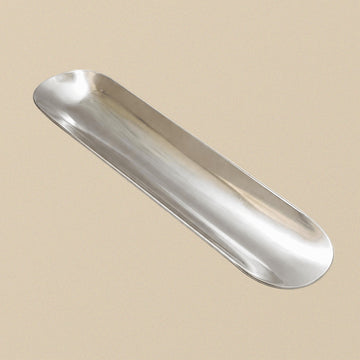
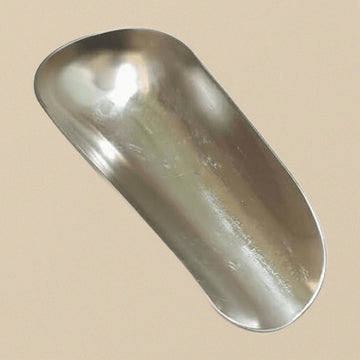
Quick answer: Buy two anti-magnetic stainless scoops: a small one (62–70 mm) for the setting bench and single-stone transfers, and a large one (105–125 mm) for sorting, sweep-up and the scrap jar. Anti-magnetic Japanese 304 steel matters — steel findings and filings release in one clean pour instead of clinging, and pickle splashes will not corrode it.
Nobody plans to buy a bead scoop; everybody who works with small components eventually wishes they had three. Beads, findings, jump rings, cut stones, watch screws, filings for the refining jar — all of it moves around a bench faster and with fewer losses when there is a proper scoop in reach. Here is what separates a good one from a bent business card, and which sizes to keep where.
Why anti-magnetic stainless matters
Our scoops are pressed from Japanese 304 stainless steel, anti-magnetic — and that spec is doing real work. Steel findings, watch parts and tool-steel filings cling to a magnetised scoop and then leap off at the wrong moment; a non-magnetic scoop releases everything in one clean pour. 304 stainless also shrugs off pickle splashes, oxidiser and daily knocks without corroding, and its smooth pressed surface has no seams for a 1 mm bead to hide in.
The shape: why a scoop beats a folded card
A proper scoop has a flat, thin leading edge that sits flush on the bench or the bead mat — slide it forward and components climb aboard rather than escaping in front of it. The raised back wall and side walls hold a pour without spill, and the tapered nose funnels everything into a bag, a tube or a triblet of stringing wire with no stragglers. The pressed-steel spring in the walls also lets you pinch the nose into a narrower funnel for tube-loading tiny stock.
Sizes: small catches, large sorts
The range runs in graduated sizes, and the ends of the range do different jobs:
- 62 × 28 mm and 70 × 33 mm: pick-up scoops — single-stone transfers, watch screws, seed beads back into their vial.
- 85 × 33 mm and 100 × 28 mm: the everyday middle — clearing a bead mat, decanting findings, feeding the scale pan.
- 105 × 30 mm and 125 × 33 mm: sorting and sweep-up — emptying a sorting tray, gathering lemel and filings for the scrap pot.
If you are buying once, take a small and a large: the small lives at the setting bench, the large by the scale and scrap jar.
Small habits that stop losses
Scoop toward the bench skin or mat edge, never toward open floor. Decant over a tray, so the one bead that bounces stays caught. Keep a dedicated scoop for lemel and filings only — precious-metal scrap stays uncontaminated for the refiner, which is money at year end. And wash scoops that have handled pickle-wet work before they touch anything else; 304 does not care, but your fingers and stones do.
Every size above is in UK stock with same-day dispatch before 2pm — browse the bead scoop and sorting range below.
Related guides
- Shop Bead Scoops & Sorting →
- Beading & Knotting Tools: Pro Kit vs Amazon Basics
- Setting Up a Jewellery Bench: UK Essentials
- Bench Organisation: Tool Racks, Stands & Storage
Frequently asked questions
Which bead scoop sizes do I need at the bench?
If you are buying once, take a small and a large. The 62 × 28 mm and 70 × 33 mm scoops handle single-stone transfers, watch screws and seed beads; the 85–100 mm middle sizes clear bead mats and feed the scale pan; the 105–125 mm scoops sort, sweep up and gather lemel and filings for the scrap pot.
Why does anti-magnetic stainless steel matter in a bead scoop?
Steel findings, watch parts and tool-steel filings cling to a magnetised scoop and then leap off at the wrong moment; anti-magnetic Japanese 304 stainless releases everything in one clean pour. It also shrugs off pickle splashes, oxidiser and daily knocks without corroding, and the smooth pressed surface has no seams for a 1 mm bead to hide in.
How do I stop losing beads and findings at the bench?
Scoop toward the bench skin or mat edge, never toward open floor, and decant over a tray so the one bead that bounces stays caught. Keep a dedicated scoop for lemel and filings only — precious-metal scrap stays uncontaminated for the refiner, which is money at year end — and wash pickle-wet scoops before they touch anything else.