Quick answer: Upgrade your thread before any tool — Fireline 6lb plus Nymo D is the professional minimum, and thread failure loses more five-star reviews than bead quality ever does. Then add dedicated crimping pliers, angled AA stainless tweezers, a bead mat, a knotting tool and fine-point thread scissors. The full professional upgrade costs around £65–£120, and each tool is a once-in-a-career purchase.
Beading looks simple from the outside: pick up a bead with tweezers, thread it on, tie a knot. In practice, the tools separate amateur work from properly finished pieces — knots that sit right, tensions that hold over years, and beadwork that doesn't unravel the first time it's caught on a sleeve.
This guide is for beaders moving beyond kitchen-table craft and starting to sell work, teach classes, or produce matched editions. It covers what pros actually use, and where the Amazon/import shortcuts let you down.
Thread: the unsung hero
Before the tools, a word on thread — because no tool will save a piece strung on the wrong thread.
- Nymo D or Nymo O: classic waxed nylon, cheap, widely available. Fine for practice and low-value beadwork. Does stretch over time.
- Fireline (6lb or 8lb): braided fishing line. Strong, low-stretch, almost invisible. Pro default for bead weaving.
- C-Lon / S-Lon: bonded nylon in heavier gauges. Good for knotted pearl work and kumihimo.
- Silk beading thread: traditional for knotted pearls. Beautiful, but perishes in UV — restring pearls every 7–10 years.
- Monofilament (Illusion cord): transparent. Good for "floating" bead illusions; stretches in direct sun.
The gap between £2 craft-store thread and £8 professional thread is enormous on real work. Amateur Etsy sellers who lose five-star reviews almost always lose them because of thread failure, not bead quality.
The core beading tool set
Beading needles
Size matters. Size 10 beading needles fit size 11/0 seed beads; size 12 fits 15/0. For bugle beads and Delicas (11/0 Miyuki Delica), size 11 or 12. Buy a mixed pack to start; replace broken ones fast — a slightly bent needle slows down an entire session.
Beading tweezers (stainless, angled tip)
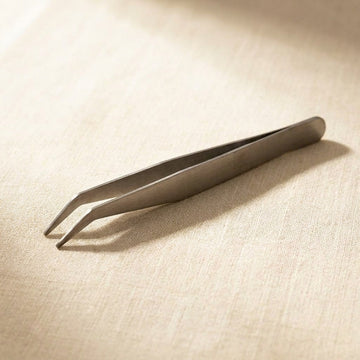
Angled-tip stainless tweezers with a 5" shaft are the go-to for picking beads off a bead mat one at a time. See Tweezers & Clamps — look for AA or 4A point grade for the finest pickup work.
Beading pliers (crimping + flat-nose)
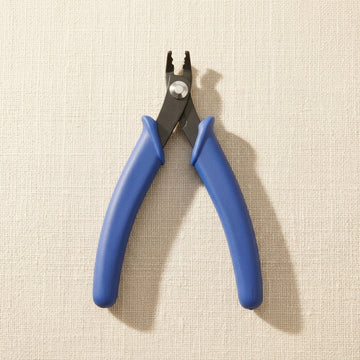
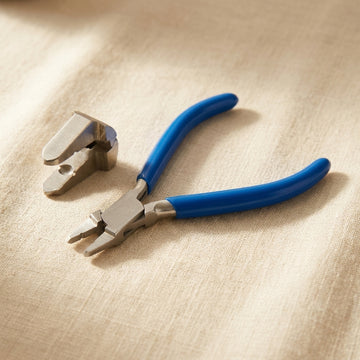
For bracelet and necklace work where you're using crimp tubes or crimp beads, you need dedicated crimping pliers — not regular chain-nose. Crimping pliers have two indentations: the first rolls the tube shut, the second folds it round into a tight bead. Amateur pieces flatten crimp tubes with flat pliers and the joins fail under tension within weeks. See Pliers & Cutters.
Bead mat
Non-slip Vellux bead mat (around £4–£8) prevents beads rolling away and gives your tweezers something to grip against. One of those tools you only appreciate when you try to work without it.
Knotting tool
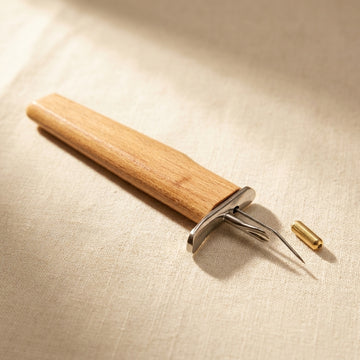
For proper pearl or bead knotting — where each bead has a knot next to it so if the string breaks you only lose one bead — a dedicated knotting tool (like the "Bead Knotter") makes each knot consistently tight against the bead. Hand-knotting without a tool is possible but the tension varies piece-to-piece and the knots look uneven. A small investment (~£15–£25) that transforms the finished look.
Scissors: thread vs beading
Fine-point embroidery scissors (spring-return or straight) for cutting thread close to the work. Keep them away from the metal bench — cutting wire with thread scissors ruins them in one cut. See the Scissors & Shears collection for dedicated thread scissors.
Bead reamer
For enlarging the hole in pearls or stones so they'll fit over thicker thread or wire. Usually a fine diamond-coated rod used wet. Essential for knotted pearl necklaces where you're using 0.5mm or 0.7mm silk.
What pros use that Amazon doesn't stock
Specialist beading supplies that rarely appear in generic marketplaces:
- French wire (gimp): fine coiled wire used to protect thread where it meets a clasp. Separates finished-looking pearl work from amateur work.
- Bullion wire: similar to French wire but in precious metals. Sold through UK jewellery suppliers, not craft sites.
- Soft-flex beading wire: multi-strand stainless with nylon coating. Replaces tigertail. UK pros use 49-strand; 7-strand is garbage.
- Professional bead boards: with cm/in scales and pre-marked dividers for necklace planning. Craft-store bead boards are flimsy plastic; pro boards last decades.
- Quality crimp covers: small half-shell beads that hide crimp tubes for a finished look. Tiny detail, massive visual difference.
The buying-order recommendation
For a new UK beader upgrading from beginner kit in 2026:
- Replace your thread first (£8–£15). Fireline 6lb crystal + Nymo D black as minimum pair.
- Dedicated crimping pliers (£12–£25).
- Angled-tip AA stainless beading tweezers (£10–£18).
- Non-slip Vellux bead mat (£4–£8).
- Knotting tool (£15–£25).
- Fine-point thread scissors (£8–£15).
- French wire pack (£5–£10) — if doing pearl work.
Total upgrade spend: around £65–£120. Every tool is a once-in-a-career purchase with reasonable care. Browse the full range in Tweezers & Clamps, Pliers & Cutters and Scissors & Shears — UK-warehoused, same-day dispatch before 2pm weekdays.
A note on where to buy beads (not just tools)
Toolsmith stocks the tools, not the beads themselves. For UK bead supply, established trade sources include Beads Direct, The Bead Shop Nottingham, and Spoilt Rotten Beads. For speciality Japanese seed beads (Miyuki, Toho), check UK suppliers with current-season colour inventories; craft-store stock is usually two years behind.
Related guides
- Best Jewellers Pliers Under 30 Pounds (UK, 2026)
- Parallel-Action vs Standard Jewellers Pliers - Whats Worth the Premium
- Bead & Bench Scoops: Sizes, Anti-Magnetic Steel & Tidy Sorting
Frequently asked questions
What beading tools do I need to move from hobby to professional work?
Seven upgrades, in order: professional thread (Fireline 6lb and Nymo D), dedicated crimping pliers, angled-tip AA stainless tweezers, a non-slip Vellux bead mat, a knotting tool, fine-point thread scissors, and French wire if you do pearl work. Around £65–£120 in total, and every item should last a career with reasonable care.
Do I really need crimping pliers instead of flat-nose pliers?
Yes, for any bracelet or necklace built on crimp tubes or crimp beads. Crimping pliers have two indentations — the first rolls the tube shut, the second folds it round into a tight bead. Flattening crimps with ordinary flat pliers is the classic amateur shortcut, and those joins fail under tension within weeks.
Why does beading thread matter more than the beads?
Because thread is what fails. Nymo stretches over time, silk perishes in UV (knotted pearls need restringing every 7–10 years), and monofilament stretches in direct sun. Fireline 6lb or 8lb is the strong, low-stretch professional default for bead weaving. The step from £2 craft-store thread to £8 professional thread is the biggest quality jump in finished beadwork.