Quick answer: A working silversmith needs seven core hammer types — chasing, raising, planishing, domed forming, a rawhide repoussé mallet, cross-pein and ball-pein — and a professional-quality eight-hammer starter library costs around £280–£450 at 2026 UK prices. Buy German workhorses such as Picard or Peddinghaus for the core forming hammers, spend the most you can on the raising hammer, and avoid cheap multi-hammer kits entirely.
To the uninitiated, a hammer is just a hammer. To a silversmith, hammers are not merely tools; they are an extension of the hand, the eye, and the creative will. They are the work. Every gram of weight, every millimetre of curve on a face, every nuance of balance in the handle—these are the variables that translate an idea into a tangible, shimmering object. A silversmith doesn’t own a random collection of hammers; they curate a library. For a student just starting their journey at the Goldsmiths' Centre or Bishopsland, that library might begin with five essential hammers. A working bench silversmith, moving from jewellery into the demanding world of hollowware, will find their collection quickly grows to fifteen. And a master smith? Walk into their workshop and you’ll likely find a rack of thirty or more, each one earned, modified, and understood, each a solution to a specific problem in metal. This is not excess; it is expertise.
Chasing vs Repoussé: The Difference
Amongst the most intricate work a silversmith undertakes, chasing and repoussé stand out. Whilst often used interchangeably by those outside the craft, they are distinct, complementary processes that create detailed relief work on a metal surface. Understanding the difference is fundamental, as is knowing why a specific type of hammer is required for the task.
Chasing is the art of working from the front, or 'face,' of the metal. Using a variety of fine, chiselled steel punches (often called 'chasers'), the silversmith strikes the punch with a chasing hammer to push and define detail into the surface. This is how sharp lines, textures, and patterns are created. The metal sheet is typically held on a bed of chaser's pitch—a firm, resin-like substance that supports the metal whilst allowing it to be displaced.
Repoussé, from the French for "to push up," is the opposite. The smith works from the back of the metal sheet, pushing the material out to create volume and high relief. This is usually done with more rounded punches and, crucially, a softer-faced mallet, often made of wood or rawhide. The work is held on a softer pitch that allows for deeper displacement of the metal.
A single piece of work will be flipped back and forth dozens, sometimes hundreds, of times. The smith will work from the back with repoussé techniques to raise the basic forms, then flip the piece over, anneal it, and use chasing techniques from the front to refine the details and sharpen the design. This rhythmic dance between front and back, pushing and pulling, is the heart of the craft.
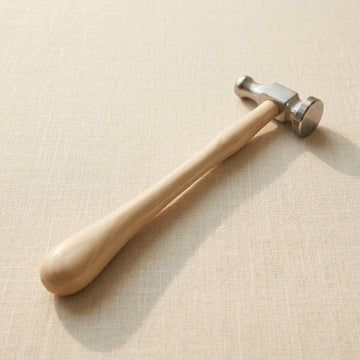
This is why the chasing hammer is so unique. Its distinctive bell-shaped head, long, thin neck, and bulbous handle are not stylistic affectations. The head is relatively light, designed for thousands of precise, rapid strikes. The balance is exquisite, allowing the head to rebound almost effortlessly, creating a rhythm that the smith can maintain for hours. It’s a design perfected over centuries for a single purpose: to provide flawless, rhythmic control for the delicate work of chasing. Using a heavy, clumsy hammer for this would be like trying to paint a miniature with a household paintbrush—all force and no finesse.
The Seven Hammer Types Every UK Silversmith Needs
Building your hammer library should be a deliberate process. Each of these seven hammers serves a distinct, non-negotiable purpose at the silversmith's bench. Using one in place of another is a recipe for frustration, wasted time, and, worst of all, damaged silver.
Chasing Hammer
As discussed, this is a specialist's tool. With a head weight typically between 80 and 120 grams, its large, flat face is for striking steel punches, never for touching the silver directly. The smaller, rounded pein on the back is useful for pinning down sheet metal into the pitch before the main work begins. Its delicate balance and responsive feel make it the only choice for controlled, rhythmic chasing work. To use a chasing hammer for forming is to misunderstand its very soul; its light weight and hard face are unsuited for moving metal in any significant way.
Raising Hammer
For anyone serious about hollowware—beakers, bowls, vases—the raising hammer is a revelation. Its long, thin head features two rectangular faces with a gentle lengthwise curve. You work on a T-stake, striking the silver just below the point of contact with the stake. With each controlled blow, the metal is compressed and begins to curve upwards, forming the vertical walls of a vessel. A well-balanced raising hammer, with the correct weight and face profile, feels alive in the hand. It makes the difference between a gruelling 12-hour slog to raise a small bowl and an efficient, even enjoyable, 6-hour process. This is the hammer that truly separates the jeweller from the silversmith.
Planishing Hammer
After the energetic work of raising and forming, the metal is covered in tool marks. The planishing hammer is the tool for refinement. It has one or two highly polished, very slightly domed faces. By working over the surface of the silver, which is supported on a polished steel stake or anvil, the planishing hammer smooths out the raising marks, compresses the metal's grain structure, and imparts a beautiful, uniform surface. Its face must be kept immaculately polished and free of scratches, as any imperfection on the hammer will be transferred directly to your work.
Forming / Domed Face Hammer
Before you can raise a vessel, you often need to sink a bowl. This is the job of the forming hammer. With one or two distinctly rounded, dome-shaped faces, this hammer is used to stretch the metal into a concave shape. Typically, this is done by hammering the sheet into a hollowed-out wooden block or a sandbag. The domed face allows you to stretch the metal evenly, creating the initial dish shape from which a more complex form can be raised. They come in a variety of face curvatures and weights for different scales of work.
Repoussé Mallet (Rawhide/Wood)
When working from the back of the metal in repoussé, you are pushing large areas of metal outwards. A steel hammer on a steel punch creates a sharp, high-impact blow that can easily tear through the sheet. A rawhide or wooden mallet, however, delivers a firm but "dead" blow. It pushes the punch into the metal rather than striking it, giving a softer, more controlled displacement that is ideal for creating volume without thinning the metal excessively or causing damage.
Cross-Pein Hammer
The cross-pein hammer has a standard flat face on one side and a wedge-shaped 'pein' on the other, oriented perpendicular to the handle. A small version, around 150g, is an indispensable bench tool. The pein is used for 'drawing out' or spreading metal in a linear direction. It's perfect for forging tapers on wire, spreading the edge of a bezel, or for creating specific linear textures. It moves metal in a very different way to a domed hammer, making it essential for controlled forging operations.
Ball-Pein Hammer
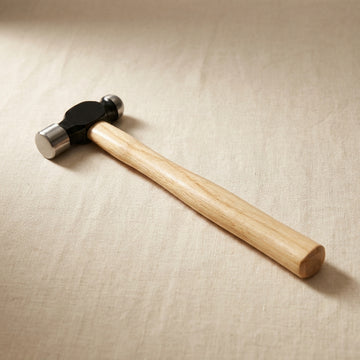
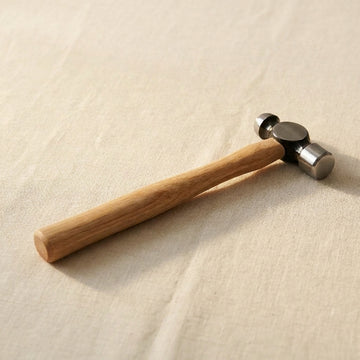
The humble ball-pein is perhaps the most recognisable hammer, but a small, well-balanced version (again, around 150g) is a silversmith's general workhorse. The flat face is used for general tasks like riveting, stamping, or flattening small components. The spherical 'pein' is brilliant for creating a classic hand-hammered texture, for peining the end of a rivet to secure it, or for shaping metal into tight curves. It's the versatile odd-job hammer that you'll find yourself reaching for constantly.
Brand Reality: Peddinghaus vs Picard vs Glardon vs Fretz vs Value Hammers
The brand of hammer you choose has a significant impact on your work, your wallet, and your long-term satisfaction. The market can be confusing, so here is a bench-level assessment of the main players.
Fretz (USA): These are the undisputed premium choice for silversmiths. Made from beautiful cast stainless steel and mounted on elegant, perfectly shaped padauk wood handles, Fretz hammers are a joy to behold and to use. Their balance is second to none, and their range of specialised miniature stakes and hammers for jewellery and hollowware is extensive. They are, however, an investment, with individual hammers costing anywhere from £90 to £180. For many, they are an aspirational goal, a reward for professional success.
Picard / Peddinghaus (Germany): These are the workhorses of the UK trade. German-made, forged from high-quality tool steel, and fitted with sturdy hickory or ash handles, brands like Picard and Peddinghaus (often sold under the 'Sugar' name in the UK) represent the professional standard. They are exceptionally well-made, durable, and offer excellent performance for a reasonable price, typically in the £40-£90 range. You will find these hammers on the benches of professional silversmiths and in the workshops of the Goldsmiths' Centre for a reason: they get the job done, day in and day out.
Glardon / Vallorbe (Switzerland): Hailing from the heart of Swiss watchmaking, Glardon hammers (part of the Vallorbe group) are, as you might expect, focused on precision and fine work. They are often smaller in scale, beautifully finished, and ideal for jewellers and those working on delicate chasing or filigree. They are an excellent choice for jewellery-scale work but may lack the heft needed for larger hollowware.
Value hammers (about £7–£25): Widely sold online and variable in quality, so check each one: the head should sit tight on the handle with no movement, the balance should feel even in your hand, and the striking faces should be smooth, polished and free of pits, because any mark on a face transfers into your metal. For a beginner learning to use a chasing hammer on pitch, where the hammer's balance is less critical than the punch control, a value hammer that passes those checks is a sensible start. For heavy forming, planishing and raising, a well-balanced professional hammer saves time.
Toolsmith's range: our chasing, planishing, embossing and forming hammers are made in Pakistan and sit in this value band; current prices are shown below. They suit students, hobbyists and everyday bench work; for heavy raising, the professional brands above are the usual step up.
When to step up: A serious raising hammer is the one tool where you should invest as much as you can afford. The difference in efficiency between a cheap, poorly balanced raising hammer and a professional-grade Fretz or Peddinghaus is staggering. It is a lifelong investment that will pay for itself in saved time and superior results.
Handle Care: Hickory vs Ash
The handle is your interface with the hammer; it’s as important as the head. The UK trade default is hickory. It’s an American wood with a long, straight grain that provides immense strength and excellent shock absorption, which is vital for protecting your wrist and elbow during long sessions of hammering. Ash is a common European alternative, also strong and flexible, but hickory is generally favoured for its superior durability.
A good handle should have a slightly oval cross-section. This provides a better grip than a perfectly round handle and, more importantly, gives you tactile feedback on the orientation of the hammer head without having to look. The handle should feel comfortable and secure, not thick and clumsy. If a handle feels too thick, it restricts your ability to make fine, accurate adjustments, costing you accuracy.
Over time, with changes in humidity, a head can become loose. This is dangerous and must be addressed. The fix is usually to drive the wooden wedge further into the top of the handle, or to add a small metal wedge. To protect the wood and prevent it from drying out, give your handles a light wipe with boiled linseed oil once or twice a year. This preserves the wood and improves your grip.
Head Finish: Polished vs Textured vs Leather-Faced
The face of the hammer defines the surface of your silver. The unforgiving truth is that any mark, scratch, or imperfection on your hammer's face will be directly and faithfully transferred to your workpiece.
A planishing hammer's polished face is the most critical. It must be kept mirror-smooth. Protect it. Store it in a way that it cannot be knocked by other tools. Before a planishing session, inspect the face and polish out any minor scratches with fine-grade abrasive paper (working through the grits) and a final polish with rouge on a mop. A scratched hammer guarantees a scratched bowl, creating hours of extra finishing work.
Texturing hammers are a different beast. Their faces are intentionally cut with patterns—cross-hatches, lines, or dimples—to impart a decorative finish. These are used as a final step to create a specific aesthetic, such as the classic "hammered finish."
Leather-faced and brass-faced hammers are for non-marring work. When you need to adjust the shape of a piece that is already partially polished, or tap a bezel closed without leaving a mark, a soft-faced hammer is essential. The soft material deforms before the silver does, allowing you to apply force without damaging the surface.
Bench Setup: How to Hold the Work
A hammer is useless without a solid, appropriate support for the workpiece. The hammer and the support work as a pair.
- Chasing and Repoussé: The work is held on a pitch bowl, a heavy cast-iron hemisphere filled with chaser's pitch. The bowl itself rests on a leather doughnut or rubber ring, allowing it to be tilted to any angle.
- Forming and Sinking: Initial shaping is often done into a leather sandbag, which provides a forgiving, absorbent surface that allows the metal to dish easily.
- Raising: This is performed on a steel stake, most commonly a T-stake held securely in a vice. The hammer strikes the silver against the hard, curved surface of the stake.
- Planishing: This requires a highly polished steel stake or a flat anvil-block that perfectly supports the area being hammered.
Your posture and grip are just as important as the tools. For a detailed breakdown of the correct techniques, please see our existing technique guide on how to hold a hammer.
The Eight-Hammer First Library (£280-450, UK 2026 Prices)
For a student or apprentice ready to build a foundational, professional-quality kit, this is our recommended starting library. The price ranges reflect the choice between good-value hammers for non-critical tasks and solid German workhorses for the core forming processes.
- Chasing Hammer (90g): The essential tool for all punch work. (~£35-70)
- Small Raising Hammer: Your first step into hollowware. Choose the best you can afford. (~£55-90)
- Planishing Hammer (Polished Face): For achieving that final, smooth finish. (~£40-80)
- Domed Forming Hammer: For sinking bowls and initial shaping. (~£35-65)
- Rawhide Mallet (Size 2 or 3): For repoussé and non-marring forming. (~£25-40)
- Cross-Pein Hammer (150g): For forging and moving metal linearly. (~£20-35)
- Ball-Pein Hammer (150g): The versatile bench hammer for riveting and texturing. (~£15-30)
- Wood/Horn Mallet: For shaping sheet on a stake without stretching it (bossing). (~£20-35)
Total Investment: £280 - £450. This is a serious, considered investment in your career that will serve you well for years, forming the core of a library that will grow with your skills.
What to check in a hammer kit
A final piece of advice. Multi-hammer "silversmith hammer kits" are sold on Amazon and eBay at low prices. Check every hammer in a kit before it touches your silver: the head should sit tight on the handle with no movement, the striking faces should be smooth and polished with no pits or grinding marks, and the hammer should feel balanced in the hand. Any mark on a hammer face is transferred to your work and has to be planished out afterwards, so choose each hammer on those points, even if that means buying fewer.
UK-Stocked: Fast UK Dispatch
Toolsmith's hammers are made in Pakistan and shown below; we do not sell the Fretz, Picard, Peddinghaus or Glardon hammers discussed above. Everything we sell ships from UK stock, and we aim to dispatch orders placed before 2pm UK time, Monday to Friday, the same working day.
Related guides
- How to Hold a Hammer at the Bench — Technique Guide
- Doming & Dapping: Steel Punches and Forming Blocks
- Forming Stakes & Mini Anvils for Silversmiths: T-Stakes, Wheel Stakes & Micro-Forming
- Shop all Hammers & Forming Blocks
Frequently asked questions
Which hammers do I need to start silversmithing?
A recommended first library is eight hammers: a 90g chasing hammer, a small raising hammer, a polished-face planishing hammer, a domed forming hammer, a rawhide mallet, a 150g cross-pein, a 150g ball-pein and a wood or horn bossing mallet. Expect £280–£450 in total, with the raising hammer the one to spend most on.
What is the difference between chasing and repoussé?
Chasing works from the front of the metal, striking fine steel punches with a light chasing hammer to define lines and texture. Repoussé works from the back, pushing volume out with rounded punches and a softer rawhide or wooden mallet. A single piece is flipped between the two techniques many times, with the work supported on chaser's pitch.
Are cheap silversmithing hammer kits worth buying?
No. The five- or six-hammer kits sold for around £40 on marketplaces use poor steel, badly finished faces and loosely fitted heads, and any imperfection on a hammer face transfers straight into your silver, costing hours of remedial planishing. Keep budget hammers for non-critical tasks, check every face before use, and buy fewer hammers of better quality instead.