Quick answer: Buy the forceps patterns your training or practice protocol specifies — beaks are designed to grip the root, not the crown, with separate upper and lower patterns for each tooth position. Pair them with luxators for cutting the periodontal ligament and elevators for controlled levering, and choose serrated stainless steel that survives constant autoclaving.
A tooth comes out cleanly when controlled force is applied in the right direction — and that depends entirely on instruments shaped to the job. Extraction forceps and elevators look intimidating to the uninitiated, but their design is logical: each pattern is built to grip a particular tooth or lever a particular root. This guide explains how the extraction set is organised, what the numbered patterns mean, and how to choose forceps and elevators that grip true and last.
How forceps are designed
An extraction forceps is shaped so its beaks adapt to the root below the crown, not the crown itself — that is where grip and control come from. The handle, joint and beak angle are matched to whether the tooth is upper or lower and front or back, because the line of withdrawal differs for each. A forceps that fits the root delivers force where it is needed; one that grips the crown crushes it.
Upper (maxillary) forceps
Upper patterns are broadly: upper universal forceps for incisors, canines and premolars; upper molar forceps in left and right versions, with a pointed beak that engages the buccal furcation between the roots; and fine bayonet or root forceps for retained roots and upper third molars, whose offset reaches the back of the arch.
Lower (mandibular) forceps
Lower patterns include the lower universal for anteriors and premolars, the lower molar forceps with twin pointed beaks for the bifurcation, and the cowhorn — whose sharp, curved beaks are driven into the bifurcation of a lower molar to lever it from its socket. Cowhorns are a specific technique, not a general-purpose forceps.
Reading the pattern numbers
Forceps are catalogued by long-standing pattern numbers (for example a #1 upper universal, or a #23 cowhorn). The numbers are a shorthand for shape and indication rather than a logical sequence, so the practical advice is simple: buy the patterns your training, principal or local protocol specifies, and learn that set well rather than collecting unfamiliar shapes.
Luxators and elevators
Before or instead of forceps, hand instruments mobilise the tooth:
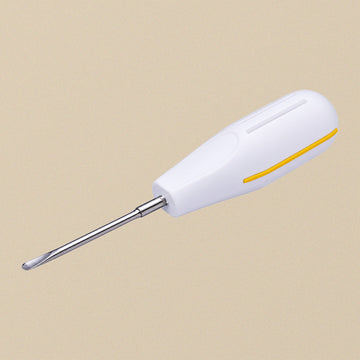
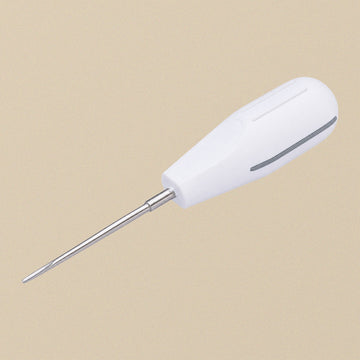
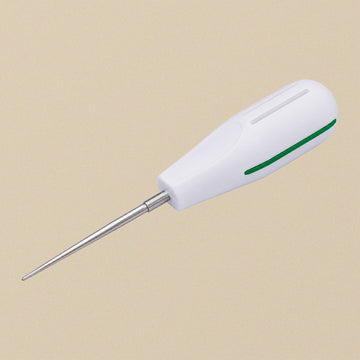
- Luxators have a fine, sharp blade designed to cut the periodontal ligament and gently expand the socket — they are eased around the root, not levered hard.
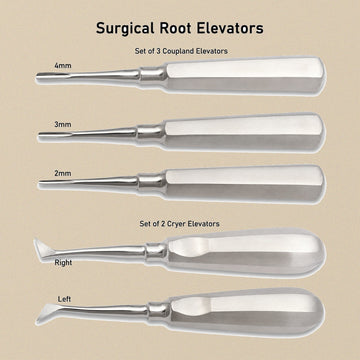
- Elevators (straight/Coupland's, Cryer's, Warwick James) are levers that apply controlled force to luxate and elevate a tooth or root, using the bone as a fulcrum.
The distinction matters: a luxator is for cutting and easing, an elevator for levering. Using one as the other damages tips and bone.
Choosing and caring for the set
Grip and durability come from the steel and the finish. Serrated beak tips bite the root without slipping; good stainless steel holds a sharp elevator edge and survives constant autoclaving without pitting. Check the joint for any side-play and the beaks for clean, matching tips. Keep the set in a cassette through sterilisation to protect those tips, and retire a luxator or elevator once its working edge dulls — a blunt one needs dangerous force.
For the diagnostic instruments that precede extraction and the sterilisation that follows, see our companion dental guides, and browse the extraction range below.
Related guides
- Tofflemire Matrix Retainers & Aspirating Syringes: A UK Restorative Guide
- Dental Implant Surgical Kits: Trephines, Osteotomes & Sinus-Lift Instruments
- Shop Extraction — Forceps & Elevators →
- Dental Examination Instruments: Mirrors, Probes & Explorers
- Dental Burs: Carbide vs Diamond vs Tungsten
- Dental Lab Sterilisation: A UK Practice Guide
Frequently asked questions
Which extraction forceps patterns do I need to buy first?
Buy the patterns your training, principal or local protocol specifies rather than collecting shapes — the numbering (a #1 upper universal, a #23 cowhorn) is shorthand for indication, not a logical sequence. A working spread covers upper and lower universals for anteriors and premolars, left and right upper molar forceps, lower molar forceps, and fine bayonet or root forceps for retained roots.
What is the difference between a luxator and an elevator?
A luxator has a fine, sharp blade that cuts the periodontal ligament and gently expands the socket — it is eased around the root, never levered hard. An elevator (straight/Coupland's, Cryer's, Warwick James) is a lever that applies controlled force against bone to mobilise the tooth or root. Using one as the other damages tips and bone, so keep the roles distinct.
How should extraction forceps and elevators be cared for?
Check the joint for side-play and the beaks for clean, matching serrated tips before buying, then keep the set in a cassette through sterilisation to protect those tips. Good stainless steel resists pitting through constant autoclaving. Retire a luxator or elevator once its working edge dulls — a blunt instrument needs dangerous force to do its job.