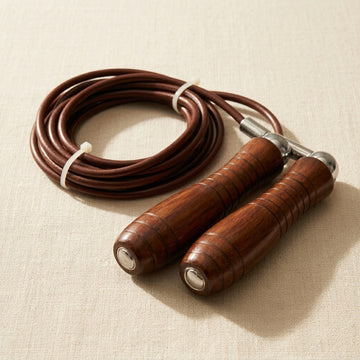
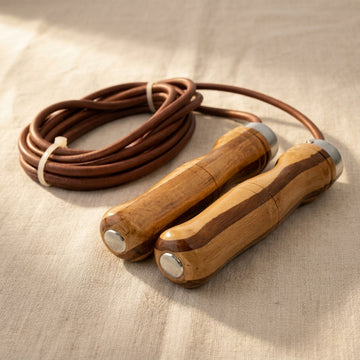
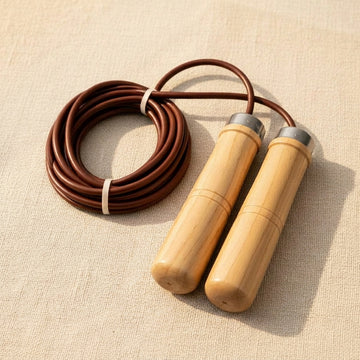
Quick answer: If you are buying one skipping rope to learn on, choose an adjustable leather rope with wooden handles: the weighted thong gives constant feedback that builds honest wrist mechanics and timing. Keep a PVC-coated steel cable rope for speed work and double-unders. Size it so the handle tops reach roughly your armpits when you stand one foot on the middle.
Boxers never stopped skipping, and the rope most of them reach for has not fundamentally changed in a century: a leather thong swinging on turned wooden handles. In an era of app-connected fitness kit, that endurance is worth explaining. This guide covers why leather ropes still earn their gym-bag space, how they compare with steel-cable speed ropes, and how to size and care for one.
Why leather, still
A leather rope has weight distributed along its whole length, so you can feel exactly where it is through the entire arc. That feedback is the training point: it forces honest wrist mechanics and rhythm, punishes lazy timing with a lash on the calves, and builds the timing that lighter ropes let you fake. The turned wooden handles are part of the same philosophy — no bearings to coast on, just a smooth spin driven entirely by your wrists. Ten minutes on leather is conditioning for the hands and forearms as much as the lungs.
Leather vs steel cable: different tools
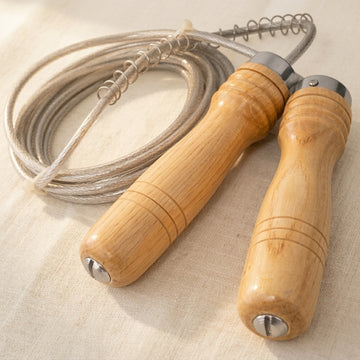
Our PVC-coated steel cable ropes — same wooden handles, very different rope — are built for pace: the thin cable slices air with almost no drag, which is what you want for double-unders, high-rep intervals and speed work. The trade-off is feel: a cable is so light you steer it by faith and rhythm rather than feedback. A useful way to own it: leather is the barbell, cable is the sprint. Serious skippers usually keep both — leather for technique and conditioning rounds, cable for speed sessions. If you are buying one rope to learn on, learn on leather; the skills transfer downward to cable easily, rarely the reverse.
Getting the length right
Both patterns here are adjustable, which matters more than any other spec. The classic starting point: stand one foot on the middle of the rope — the handle tops should reach roughly your armpits (a touch shorter for speed work, a touch longer while you are learning). Adjust, skip a round, adjust again; commit to a length only after a proper session. Households sharing one rope should buy adjustable and re-set it in seconds rather than compromise on a fixed length.
Looking after a leather rope
- Skip on forgiving surfaces — wooden floors, rubber matting, short carpet. Concrete and tarmac shred leather (and ankles) fast; that is what the steel-cable rope is for.
- Wipe and hang — sweat is salty; a quick wipe and a hook keeps the thong supple and straight. Never leave it coiled tight in a damp bag.
- Feed it occasionally — a little leather conditioner or neatsfoot oil every few months stops dry-out and cracking, exactly as you would treat a watch strap.
- Check the handle throats — where rope meets handle is the wear point on any rope; ours are built generously there, but inspect any rope you train hard on.
The buy-once logic
A leather rope with wooden handles contains nothing that stops working: no bearings to seize, no plastic to crack, no battery. Rope thongs are replaceable, handles last decades, and the whole thing costs less than a month of most gym add-ons. It is the same buy-once philosophy as everything else we stock — precision-made simple tools, shipped same-day from UK stock.
Browse the skipping rope range below — leather, cable and replacement options included.
Related guides
- Lifting Straps & Cable Attachments: A UK Gym Kit Guide
- Shop Fitness & Sport →
- Same-Day UK Dispatch: What It Actually Means at Toolsmith
- Your First Leather Watch Strap Build: A UK Kit Walkthrough
- UK Trade Accounts: Colleges, Bulk Orders & VAT
Frequently asked questions
Which skipping rope should I buy first, leather or steel cable?
Learn on leather. A leather rope's weight is spread along its whole length, so you feel exactly where it is through the arc — feedback that builds wrist mechanics and rhythm which transfer easily down to a lighter cable rope. Steel-cable ropes are for speed work and double-unders; serious skippers usually end up keeping both.
How do I get the length of a skipping rope right?
Stand one foot on the middle of the rope: the handle tops should reach roughly your armpits — a touch shorter for speed work, slightly longer while you are learning. Buy adjustable rather than fixed length, skip a proper round before committing to a setting, and re-set it in seconds if the rope is shared.
How do I look after a leather skipping rope?
Skip on forgiving surfaces — wooden floors, rubber matting or short carpet; concrete and tarmac shred leather fast. Wipe the sweat off after sessions and hang the rope rather than leaving it coiled in a damp bag. Feed the thong a little leather conditioner or neatsfoot oil every few months, and inspect the handle throats for wear.