Quick answer: Match the tool to the procedure and the law before buying: a 9-inch Burdizzo suits lambs and kids while an 18-inch gives the leverage for larger calves; elastrator rings may only be applied in the first week of life; dehorning has specific anaesthesia requirements. Buy well-made jaws that close flush — and get training and current DEFRA guidance first.
Husbandry tools are among the oldest instruments we sell, and the ones where getting the choice right matters most — for the animal above all. Burdizzos, elastrators and dehorners are simple mechanical devices, but each is tied to specific procedures, ages and legal limits in the UK. This guide covers what the tools are and how to judge quality; it is not a substitute for veterinary advice or for the current regulations, both of which should govern what you actually do.
The Burdizzo: bloodless castration
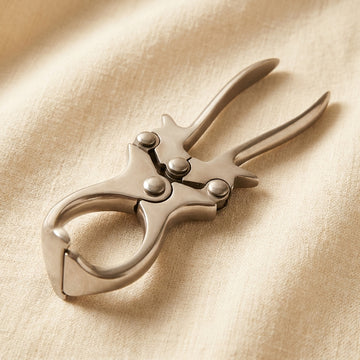
A Burdizzo (an emasculator) crushes the spermatic cord through intact skin, so nothing is opened and there is no wound to become infected — hence "bloodless". The jaws must close with real, even force along their full length, which is why the tool is built like a bolt cropper and why length matters: our 9-inch pattern suits lambs and kids, while the 18-inch gives the leverage needed for larger calves. Check that the jaws meet flush across their width when closed and that the pivot has no side-play; a Burdizzo with worn jaws does not do the job humanely, and a tool this cheap is never worth nursing along past its life.
Elastrator pliers and rubber rings
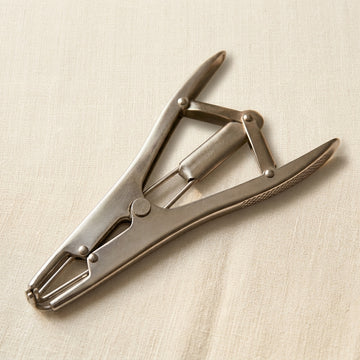
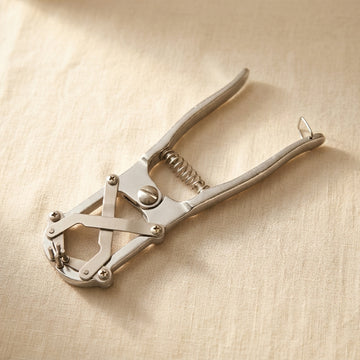
Elastrator pliers stretch a small rubber ring over four prongs so it can be released onto the tail or scrotum. They are the simplest tool here and the most tightly regulated in use: in the UK, rubber rings may only be applied within the first week of life. Beyond that window, the law and welfare guidance change entirely. Pliers come in standard and large patterns; look for prongs that stay parallel under tension and a spring that returns cleanly, because a ring released unevenly is a welfare problem in itself. Rings are consumables — buy fresh stock and store it out of sunlight, as perished rubber snaps at the worst moment.
Dehorners and disbudding
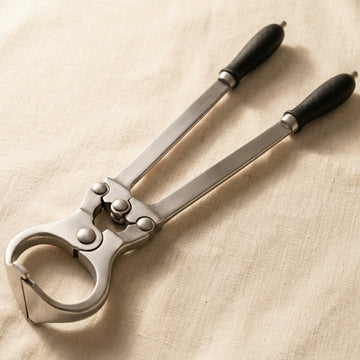
A calf dehorner — ours is a 13-inch surgical-steel pattern with rubber grips — removes horn tissue by a scooping, shearing action. Disbudding and dehorning are procedures with specific anaesthesia requirements in the UK, and the age of the animal changes what is permitted and by whom. Whatever the route, the tool itself should be sharp, cleanly ground and disinfected between animals; a blunt dehorner turns a quick procedure into a prolonged one.
Handling and restraint
Good restraint is a husbandry tool in its own right. Cattle and calf holder tongs in heavy stainless give controlled handling for short procedures, and an aluminium swing-arm anti-suckling weaning device addresses cross-suckling in calves and lambs without confinement. As with everything here, the kit works best when the animal is calm, the job is quick and the operator has a second pair of hands.
The legal and welfare frame — read this first
- Age limits are strict and procedure-specific. Rubber rings are first-week-of-life only; other methods have their own upper age limits, beyond which a vet and anaesthesia are required.
- Check current DEFRA and Red Tractor guidance before any procedure — the rules are periodically updated and differ between England, Scotland, Wales and Northern Ireland.
- Training matters. If you have not been shown the technique by a vet or an experienced stockperson, get that first — the tool is the easy part.
- Clean between animals and inspect jaws, prongs and edges each season.
Every instrument above ships from UK stock with same-day dispatch before 2pm — browse the veterinary range below.
Related guides
- Shop Veterinary Instruments →
- Small-Animal Vet Surgery Kit: 12 Essentials for a UK Clinic
- Equine Dental Rasps & Floats: A UK Vet Toolkit Guide
- UK Veterinary Haemostats: 5 Must-Have Forceps
Frequently asked questions
Which size Burdizzo do I need for my stock?
A 9-inch Burdizzo suits lambs and kids; an 18-inch pattern gives the leverage needed for larger calves. Check that the jaws meet flush across their full width when closed and that the pivot has no side-play — a Burdizzo with worn jaws does not do the job humanely and should be replaced rather than nursed along.
When can rubber rings legally be used on lambs in the UK?
Only within the first week of life — beyond that window, the law and welfare guidance change entirely. Rules are procedure-specific, periodically updated and differ between England, Scotland, Wales and Northern Ireland, so check current DEFRA and Red Tractor guidance before any procedure, and get training from a vet or experienced stockperson first.
What should I check before buying elastrator pliers?
Look for prongs that stay parallel under tension and a spring that returns cleanly — a ring released unevenly is a welfare problem in itself. Pliers come in standard and large patterns. The rings are consumables: buy fresh stock and store it out of sunlight, because perished rubber snaps at the worst possible moment.