Quick answer: A first small-animal surgical kit is built on twelve versatile instruments: Mayo, Metzenbaum, Iris and bandage scissors; Adson and Allis forceps; Backhaus towel clamps; mosquito artery forceps; Olsen-Hegar and Mayo-Hegar needle holders; a suture removal kit; and a Senn retractor. Choose stainless-steel instruments with smooth joints, aligned tips and clean ratchets, and put most of your budget into the scissors and needle holders you use most.
Building Your First Surgical Kit: A Foundation for Practice
Stepping into practice as a newly qualified vet, or setting up your own clinic, involves countless decisions. Among the most critical is equipping your surgical suite. The sheer volume of available instruments can be daunting, but a solid foundation can be built around a core set of versatile, high-quality tools. This isn't about having one of everything; it's about having the right tool for 90% of your common small-animal procedures.
This guide focuses on twelve essential instruments that form the backbone of a general surgical kit. We will cover what each tool does, why you might choose it over an alternative, and what to look for in terms of quality and material. For UK practices, we also cover how the medical device rules apply to veterinary instruments.
Cutting and Dissection Instruments
Precision starts with the cut. Your ability to navigate different tissue layers cleanly and efficiently depends entirely on having the right scissors for the job. Using the wrong type not only makes your work harder but can cause unnecessary tissue trauma.
Mayo Scissors
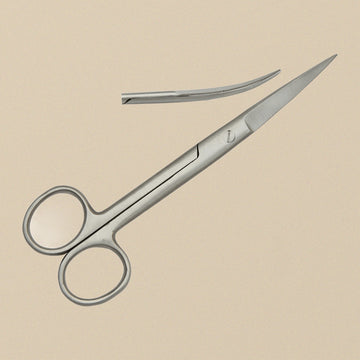
What they do: Mayo scissors are the heavy-lifters of the surgical world. They are robust, sturdy scissors designed for cutting dense, fibrous tissues. Think fascia, connective tissue, or even sutures. Their thick blades can withstand the pressure required for these tougher jobs without flexing or dulling quickly.
When to use them: Reach for Mayos when you need to cut anything other than delicate tissue. They come in straight and curved variations. Straight Mayo scissors are excellent for surface-level work, like cutting suture material. Curved Mayo scissors allow for better visualisation and access when dissecting deeper into a surgical site, allowing the blades to follow the contour of the tissue.
The alternative: Never use delicate scissors for tough jobs. You will ruin them. For cutting sutures, some prefer dedicated stitch scissors, but a straight Mayo is perfectly adequate and more versatile.
Metzenbaum Scissors
What they do: If Mayos are the workhorse, Metzenbaums are the artist's brush. These are delicate dissecting scissors, characterised by their long shanks and short, fine blades. This design provides excellent control and precision deep within a wound, far from the surgeon's fingers.
When to use them: Metzenbaums are exclusively for fine tissue dissection and isolation. Use them for separating delicate muscle layers, working around vessels and nerves, or excising soft, delicate masses. Their blunt-tipped design helps prevent accidental punctures of underlying structures.
The alternative: The most common mistake is using Metzenbaums to cut sutures or tough fascia. This will rapidly dull and misalign the blades, rendering them useless for their intended purpose. Always have a pair of Mayos handy for the heavy work. The difference in 'feel' between a sharp pair of Metzenbaums and a damaged pair is night and day.
Iris Scissors
What they do: Originally designed for ophthalmic surgery, Iris scissors are small, extremely sharp, and pointed scissors. They offer the ultimate in fine-tipped precision for detailed work.
When to use them: While essential for eye procedures, their utility extends to any situation requiring minute, precise cuts in delicate tissue. This could be in exotic animal surgery, vascular repair, or for trimming the edges of a small skin graft. They are an invaluable tool for when Metzenbaums are still too large or clumsy for the task at hand.
Bandage and Utility Scissors (e.g., Lister)
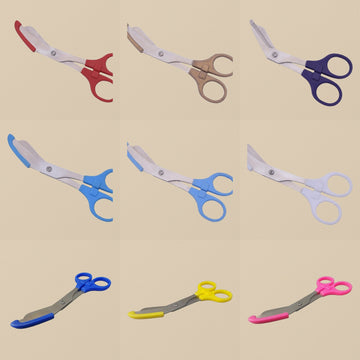
What they do: These are not sterile theatre instruments, but they are an essential part of any clinic's inventory. The defining feature is the blunted, flattened lower blade. This design allows the user to slide the blade directly against the patient's skin to cut bandages, dressings, or casts without risk of injury.
When to use them: Primarily for post-operative care, emergency first aid, and dressing changes. Every consult room and prep area should have a pair. While not used in surgery itself, they are critical for the patient journey from prep to recovery.
Grasping and Holding Tissue
Maintaining a clear surgical field and handling tissue with the appropriate level of care is paramount. Forceps are not all created equal; some are designed for a feather-light touch, others for a grip that won't let go.
Adson Tissue Forceps
What they do: Adson forceps are the standard for delicate tissue handling. They are relatively small with a wide, flat thumb grip area for fine control. They come in two main variants:
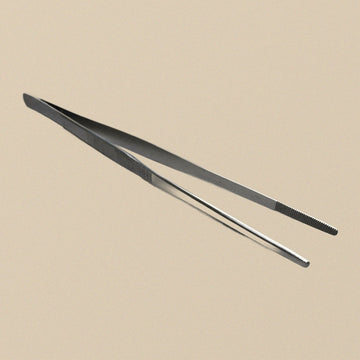
- Adson 1x2 (Toothed): These have a single tooth on one jaw that interlocks with two teeth on the other. This provides a secure grip on tissues like skin or fascia with minimal crushing force. They are the go-to for handling the edges of a wound during suturing.
- Adson Dressing (Non-Toothed): These have serrated jaws but no teeth. They are used for handling extremely delicate tissues where even the small punctures from a toothed forcep would be unacceptable. They are also useful for handling sterile dressings and swabs.
When to use them: Use them whenever you need to hold or manipulate tissue that will remain in the patient. Their fine control is essential for good surgical technique.
Allis Tissue Forceps
What they do: Allis forceps are designed for a powerful, secure grip. They have sharp, interlocking teeth that are significantly more aggressive than those on Adson forceps. This makes them a traumatic instrument.
When to use them: Crucially, Allis forceps should only be used on tissue that is going to be removed from the patient. They are excellent for grasping tough fascia, tumours, or sections of tissue for excision. Their secure grip prevents slippage, which is vital when tension is required. Never, ever use them on skin or organs that are being left in situ.
Backhaus Towel Clamps
What they do: A simple but indispensable tool. Backhaus towel clamps are used to secure surgical drapes to the patient's skin, holding the sterile field in place. They have sharp, curved, pointed tips that perforate the skin and drape material, with a ratchet to lock them securely in position.
When to use them: Used at the start of almost every surgical procedure to establish the sterile field. Once a perforating clamp is placed, it is considered non-sterile at the tip and should not be repositioned.
Haemostasis (Controlling Bleeding)
Effective haemostasis is a cornerstone of safe surgery. Artery forceps, or haemostats, are designed to clamp blood vessels to prevent or control bleeding.
Halsted Mosquito Artery Forceps
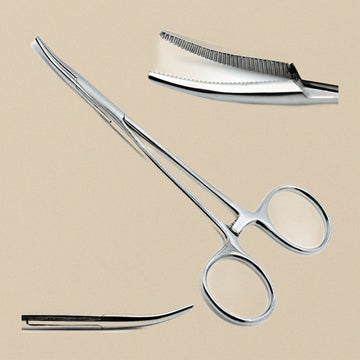
What they do: Mosquito forceps are the finest and most delicate of the common haemostats. They have fine, fully serrated jaws and are used to clamp small blood vessels. The ratchet lock allows them to be clamped onto a vessel and left in place, freeing up the surgeon's hands.

When to use them: For precise, point-by-point haemostasis of small bleeders in any surgical field. They come in straight and curved varieties; the curved version is often preferred as it allows for better visibility around the tip. For a more detailed look at the different types of haemostats, our UK veterinary hemostats guide offers a comprehensive overview.
Suturing and Wound Closure
The final stage of any surgery requires instruments that can securely hold a needle and, in some cases, cut the suture material.
Olsen-Hegar Needle Holder
What they do: This is a combination instrument that functions as both a needle holder and a pair of scissors. The jaws are designed to grip a suture needle securely, while a pair of cutting blades is integrated into the shank just behind the jaws.
When to use them: They are popular with solo surgeons or for procedures where speed is a factor, as they eliminate the need to constantly switch between a needle holder and a separate pair of scissors. The main drawback is the risk of accidentally cutting the suture material when you only intend to grasp the needle, which can be a source of great frustration.
Mayo-Hegar Needle Holder
What they do: The Mayo-Hegar is a dedicated needle holder, with no cutting function. Its sole purpose is to grip a suture needle with absolute security. The best models feature tungsten carbide (TC) inserts in the jaws. These gold-handled instruments offer a much harder, more durable gripping surface that lasts far longer than standard stainless steel.
When to use them: This is the workhorse needle holder for most surgeons. It provides an uncompromising grip and excellent tactile feedback. While it means you need a second pair of hands (or your own) to cut the suture with scissors, many prefer this deliberate, two-step process to avoid the risks associated with the Olsen-Hegar.
Suture Removal Kit
What they do: This isn't a single instrument but a necessary function. For follow-up appointments, you need a safe way to remove sutures. This is typically achieved with a simple stitch cutter—a small, hooked blade designed to slip under a suture and cut it—or a pair of fine, sharp scissors (like Iris scissors) and a pair of forceps (like Adsons) to lift the knot.
When to use them: Essential for post-operative checks and wound management. Keeping a dedicated, sterilised pack ready for this purpose is a mark of good practice.
Exposure and Retraction
You can't operate on what you can't see. Retractors are used to hold tissues and organs apart, providing vital exposure of the surgical site.
Senn Retractor
What they do: The Senn retractor is a small, double-ended, handheld retractor. One end typically has three sharp or blunt prongs, while the other end is a small, L-shaped blade. It's incredibly versatile for small-scale surgery.
When to use them: Perfect for maintaining exposure in small skin incisions, lump removals, or any procedure in a confined space. The choice between sharp and blunt prongs depends on the delicacy of the tissue being retracted. It’s an instrument you’ll find yourself reaching for constantly.
A Note on Instrument Quality, Sterilisation, and UK Compliance
Choosing the right instruments is only half the battle. Understanding their quality and how to care for them is what makes them a long-term investment.
Material and build quality: what to check
You will often see instruments graded by their country of origin, but quality varies within every manufacturing country, so check the instrument itself.
- Joints and action: box joints and screw joints should move smoothly with no side play, and ratchets should engage and release cleanly at each step.
- Jaws, tips and finish: jaws and tips should meet evenly along their length, scissors should cut cleanly to the tips, and the finish should be free of pits, burrs and rough edges, which makes instruments easier to clean.
Put most of your budget into the instruments you use most, such as scissors and needle holders; value instruments suit training and less-critical items such as towel clamps. Toolsmith's instruments are made in Pakistan, and our manufacturer's ISO 9001:2015 and ISO 13485:2016 quality-management certificates are on our quality and compliance page.
UK Compliance and Sterilisation
The Medical Devices Regulations 2002, which the Medicines and Healthcare products Regulatory Agency (MHRA) enforces in the UK, define a medical device as one its manufacturer intends to be used for human beings. An instrument intended only for veterinary use is not a medical device under that definition, so UKCA or CE marking for medical devices does not apply to it. For a veterinary kit, what matters is the steel, the build quality and the manufacturer's quality documentation.
All the stainless steel instruments listed here are designed to be sterilised in a standard veterinary autoclave using steam and pressure. It is vital that instruments are thoroughly cleaned and disinfected before being placed in the autoclave. Debris left on an instrument will be baked on during sterilisation, leading to corrosion, stiff joints, and potential patient infection.
For practices looking to equip entire new suites or multiple vets, we offer specialised services. You can learn more about setting up trade accounts for UK veterinary practices to streamline your procurement.
Key Takeaways
- A foundational surgical kit is built on versatility. These 12 instruments cover cutting, grasping, haemostasis, suturing, and retraction for most common procedures.
- Know your scissors: Use Mayo for tough tissue and sutures; use Metzenbaum for delicate dissection only.
- Respect the tissue: Use Adson forceps for tissue that will remain in the patient; use Allis forceps only for tissue being removed.
- Choose your needle holder based on preference: Olsen-Hegar for speed and convenience (with risk); Mayo-Hegar for dedicated, secure grip.
- Material matters: check joints, tips, ratchets and finish on every instrument, whatever its country of origin.
- Instruments intended only for veterinary use are not medical devices under the UK Medical Devices Regulations 2002, so medical-device UKCA/CE marking does not apply; ask for the manufacturer's quality documentation instead.
Building your personal or practice kit is a process that evolves with your skills and caseload. Starting with this core list of high-quality, reliable instruments ensures you have a capable and compliant foundation from day one. As you gain experience, you will discover other specialised tools you wish to add, but this set will remain the dependable heart of your surgical toolkit. When you are ready to select your tools, you can browse our entire surgical instruments collection to find the right fit for your practice.
Sources
- The Medical Devices Regulations 2002, regulation 2 — definition of a medical device (legislation.gov.uk)
- MHRA — Medical devices: how to comply with the legal requirements (GOV.UK)
Related guides
- Surgical Scissors for UK Vets: Mayo, Metzenbaum & Iris
- Veterinary Needle Holders: Mayo-Hegar, Olsen-Hegar & Castroviejo
- Reflex Hammers Explained: Taylor, Buck, Babinski & Queen Square
- Laryngoscopes: Macintosh vs Miller, Conventional vs Fibre-Optic
- Pet Nail Care: Clippers, Grinders & Styptic
- Surgical Scalpels, Gigli Saws & Bone Instruments: A UK Guide
- Otoscope & Ophthalmoscope Sets: A UK Guide for GPs, Vets & Students
- Livestock Husbandry Tools: Burdizzos, Elastrators & Dehorners
- Kidney Dishes, Trays & Instrument Boxes: A UK Clinic Guide
Frequently asked questions
What instruments do I need in my first vet surgery kit?
Twelve essentials: Mayo, Metzenbaum, Iris and bandage scissors; Adson and Allis tissue forceps; Backhaus towel clamps; Halsted mosquito artery forceps; Olsen-Hegar and Mayo-Hegar needle holders; a suture removal kit; and a Senn retractor. Together these cover cutting, grasping, haemostasis, suturing and retraction for around 90% of common small-animal procedures.
How do I judge the quality of stainless steel surgical instruments?
Judge each instrument rather than its country of origin: joints should move smoothly without side play, jaws and tips should meet evenly, ratchets should engage and release cleanly, and the finish should be free of pits and burrs. Put most of your budget into the instruments you use most, such as scissors and needle holders; value instruments suit training and less-critical items such as towel clamps. Toolsmith's instruments are made in Pakistan.
What compliance marks do veterinary surgical instruments need in the UK?
Under the Medical Devices Regulations 2002, which the MHRA enforces, a medical device is one its manufacturer intends to be used for human beings. An instrument intended only for veterinary use is not a medical device under that definition, so UKCA or CE marking for medical devices does not apply to it. Judge a veterinary instrument on its steel, its build quality and the manufacturer's quality documentation, and clean instruments thoroughly before autoclaving, as baked-on debris causes corrosion, stiff joints and infection risk.