Quick answer: A practical starting set is four pliers: a Weingart for placing archwires, a bird-beak for bending loops and stops, a three-prong for adjusting clasps, and a distal-end cutter that holds the cut wire end. Add Adams pliers once you make removable appliances. Spend most on the cutters — tungsten carbide inserts hold their edge far longer than plain steel.
Orthodontics is, at heart, the controlled bending of wire — and the pliers in the kit are what put the bend exactly where the treatment plan wants it. Where most dental instruments diagnose or remove, orthodontic pliers shape: archwires, clasps, springs and retainer components. This guide explains the core orthodontic and wire-bending pliers a UK practice or technician uses, what each one is for, and how to judge a pair that will hold its accuracy.
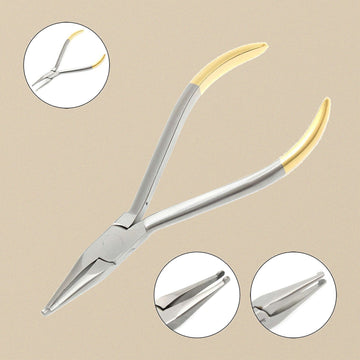
Weingart pliers
The Weingart is the placing pliers. Its slim, serrated beaks reach into the mouth to guide an archwire into the brackets and make small adjustments without slipping. The serrations grip the wire securely; the delicate tips let you work in a crowded arch. If you buy one orthodontic pliers first, it is usually this.
Bird-beak and loop-forming pliers
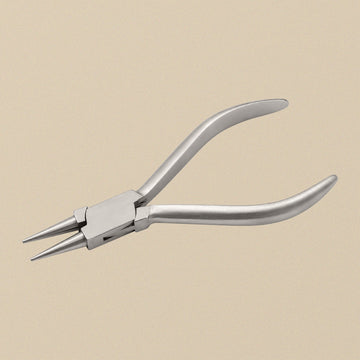
The bird-beak (or Angle pliers) carries a round beak on one side and a flat, pyramidal beak on the other — the round former shapes curves and loops, while the flat side sets sharp bends and helps close them. It is the everyday wire-bending pliers for loops, stops and helices. A dedicated loop-forming pliers with stepped round jaws makes consistent loops of set diameters when you bend a lot of the same component.
Three-prong (three-jaw) pliers
The three-prong pliers has two prongs on one side and one in the middle on the other, so it grips and adjusts wire from three points at once. It is the tool for closing and tightening clasps on removable appliances and for fine adjustments to springs without kinking the wire.
Adams pliers
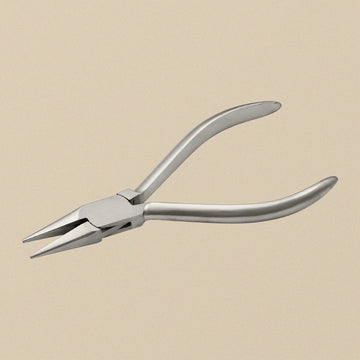
The Adams universal pliers — a square-beaked 64mm design — is the classic for forming and adjusting Adams clasps and other removable-appliance retention. Its flat, parallel-faced beaks make crisp right-angle bends and flatten without marking. Many appliance technicians regard it as the single most useful pliers on the bench.
Distal-end and ligature cutters
Cutting in the mouth needs its own tools. A distal-end cutter trims the archwire flush behind the last bracket and holds the cut end so it does not drop — a genuine safety feature. A ligature cutter snips fine ligature wires cleanly. Both work hard, so the cutting edges are where quality shows first.
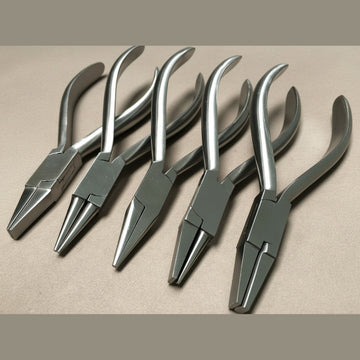
- Bend and form: Weingart, bird-beak, loop-forming, Adams.
- Grip and adjust: three-prong, clasp-bending pliers.
- Cut: distal-end and ligature cutters.
How to choose: inserts, joints and finish
For the cutters, tungsten carbide inserts hold an edge far longer than plain steel and are worth the premium on anything that cuts wire repeatedly. On forming pliers, check the beaks meet true and the box joint has no side-play — a pliers that rocks will not give you a repeatable bend. A satin finish reduces glare, and good stainless steel survives the autoclave without pitting. As with all wire tools, a clean, wobble-free joint is the mark of a pair that will stay accurate.
Building the kit
A practical starting set is a Weingart, a bird-beak, a three-prong and a distal-end cutter — that covers placing, bending, adjusting and trimming. Add the Adams pliers as soon as you make removable appliances. Spend on the cutters above all; a blunt cutter crushes wire instead of shearing it.
For the diagnostic instruments that share the tray and the burs that finish the work, see our companion dental guides, and browse the orthodontic range below.
Related guides
- Shop Orthodontic & Wire Pliers →
- Dental Examination Instruments: Mirrors, Probes & Explorers
- Dental Burs for Lab Technicians: Carbide vs Diamond vs Tungsten
- Parallel-Action vs Standard Pliers: What's Worth the Premium
Frequently asked questions
Which orthodontic pliers do I need to start with?
A Weingart, a bird-beak, a three-prong and a distal-end cutter cover placing, bending, adjusting and trimming — the four core jobs. The Weingart is usually the first purchase: its slim serrated beaks guide archwires into brackets and make small adjustments without slipping. Add the Adams universal pliers as soon as you form or adjust removable appliances.
What are Adams pliers used for?
The Adams universal pliers — a square-beaked 64mm design — forms and adjusts Adams clasps and other retention components on removable appliances. Its flat, parallel-faced beaks make crisp right-angle bends and flatten wire without marking it. Many appliance technicians regard it as the single most useful pliers on the bench, so add one as soon as removable work begins.
Are tungsten carbide cutters worth the extra cost?
Yes, for anything that cuts wire repeatedly. Tungsten carbide inserts hold their cutting edge far longer than plain steel, and the cutters are where quality shows first because they work hardest — a blunt cutter crushes wire instead of shearing it. On forming pliers, put the money into true-meeting beaks and a box joint with no side-play instead.