Quick answer: For medical, nursing or veterinary training, buy a complete cased set — otoscope and ophthalmoscope heads sharing one battery handle, with a full run of graduated ear specula. It covers OSCEs, placements and kit lists, and often stays in the bag for decades. Prioritise a hard case with cut-outs, a swivelling otoscope lens and a wide speculum range.
An otoscope and ophthalmoscope set is the classic first diagnostic purchase — bought at the start of medical, nursing or veterinary training and often still in the bag twenty years later. The instruments themselves are simple; the buying decisions are about what is in the case, how the two heads differ, and how much set you actually need at each career stage. Here is the plain-English version.
What is in a combined diagnostic set
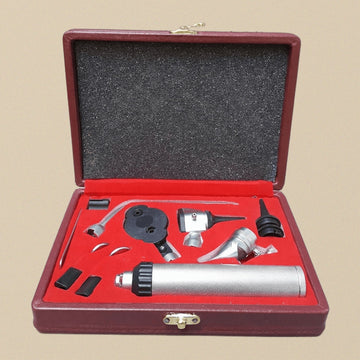
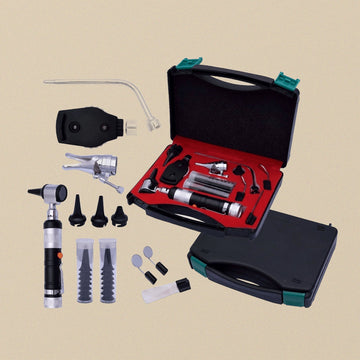
A standard presentation-case set pairs two instrument heads on a shared battery handle: an otoscope for ears and an ophthalmoscope for eyes, with a range of reusable ear specula in graduated diameters. The hard case earns its keep — these are aligned optical instruments, and a case that holds each part in cut-outs is the difference between a set that survives a locum bag and one that rattles apart. One handle, two heads is also the budget logic: you are buying the optics twice, the power once.
The otoscope side: specula and view
The otoscope is a lit magnifier down a cone. What matters in use: a swivelling magnifying lens that moves aside for instrumentation, bright even illumination without a hot spot, and a full run of speculum sizes — small diameters for paediatric and veterinary ears, larger for adult canals. Specula are stainless or polymer and clean between patients; check they seat with a positive twist-lock so they cannot drop mid-examination.
The ophthalmoscope side: apertures and dioptres
The ophthalmoscope head carries a dioptre wheel — stepped lenses that focus from the cornea back to the retina and compensate for your own prescription — and an aperture dial offering at minimum a large and small spot, and usually a slit and a red-free (green) filter for vessels. For routine fundal checks and red-reflex screening, a standard head does everything asked of it; specialist retinal work happens on clinic equipment anyway.
Who needs what
- Students (medical, nursing, paramedic, vet): a complete cased set covers OSCEs and placements — this is exactly what the kit lists mean.
- GPs and locums: the same set, chosen for case quality and spare bulbs/specula availability.
- Veterinary practice: the otoscope works hard (ears dominate small-animal consults); the wide speculum range matters more than anything else.
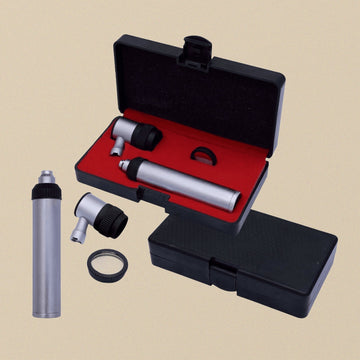
- Skin-focused work: add a dermatoscope — an illuminated skin magnifier that has become standard kit for lesion triage and is equally useful in veterinary dermatology.
Care: bulbs, batteries, alignment
Wipe specula and heads with disinfectant between patients, never immerse the optical heads, and store the set in its case with batteries removed for long gaps — leaked cells kill more diagnostic sets than drops do. Carry a spare bulb in the case cut-out; the day it blows will be a busy one.
Diagnostic sets and dermatoscopes ship from UK stock with same-day dispatch — browse the range below.
Related guides
- Shop Diagnostic & ENT Instruments →
- Reflex Hammers Explained: Taylor, Buck, Babinski & Queen Square
- Laryngoscopes: Macintosh vs Miller, Conventional vs Fibre-Optic
- Small-Animal Vet Surgery Kit: 12 Essentials for a UK Clinic
Frequently asked questions
Which diagnostic set do I need as a medical or veterinary student?
A complete cased set — two heads on a shared battery handle with graduated ear specula — is exactly what student kit lists mean, and covers OSCEs and placements. GPs and locums use the same set, chosen for case quality and spare bulb availability; veterinary buyers should prioritise the widest speculum range, because ears dominate small-animal consults.
What should I look for in the otoscope and ophthalmoscope heads?
On the otoscope: a swivelling magnifying lens that moves aside for instrumentation, bright even illumination without a hot spot, and specula that seat with a positive twist-lock. On the ophthalmoscope: a dioptre wheel that focuses from cornea to retina and an aperture dial with at least large and small spots, usually plus a slit and red-free filter.
How do I care for a diagnostic set so it lasts?
Wipe specula and heads with disinfectant between patients, but never immerse the optical heads. Store the set in its case with the batteries removed during long gaps — leaked cells kill more diagnostic sets than drops do. Keep a spare bulb in the case cut-out; the day it blows will be a busy one.