Quick answer: For student kits and routine work, the inexpensive Taylor (tomahawk) hammer is perfectly serviceable; the Buck adds two head sizes plus built-in pin and brush for sensory testing. If you examine reflexes all day, choose a Babinski or Queen Square — their weighted heads and free-swinging handles deliver consistent taps with far less effort. Let the head's mass do the work.
Key difference: the Taylor is inexpensive and familiar and the Buck adds a second head and sensory tools; the Babinski and Queen Square use a weighted head and a free swing for consistent, low-effort taps.
| Hammer | Head | Handle | Best for |
|---|---|---|---|
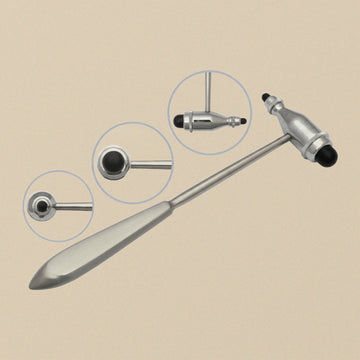
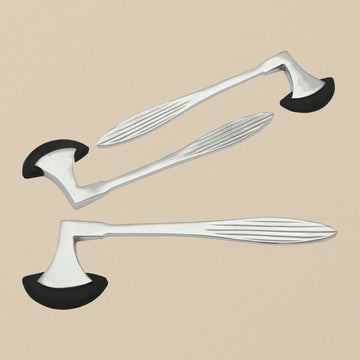
| Taylor (tomahawk) | Triangular rubber head: broad face for large tendons, pointed apex for smaller ones | Short, flat | Student kits and routine work; the light head needs a confident strike |
| Buck | Two heads, one larger and one smaller | Small metal stem; many have a retractable pin and brush for sensory testing | A compact all-rounder for a bedside or clinic-bag kit |
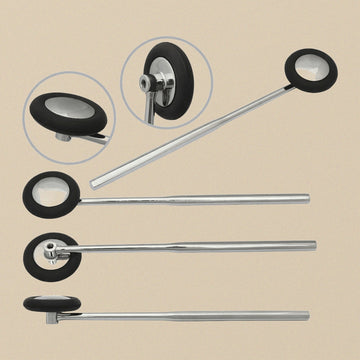
| Babinski | Heavier round head | Long and flexible; many unscrew to reveal a brush or needle | Examining reflexes all day, with repeatable results |
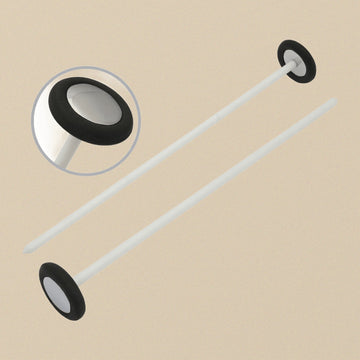
| Queen Square | Flat disc head | Long, slim cane-style handle pivoted from the wrist | A clean, low-effort strike once you have practised it |
A tendon reflex is one of the quickest windows into the nervous system — but only if it is elicited cleanly. A good reflex hammer does most of that work for you: enough mass, swinging freely, delivering a crisp tap that the muscle answers. The wrong hammer, or the wrong technique, gives a muffled or absent response that means nothing. This guide compares the four reflex hammers a UK clinician, vet or student is most likely to meet, and how to choose one that actually works.
The Taylor (tomahawk) hammer
The Taylor is the one everyone pictures: a triangular rubber head on a short flat handle. The broad face taps large tendons (knee, ankle) while the pointed apex reaches smaller ones such as the biceps. It is inexpensive, familiar and perfectly serviceable for routine work, which is why it dominates student kits and general practice. Its limitation is mass — the light head needs a confident strike to give a reliable response.
The Buck hammer
The Buck carries two heads on a small metal stem — a larger and a smaller face — so you can switch tap size without changing tools. Many Buck hammers build sensory testing into the handle: a retractable pin and a brush for assessing sharp and light touch. That makes it a compact all-rounder for a bedside or clinic-bag kit.
The Babinski hammer
The Babinski uses a heavier round head on a long, flexible handle. The flex lets the head swing freely and the extra weight delivers a consistent tap with less effort — favoured by neurologists who examine reflexes all day. Many versions unscrew to reveal a brush or needle for sensory work. It is the choice when you want repeatable results across a long list.

The Queen Square hammer
The Queen Square — a flat disc head on a long, slim cane-style handle — is the classic British neurology hammer. You hold it near the end and let it pivot from the wrist so the weighted head swings like a pendulum; the long lever and free swing produce a clean, low-effort strike. It takes a little practice but rewards it with beautifully consistent reflexes.

Technique: let the weight do the work
Whichever hammer you hold, the principle is the same: relax your grip, swing from the wrist and let the head's mass deliver the tap. Tension in your hand dampens the strike. Position the limb so the tendon is slightly stretched, strike the tendon (not the muscle belly) and compare side to side. A hammer with good free-swinging balance makes this far easier than a stiff, light one.
How to choose
Weigh the trade-offs: the Taylor for low cost and familiarity; the Buck for a compact kit with built-in sensory tools; the Babinski or Queen Square for the smooth, weighted swing that experienced examiners prefer. Look for a securely bonded head (a rubble head that works loose is useless), a comfortable handle and — if you assess sensation — integrated pin and brush so you carry one tool, not three.
Reflex testing rarely travels alone, so see our companion clinical guides, and browse the neuro range below.
Related guides
- Otoscope & Ophthalmoscope Sets: A UK Guide for GPs, Vets & Students
- Shop Reflex Hammers & Neuro Testing →
- Laryngoscopes: Macintosh vs Miller, Conventional vs Fibre-Optic
- Your First Vet Surgery Kit: 12 Essential Instruments
- Surgical Scissors: Mayo, Metzenbaum & Iris — Which Goes Where
Frequently asked questions
Which reflex hammer should I buy as a student or for general practice?
The Taylor (tomahawk) is the usual first hammer: inexpensive, familiar and perfectly serviceable, with a broad face for large tendons and a pointed apex for smaller ones like the biceps. Its light head needs a confident strike, so if you want a compact upgrade, the Buck adds a second head size plus a retractable pin and brush for sensory testing.
What is the difference between a Babinski and a Queen Square hammer?
Both are neurologists' hammers built around a weighted head and free swing. The Babinski has a heavier round head on a long, flexible handle whose flex delivers a consistent tap with little effort; many unscrew to reveal a brush or needle. The Queen Square puts a flat disc head on a long cane-style handle you pivot from the wrist like a pendulum — the classic British pattern.
Why won't my reflex hammer elicit a reflex?
Usually technique rather than the patient. Relax your grip and swing from the wrist so the head's mass delivers the tap — tension in your hand dampens the strike. Position the limb so the tendon is slightly stretched, strike the tendon rather than the muscle belly, and compare sides. A stiff, light hammer makes all of this harder than a well-balanced weighted one.