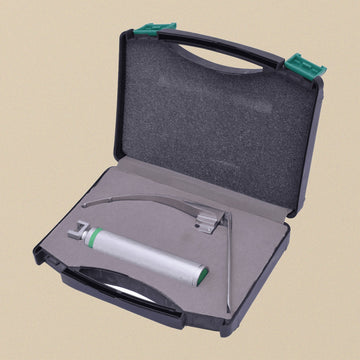
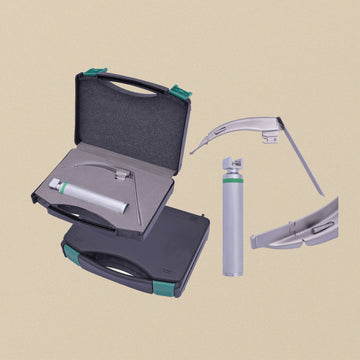
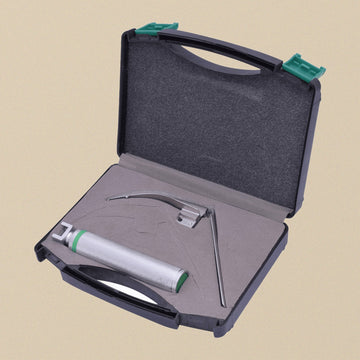
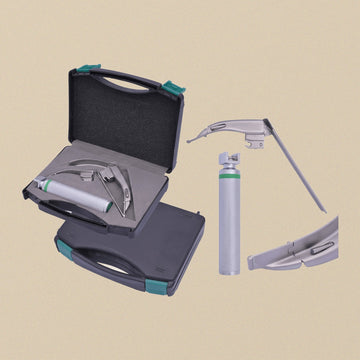
Quick answer: For routine adult intubation, most clinicians choose a curved Macintosh blade (Mac 3 or 4) on a fibre-optic handle — brighter, cooler light with the bulb protected. Straight Miller blades suit paediatric airways, difficult anterior airways and most veterinary work. Blades and handles on the same standard hook-on fitting mix freely, so build a kit with a spread of sizes.
Key difference: the curved Macintosh lifts the epiglottis indirectly from the vallecula; the straight Miller lifts it directly.
| Blade | Shape and placement | Best for |
|---|---|---|
| Macintosh | Curved; placed in the vallecula; lifts the epiglottis indirectly; broad flange controls the tongue | Routine adult intubation (usually a Mac 3 or 4) |
| Miller | Straight; lifts the epiglottis directly | Paediatric airways, difficult anterior airways and much veterinary work |
When an airway needs securing, the laryngoscope is what turns a blind procedure into a controlled one — it lifts the tissues out of the way and lights the path to the vocal cords. Choosing a set means two main decisions: blade shape (curved or straight) and light source (conventional bulb or fibre-optic). This guide explains how a laryngoscope works, the Macintosh-versus-Miller question, and how to choose a set for a UK clinic or veterinary practice.
How the system fits together
A laryngoscope is a handle and a detachable blade that clip together on a standard hook-on fitting, so one handle runs a whole set of blades. The handle holds the batteries (and, on fibre-optic sets, the lamp); the blade carries the tongue and lifts the epiglottis. Standardised fittings mean blades and handles from the same system mix freely — useful when you build a kit over time.

Macintosh (curved) blades
The Macintosh blade is curved and is placed into the vallecula — the space in front of the epiglottis — so that lifting the blade raises the epiglottis indirectly. Its broad flange controls the tongue well and it is the default for routine adult intubation. Most clinicians reach for a Mac 3 or 4 for adults.
Miller (straight) blades
The Miller blade is straight and lifts the epiglottis directly. That extra control suits paediatric airways (where the epiglottis is floppier), difficult anterior airways, and much veterinary work. Vets in particular favour straight blades across a wide range of species and sizes. Many practitioners carry both shapes and choose by the airway in front of them.
Conventional vs fibre-optic vs LED
The light source is the other big choice:
- Conventional: a small bulb sits in the blade. Simple and cheap, but the bulb can loosen and the light is warmer and dimmer.
- Fibre-optic: the lamp lives in the handle and light travels up a fibre bundle in the blade. Brighter, cooler at the tip, and the bulb is protected — the modern professional standard.
- LED: increasingly common in both styles, giving a bright, cold, daylight-white light and long battery life.
Blade sizes and handles
Blades run from size 0 (neonate) up through 1, 2, 3 and 4 (large adult), in both Macintosh and Miller patterns — a practice kit usually carries a spread rather than a single size. Handles come in standard and stubby/short versions; a shorter handle helps in patients with limited neck access or a barrel chest. Match handle and blade to the same lighting system.
Care, batteries and hygiene
Whatever you choose, reliability is the point — there is no good moment for a flat battery or a flickering bulb. Check the lamp and batteries as part of your daily airway-trolley check, keep spare bulbs and cells to hand, and clean and sterilise blades according to the manufacturer's guidance and your local decontamination policy. Stainless blades with a clean light pipe last for years of this.
For the wider clinical kit that surrounds airway work, see our companion guides, and browse the airway range below.
Related guides
- Otoscope & Ophthalmoscope Sets: A UK Guide for GPs, Vets & Students
- Shop Laryngoscopes & Airway →
- Reflex Hammers Explained: Taylor, Buck, Babinski & Queen Square
- Your First Vet Surgery Kit: 12 Essential Instruments
- Surgical Scissors: Mayo, Metzenbaum & Iris — Which Goes Where
Frequently asked questions
Which laryngoscope blade do I need — Macintosh or Miller?
The curved Macintosh sits in the vallecula and lifts the epiglottis indirectly; its broad flange controls the tongue well, making it the default for routine adult intubation (usually a Mac 3 or 4). The straight Miller lifts the epiglottis directly, which suits paediatric airways, difficult anterior airways and much veterinary work. Many practitioners carry both and choose by the airway.
Is a fibre-optic laryngoscope worth it over a conventional bulb?
For professional use, yes. A fibre-optic set keeps the lamp in the handle and carries light up a fibre bundle in the blade, giving a brighter, cooler beam with the bulb protected — the modern professional standard. Conventional blades put a small bulb in the blade itself: simple and cheap, but dimmer, warmer, and the bulb can work loose.
What laryngoscope blade sizes should a practice kit carry?
Carry a spread rather than a single size. Blades run from size 0 for neonates through 1, 2, 3 and 4 for large adults, in both Macintosh and Miller patterns. Match handle and blade to the same lighting system, consider a stubby handle for patients with limited neck access, and check lamps and batteries as part of the daily trolley check.