Quick answer: Nearly everything in this range runs on a 3/32-inch (2.35 mm) shank, so it fits any flex-shaft or micromotor. Buy cotton buffs for compound finishing, bristle brushes for detail and cleaning, and a stainless wire wheel — run slowly — for satin finishes. Keep one compound per mop and never cross-contaminate; that is what causes mystery scratches.
Polishing is where a piece either comes alive or gets quietly ruined, and most of that outcome is decided by the mop on the end of your flex-shaft rather than the compound you loaded onto it. Cotton, bristle and wire all cut differently; run the wrong one and you round a crisp edge or scratch a finish you had already earned. Here is how the small mounted accessories differ and how to use them without undoing your own work.
Shank sizes: 3/32 inch and 2.35 mm are the same thing
Almost everything in this range runs on a 3/32-inch shank — which is 2.35 mm, the standard collet size for flex-shafts, micromotors and rotary tools. If a listing quotes one and your handpiece quotes the other, they still fit. Larger buffs sometimes arrive on a 2.35 mm screw mandrel instead, where the mop is a replaceable pad that screws on: cheaper to re-stock, and worth having if you get through cloth wheels quickly.
Cotton buffs: the finishing mop
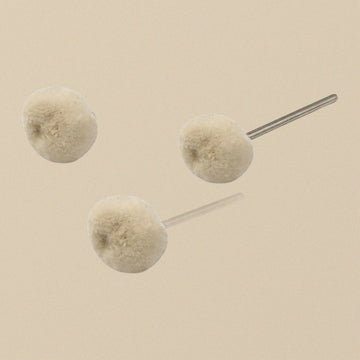
Mounted cotton buffs — including ball-shaped heads for concave work — are soft, conformable and made to carry compound. They cut only as much as the compound you charge them with, which is exactly why they are the finishing tool: tripoli on one, rouge on another, and never the two on the same mop. Ball and dome shapes get inside curves and bezels where a flat wheel cannot reach. Run them at moderate speed; a cotton mop spun too fast throws compound, burns and glazes.
Bristle brushes: cleaning and detail
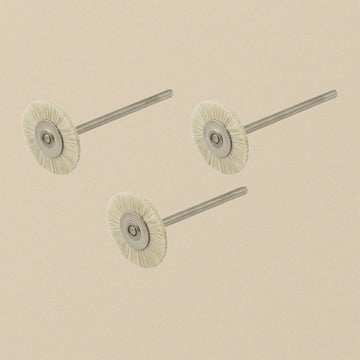
Bristle brushes come as wheels and cups, in stiff and extra-soft grades. Their job is not to cut metal but to carry compound into places a mop skates over — pierced work, engraved lines, textured surfaces, the underside of a setting. Stiff black bristle works well with cutting compound on cast surfaces; extra-soft with a stainless centre suits final polishing and cleaning around stones without risking a scratch. They are also the right first choice for cleaning pickle residue out of detail.
Wire wheels: satin, not shine
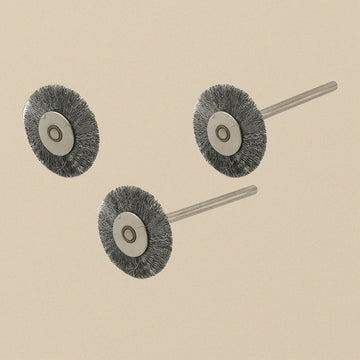
A stainless steel single-row wire wheel does something different again. It does not polish; it produces a fine satin or brushed finish, and it burnishes rather than removes. Used dry and lightly, it gives silver a soft lustre that suits oxidised and textured pieces beautifully. Two rules keep it useful: run it slowly (a fast wire wheel throws wires and marks metal), and keep a dedicated wheel per metal — steel wires that have touched brass will transfer that colour into silver.
Holding the work
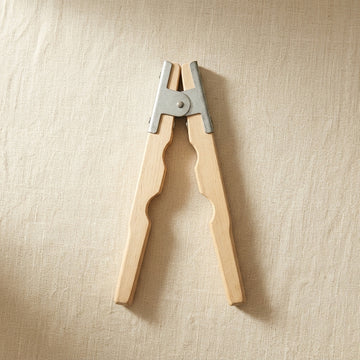
Polishing pulls, and a piece snatched out of your fingers is the classic bench injury. A wooden ring holder hand clamp with a sprung hinge grips a ring while you work the outside of the shank, keeping fingers away from the mop and letting you apply steady, even pressure. It is a £-few tool that prevents both a burnt fingertip and a dropped, dented piece.
A working order
- Cut: stiff bristle or a cotton mop with tripoli — remove marks, not metal.
- Refine: fresh cotton buff with rouge on a clean mop; never cross-contaminate compounds.
- Detail: soft bristle brush into pierced and engraved areas.
- Alternative finish: stainless wire wheel, run slow, for satin rather than mirror.
- Between stages: wash the piece — compound carried forward is what causes mystery scratches.
All accessories above ship from UK stock with same-day dispatch before 2pm — browse the polishing and finishing range below.
Related guides
- Shop Polishing & Finishing →
- Polishing Compounds: Tripoli, Rouge & White Diamond Explained
- Flex-Shaft vs Micromotor: A UK Buying Guide
- Jeweller's Burs: Hart, Bud, Cup, Ball & Wheel — a UK Guide
Frequently asked questions
Which rotary polishing accessories do I need for jewellery work?
Three families cover most benches: mounted cotton buffs (including ball shapes for concave work) to carry tripoli and rouge; bristle brushes in stiff and extra-soft grades for pierced work, engraved lines and cleaning around stones; and a stainless single-row wire wheel for satin finishes. Add a wooden ring holder clamp to keep fingers away from the mop.
Will a 3/32-inch shank fit my 2.35 mm handpiece?
Yes — 3/32 inch and 2.35 mm are the same size, the standard collet fitting for flex-shafts, micromotors and rotary tools. If a listing quotes one and your handpiece quotes the other, they still fit. Larger buffs sometimes arrive on a 2.35 mm screw mandrel instead, where the mop is a replaceable screw-on pad that is cheaper to re-stock.
How do I get a satin finish on silver instead of a mirror polish?
Use a stainless steel single-row wire wheel, dry and with a light touch. It burnishes rather than removes, giving silver a soft brushed lustre that suits oxidised and textured pieces. Run it slowly — a fast wire wheel throws wires and marks metal — and keep a dedicated wheel per metal so steel that has touched brass never transfers colour into silver.