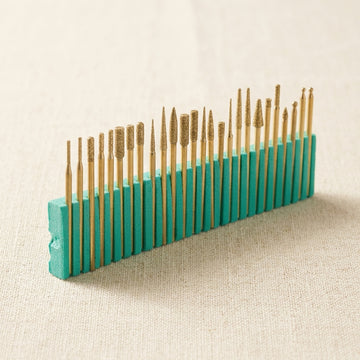
Quick answer: Seven bur shapes cover most bench work: ball, hart, bud, cup, wheel, setting cone and reverse cone. Buy HSS burs labelled with their shape and head diameter for silver and gold, reserve carbide for platinum and hard alloys, and start with a six-bur drawer at £45–£90 rather than a large mixed set.
Key difference: hart burs cut claw seats, bud burs cut bezel seats, cup burs finish prong tips and reverse cones cut undercuts for flush setting.
| Bur | Shape | Main job |
|---|---|---|
| Round / ball | Sphere | General removal; opening space for a stone; hollowing; cleaning solder pits |
| Hart / bearing | Sharp 90-degree V | Cutting the level seat (bearing) inside claws |
| Bud | Tapered bud with a pointed tip and curved belly | Seats in bezels and rub-over settings; small pavé seats |
| Cup | Hollow cup with teeth on the inner rim | Rounding prong tips after setting |
| Wheel / disc | Small wheel with teeth on the rim | Straight cuts, slots and cutting sprues |
| Setting / cone | Straight conical sides | Seats for straight-sided pavilions; channel and pavé grooves |
| Reverse cone | Wider at the cutting face than at the shank | Undercuts for flush or gypsy setting |
Walk up to any working jeweller's bench and you'll find a bur stand. It will be bristling with dozens, maybe hundreds, of burs. Some will be pristine, others worn to a nub, and a few will be caked in the ghostly white of polishing compound. The truth of the bench is that a jeweller likely owns 200 burs but uses the same 20 over and over again. To the untrained eye, the shapes look confusingly similar – a bud bur, a cone bur, a hart bur – what's the difference? The difference is everything. What they do, how they cut, and the finish they leave are worlds apart. This guide covers the seven bur shapes that matter most for professional work in the UK.
How burs are labelled
Before we can talk about shapes, we must talk about labels. Burs are sold by shape and by head diameter, and the same shape can carry different names and figure numbers from one maker to the next. Dental rotary instruments are identified under the ISO 6360 number coding system: a 15-digit number in which one three-digit group codes the shape (ISO 6360-2) and others code the working-part material, the shank and the overall length (ISO 6360-1). When you compare burs from different makers, compare the shape drawing and the head diameter in millimetres, not the name alone.
This guide gives each size as a three-digit number followed by the head diameter in millimetres — for example, Hart 021 (2.1mm).
Check the labelling before you buy a set. A set that names its burs loosely — a cone bur sold as a 'setting bur', or a bud bur as a 'flame bur' — or gives only approximate sizes is hard to match to a stone. Buy burs whose shape and head diameter are stated, so that you can order the same bur again and get the same tool.
The seven essential bur shapes
Out of the hundreds of specialised shapes available, these seven form the foundation of any jeweller's bur collection. Master these, and you can tackle 95% of the jobs that come across your bench.
Round / Ball
The most basic and versatile bur. The ball bur is the workhorse for general material removal. Its primary job in stone setting is not to cut the final seat, but to open up the space. In a four-claw setting, for example, you would use a ball bur slightly smaller than the stone to remove the bulk of the metal where the stone's pavilion will sit. This creates the initial clearance before you come in with a more precise bur. They are also invaluable for hollowing out the back of cast or fabricated pieces to reduce weight, cleaning up pits of solder in a join, or removing small areas of porosity in a casting. A jeweller will typically have a wide range of sizes, from a tiny 0.5mm (005) for fine work to a large 5.0mm (050) for heavy removal.
Hart / Bearing
This is THE setting bur. If you are setting stones in claws or prongs, the hart bur is your most critical tool. Its name in the trade is a 'bearing cutter', and that's exactly what it does. The shape, typically a sharp 90-degree 'V', is designed to cut a perfectly level shelf—the 'bearing' or 'seat'—into the inside of a prong. The girdle of the stone then rests securely on this shelf. Using a hart bur ensures the stone is level, secure, and sits at the correct height. The technique involves running the bur at a slow, controlled speed, allowing the V-shape to cut its profile into all the claws at a uniform depth. Without a correctly cut bearing, a stone will rock, be insecure, and look unprofessional. It is not an exaggeration to say that mastering the hart bur is a foundational skill in stone setting.
Bud
Where the hart bur is king for claws, the bud bur is the master of bezels and rub-over settings. Shaped like a tapered flower bud, its pointed tip allows for a very precise start to a cut, whilst its curved belly creates a smooth, concave seat that perfectly matches the curved pavilion of a brilliant-cut stone. When cutting a seat into a solid bezel wall, a bud bur allows you to control the depth and angle of the cut with far more finesse than a ball bur. It's also used for opening up seats for very small stones (mêlée) in pavé work or for carefully clearing away metal that has been burnished over the edge of a stone during setting, without touching the stone itself.
Cup
The cup bur is a finishing tool. It does not remove large amounts of material; it perfects what is already there. Its unique shape is a hollow cup with cutting teeth on the inside rim. Its sole purpose is to round the tops of prongs or claws after a stone has been set. Once a stone is secure, the excess length of the prongs is trimmed and filed. The cup bur, spun at a moderate speed, is then placed over the top of the prong. In seconds, it creates a clean, uniform, hemispherical dome. This not only looks highly professional but, crucially, it removes any sharp edges that could snag on clothing. Sizing is vital: you must match the diameter of the cup bur to the diameter of your prong wire for a perfect result. A 1.5mm cup bur (245-015) is perfect for finishing prongs made from 1.5mm wire.
Wheel / Disc
The wheel bur is for cutting straight lines and slots. Shaped like a tiny grinding wheel with teeth on its perimeter, it excels at jobs where precision linear removal is needed. Its most common use in a workshop is for separating freshly cast items from the sprue tree. A quick pass with a wheel bur will cut through the sprue far more quickly and neatly than a saw frame. It's also used for cutting channels for inlay, creating the seat for a hinge, or scoring lines. They must be used with care and a steady hand, as their shape makes them prone to grabbing and skating across a surface if not held firmly against the workpiece.
Setting / Cone
Often confused with a bud bur, the setting bur or cone bur has straight, conical sides, not curved ones. This shape is specifically designed to create seats for stones that have a straight-sided pavilion, or for creating the initial conical opening in channel and pavé setting. When setting a row of small stones in a channel, a setting bur of the correct size and angle is run along the channel to create a consistent 'V' groove for the stones to sit in. The straight sides of the bur mirror the pavilion facets of the brilliant-cut stones, allowing them to sit snugly and securely. Its pointed tip also makes it useful for accurately marking the centres for drilling holes before setting.
Reverse Cone
The reverse or inverted cone bur is a specialised shape with a specific, and very useful, purpose: creating undercuts. The bur is wider at its cutting face than at its shank, allowing you to remove material from an area you cannot access from the side. Its primary application is in flush or gypsy setting, where a stone is set directly into the metal. After drilling a hole, the reverse cone bur is used to cut a small internal groove just below the surface. The stone is then placed in the setting, and the thin lip of metal above the undercut is burnished over the stone's girdle, locking it securely in place. It's an ingenious tool for a very strong and sleek setting style.
Carbide vs HSS vs steel: what your bur is actually made of
The material your bur is made from dictates its performance, lifespan, and cost. There are two main players for metalwork: HSS and Tungsten Carbide.
- HSS (High-Speed Steel): This is the UK trade default and the workhorse of the industry. Typically made from M2 tool steel, HSS burs are relatively inexpensive (£0.40 - £1.20 each) and perform exceptionally well on non-ferrous metals like silver, gold, copper, and brass. They are forgiving and tough, but will lose their sharpness relatively quickly, especially if run too fast or without lubricant. For most jewellers working in silver and gold, a drawer full of sharp Busch HSS burs is the most cost-effective solution. They are considered a consumable item.
- Tungsten Carbide: Carbide burs are significantly harder and more wear-resistant than HSS. They cost more (£3 - £12 each) but can last 5 to 10 times longer if used correctly. Their extreme hardness means they hold a sharp edge for much longer, resulting in a cleaner, smoother cut. For tough-to-cut metals like platinum, palladium, titanium, and hard white gold alloys, carbide is not a luxury; it is essential. An HSS bur will be destroyed in seconds by platinum. The downside is that carbide is brittle. Dropping a carbide bur on a concrete floor will likely chip a flute, rendering it useless.
- Diamond-Grit Burs: It is crucial to understand that diamond burs are not for cutting metal. They are abrasive tools, consisting of a steel blank coated in diamond particles. Their purpose is to grind hard, brittle materials like gemstones, ceramics, or glass. If you use a diamond bur on metal, the soft metal will instantly clog the diamond grit (a process called 'loading'), and the bur will be ruined. Keep them separate and use them only for stone and glass work.
Choosing the right shape for the job
Here is a quick decision-making guide for common bench tasks:
-
Task: Setting a 3mm round brilliant stone in a claw setting.
Tool: Hart Bur. The rule of thumb is to use a bur that is 60-70% of the stone's diameter. For a 3mm stone, this is 1.8mm-2.1mm. A Hart 021 (2.1mm) would be the ideal choice to cut a secure, well-proportioned seat. -
Task: Cutting a seat for a 4mm cabochon in a bezel.
Tool: Bud Bur. You don't want to match the full diameter. Start with a smaller bud bur, like a Bud 025 (2.5mm), to create the initial groove, then work up in size or 'walk' the bur around to open the seat up to the required diameter, constantly checking the fit of the stone. -
Task: Cleaning up the nub left from a sprue on a silver casting.
Tool: Wheel Bur. A large-diameter wheel, such as a Wheel 060 (6.0mm), will make short work of the excess metal, followed by a flat file to finish. -
Task: Finishing the prongs on a newly set engagement ring.
Tool: Cup Bur. Measure the diameter of your prong wire. If you used 1.2mm wire, select a Cup 012 (1.2mm) for a perfect, snag-free dome. -
Task: Preparing a channel for setting a row of 2mm square stones.
Tool: Setting Bur. Applying the 70% rule, a Setting Bur 014 (1.4mm) would be the correct starting point to cut the V-groove that will form the seats along the channel walls.
The six-bur starter drawer (UK £45-90)
If you are stocking your first bur drawer or advising a student, you don't need hundreds of burs. You need a small, versatile, and high-quality selection. This six-bur set will cover a vast range of tasks and represents a sound initial investment. The price range reflects buying all HSS burs versus investing in one or two carbide burs for key shapes.
- Round 010 (1.0mm) HSS: Your go-to for pilot holes, solder clean-up, and fine detail removal. An absolute essential.
- Hart 016 (1.6mm) HSS: For setting stones in the common 2.2mm to 2.5mm range. Perfect for accent stones.
- Hart 023 (2.3mm) Carbide: For setting stones in the 3.0mm to 3.5mm range (a very popular size for rings). Investing in a carbide hart bur for your most-used size is a wise move.
- Bud 014 (1.4mm) HSS: A versatile size for starting seats in small bezels and for fine contouring work.
- Cup 016 (1.6mm) HSS: Ideal for finishing the prongs on most standard-sized rings and pendants.
- Wheel 080 (8.0mm) HSS: A robust wheel for quick and easy removal of casting sprues.
RPM matters more than you think
The speed at which you spin your bur is just as important as the shape you choose. There are two common failure modes. Spinning a bur too slow causes it to 'chatter' and 'grab', yanking the workpiece and leaving a terrible, bumpy finish. Spinning a bur too fast generates excessive heat, which can burn the metal, create a hardened, oxidised layer, and, most critically, instantly ruin the temper of an HSS bur, making it dull. The general rule is: smaller burs need faster speeds, larger burs need slower speeds. Harder metals like platinum require slower speeds and more torque than soft metals like silver.
A rough guide for a pendant motor:
- Small burs (0.5mm - 1.5mm) on Silver/Gold: 10,000 - 20,000 RPM
- Medium burs (1.5mm - 3.0mm) on Silver/Gold: 5,000 - 10,000 RPM
- Large burs (>3.0mm) on Silver/Gold: 2,000 - 5,000 RPM
- Any bur on Platinum: Start at 1,000 - 4,000 RPM and adjust based on feel. Use carbide only.
Listen to the tool. A bur cutting correctly will make a smooth hissing or shearing sound and produce fine metal shavings. A bur that is screaming is running too fast. A bur that is thumping is running too slow.
Lubrication: Bur-Life vs beeswax vs paraffin
Lubrication is non-negotiable. It reduces friction, which in turn reduces heat. This keeps your HSS burs sharper for longer and prevents clogging of the flutes. A lubricated bur cuts more cleanly and efficiently. You only need a tiny amount. The most common options are proprietary lubricants like Bur-Life (a light, non-staining oil), 3-in-1 oil, or a block of beeswax or paraffin wax. To use wax, simply touch the spinning bur to the block for a fraction of a second before you begin your cut. This simple step can easily double the life of your bur.
When to bin a bur
HSS burs are consumables. Trying to save 80p by persevering with a dull bur will cost you far more in frustration, poor quality work, and the risk of slipping and ruining a piece. It's time to bin a bur when you see these signs:
- A glazed appearance: Look closely at the cutting edges. If they are shiny and reflect light, they are rounded and dull. A sharp bur has matte, non-reflective edges.
- It won't 'bite': If you have to apply significant pressure to get the bur to start cutting, it's blunt. A sharp bur should engage the metal with minimal pressure.
- 'Chattering': The bur vibrates and skips across the surface instead of cutting smoothly. This is a classic sign of a dull or chipped tool.
- Visible damage: If you can see a chip on one of the cutting flutes (especially on carbide burs), its cutting action will be unbalanced and rough. Bin it.
Don't be a hero. A fresh, sharp bur is a joy to use and one of the cheapest ways to improve the quality and efficiency of your work.
Dispatch from UK stock
Toolsmith does not currently sell individual hart, bud, cup, ball or wheel burs; our bur range is a 30-piece diamond bur set with a 1/8" shank. Everything we sell ships from UK stock, either packed by us or through Amazon's UK fulfilment centres. We aim to dispatch orders placed before 2pm UK time, Monday to Friday, the same working day; later orders go out from the next working day. Most UK orders arrive 2–3 working days after dispatch, and UK delivery is free.
Sources
- ISO 6360-1:2004 — Dentistry — Number coding system for rotary instruments — Part 1: General characteristics (iso.org)
- ISO 6360-2:2004 — Dentistry — Number coding system for rotary instruments — Part 2: Shapes (iso.org)
Related guides
- Bezel vs Prong: A Stone-Setting Guide for UK Jewellers
- Polishing Compounds Demystified
- Flex Shaft vs Micromotor: Rotary Power Compared
- Rotary Polishing Wheels, Buffs & Brushes: A UK Bench Guide
- Shop all Jewellery Making Tools
- Nail Drill Bits Explained: A Guide for UK Nail Techs
Frequently asked questions
Which burs do I need to start jewellery making?
A six-bur starter drawer covers most tasks: a 1.0mm round for pilot holes and clean-up, 1.6mm and 2.3mm hart burs for setting common stone sizes, a 1.4mm bud for bezel seats, a 1.6mm cup for finishing prongs and an 8.0mm wheel for sprue removal. Expect £45–£90, with carbide worth it for your most-used hart size.
What size bur should I use to set a stone?
Follow the 60–70% rule: choose a hart or setting bur roughly 60–70% of the stone's diameter, so a 3mm round brilliant takes a 2.1mm (021) hart bur to cut a secure, well-proportioned seat. Cup burs are the exception — match them exactly to your prong wire diameter, such as a 1.2mm cup for 1.2mm wire.
When should I use carbide burs instead of HSS?
HSS is the cost-effective default for silver, gold, copper and brass, treated as a consumable at £0.40–£1.20 each. Carbide is essential for platinum, palladium, titanium and hard white gold alloys — platinum will destroy an HSS bur in seconds — and lasts five to ten times longer, though it is brittle if dropped. Diamond-grit burs are for stones and glass only, never metal.