Quick answer: For most silver and gold soldering, a hardwood charcoal block of around 100mm x 75mm is the best all-round choice: it balances durability with workability, reflects heat evenly and creates a reducing atmosphere that keeps firescale off the metal. Choose soft willow when you need to carve custom supports, compressed charcoal for the longest life, and always use the block in a fireproof holder.
Why Solder on Charcoal? The Science of a Cleaner Join
The choice of soldering surface is a foundational decision for any jeweller's bench. While many options exist, the humble charcoal block has remained a constant for centuries, and for good reason. Its utility goes far beyond simply providing a fireproof surface on which to work. The properties of charcoal actively contribute to a better, cleaner soldering process, reducing both effort and the potential for error.
Understanding why charcoal works so effectively is key to mastering its use. It is not merely a passive platform; it is an active participant in the soldering operation. From managing heat to controlling the atmosphere around the workpiece, a charcoal block offers distinct advantages that other surfaces cannot replicate. For anyone serious about soldering precious metals, particularly silver and gold, it is an indispensable tool.
The Unique Advantages of a Charcoal Surface
Three primary characteristics make charcoal the preferred surface for many intricate soldering tasks: its ability to create a reducing atmosphere, its excellent heat management, and its carvability for supporting complex work.
The Reducing Atmosphere
When you heat a piece of metal like silver or copper, the oxygen in the air eagerly reacts with the hot surface, forming oxides. This layer of oxidation, often called firescale, can prevent solder from flowing correctly and creates a discoloured surface that must be laboriously removed during finishing. A charcoal block combats this directly. As the charcoal is heated by your torch, it begins to smoulder and consume the oxygen in the immediate vicinity of your workpiece. This creates an oxygen-deprived, or ‘reducing’, atmosphere. By starving the metal of the oxygen it needs to oxidise, the charcoal helps keep your piece clean, bright, and ready for a seamless solder flow. This is particularly noticeable when working with sterling silver, which is prone to stubborn firescale.
Heat Retention and Reflection
Charcoal is an excellent insulator. Rather than drawing heat away from your workpiece like a large, dense firebrick might, it contains and reflects it. When you direct your torch flame onto a piece resting on charcoal, the heat doesn't just come from the top; the block absorbs the energy and radiates it back onto the underside of the metal. This creates a much more even heating environment, which is critical for successful soldering. The entire piece is brought up to temperature more quickly and uniformly, allowing the solder to flow decisively across the join. This efficiency means you can often use a smaller flame or complete the job faster, reducing the risk of overheating or melting delicate components.
Carvability and Support
Unlike hard, unyielding surfaces, charcoal can be easily carved and shaped. This allows you to create custom-fit supports for awkwardly shaped items. You can carve a groove to hold a ring shank perfectly steady, create a small depression to stop a bezel from rolling away, or shape a channel to align two pieces of wire for a butt join. This ability to create bespoke jigs on the fly is invaluable. By embedding part of the workpiece into the charcoal, you also increase the surface area contact, further improving the even distribution of heat. Once a job is complete, the surface can be sanded flat again, ready for the next task.
Choosing Your Charcoal Block: Types and Sizes
Not all charcoal is created equal. The blocks available for jewellery work are typically categorised by the material they are made from and their density. The main types are willow, hardwood, and compressed charcoal, each with its own set of working properties.
Willow Charcoal
Willow is a soft, lightweight, natural charcoal. It is very easy to carve, making it ideal for creating custom supports for intricate pieces. It also provides an excellent reducing atmosphere. The main drawback is its lifespan; being softer, it burns away more quickly than denser alternatives and can crumble with repeated use. It's a good choice for delicate work where carvability is the top priority.
Hardwood Charcoal
As the name suggests, hardwood blocks are made from denser woods, resulting in a block that is more robust and longer-lasting than willow. It still offers the same heat-reflective and reducing atmosphere benefits but will stand up to more intense or prolonged heating. It is slightly more difficult to carve than willow but offers a good compromise between durability and workability. For general-purpose soldering, a hardwood block is often the default choice for many jewellers.
Compressed Charcoal
Compressed blocks are manufactured from charcoal dust that has been bonded together under immense pressure. This creates the densest and most durable type of charcoal block. They have a very smooth surface and last significantly longer than natural wood blocks. Because they are so dense, they reflect heat extremely well. Some jewellers find them more brittle and prone to cracking if dropped, but for longevity and a consistently flat surface, they are an excellent investment. They are less suited to deep carving.
Common Sizes for the UK Bench
Charcoal blocks are available in several standard sizes to suit different scales of work. It is often practical to have more than one.
- 75mm x 75mm x 25mm (approx. 3 x 3 x 1 inch): A small, handy block for soldering small components like jump rings, earring posts, or fine chain repairs. Its small size makes it easy to manipulate and heat quickly.
- 100mm x 75mm x 25mm (approx. 4 x 3 x 1 inch): A versatile, all-round size suitable for most common jewellery tasks, from ring making to small pendant construction.
- 150mm x 75mm x 25mm (approx. 6 x 3 x 1 inch): A larger block ideal for bigger projects like bangles, cuffs, or small hollow forms. It provides a more substantial work area and greater stability.
The Essential Companion: The Charcoal Block Holder
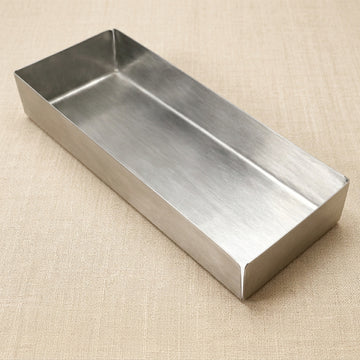
A charcoal block should never be used directly on your workbench. It gets extremely hot and can shed burning embers. A dedicated holder is not an optional accessory; it is a critical piece of safety equipment. The holder contains the block, catches any sparks or stray solder, and protects your bench from scorch marks.
A well-designed tray, such as an anti-magnetic charcoal block holder, offers several benefits. The stainless steel construction is durable and will not be damaged by the heat. The raised edges effectively contain the block and any debris. The anti-magnetic property is a subtle but important feature; it ensures that tiny steel tools, like tweezers or solder picks, are not frustratingly pulled towards the holder by residual magnetism, which can sometimes occur with other steel equipment on the bench.
Charcoal vs. Other Soldering Surfaces
While charcoal is excellent, it is wise to understand the alternatives and when they might be a better choice. The complete soldering station is often equipped with more than one type of surface.
- Charcoal Blocks: The primary choice for soldering precious metals due to the reducing atmosphere that minimises oxidation. Excellent heat reflection for efficient work. The main disadvantage is that they are consumable and will need replacing over time.
- Solderite Boards: These are durable, rigid, and asbestos-free ceramic boards. They can withstand very high temperatures and last a long time. You can pin work directly to their surface. However, they are neutral and do not provide a reducing atmosphere, so meticulous fluxing is required. They also tend to absorb more heat than charcoal, potentially requiring a hotter flame.
- Magnesia Blocks: Similar in appearance to charcoal, a magnesia block is a brilliant white, lightweight block with an extremely high melting point. It is an outstanding heat reflector, even more so than charcoal. This can be a double-edged sword; it is superb for work that needs a lot of heat, like platinum soldering, but can make it easy to overheat delicate silver work. It does not offer a reducing atmosphere.
- Soldering Bricks (Firebricks): These are porous, insulating bricks, the same kind used in kilns and forges. They are inexpensive, stable, and great for building larger soldering hearths for annealing large pieces of metal. However, for small-scale jewellery soldering, they act as a significant heat sink, drawing warmth away from the workpiece and making it difficult to reach soldering temperature efficiently.
For most silver and gold jewellery making, a charcoal block is the superior day-to-day choice, with a Solderite board serving as a useful, durable partner for jobs where pinning is required.
Basic Soldering Technique on a Charcoal Block
Using a charcoal block is straightforward. The process follows the fundamental steps of soldering, enhanced by the block's properties. For a comprehensive walkthrough, our silver soldering first-time guide provides a detailed breakdown.
- Prepare Your Workspace: Place your charcoal block in its holder on a fireproof surface. Ensure your ventilation is on and you have a quench bowl of water nearby.
- Position the Workpiece: Arrange the clean, degreased metal parts on the block. If necessary, carve a small groove or niche to hold the piece steady. Ensure the join is perfectly flush.
- Apply Flux: Liberally apply flux to the entire piece, especially the join area. The flux will help prevent oxidation and indicate temperature as you heat the metal.
- Place Solder Paillons: Using fine tweezers, place small pieces of solder (paillons) along the join. You can often tuck them into the join for a neater result.
- Heat the Piece Evenly: Using an appropriate torch, begin heating the entire piece, not just the join. Use a large, gentle, 'bushy' flame, keeping the torch moving. The charcoal will reflect heat from below, helping the piece come to temperature uniformly.
- Watch for the Flow: As the piece reaches temperature, the flux will turn clear, and the metal may begin to glow faintly. Focus a little more heat around the join area, and the solder will flash and flow along the seam, drawn by the heat and the flux.
- Quench and Pickle: Once the solder has flowed, remove the flame. Allow the piece to cool for a moment before using tweezers to pick it up and quench it in the water bowl. This will cool it and may remove some investment from casting. The final step is to place it in a warm pickle solution to remove the flux and any surface oxidation.
Safety at the Soldering Station
Working with high temperatures necessitates a strict adherence to safety protocols. A charcoal block, while a tool, is also a fire hazard if not managed correctly.
Ventilation
This is non-negotiable. Heating metal and flux produces fumes that should not be inhaled. A proper extraction system, whether a dedicated fume extractor or a well-ventilated room with an open window and cross-breeze, is essential.
Fire Safety
Your soldering station must be located on a fireproof surface. A steel sheet, large ceramic tile, or a purpose-built soldering hearth are all good options. Keep flammable materials well away from the area. Always have a fire extinguisher rated for your workshop type nearby, as well as a bucket of water which serves for both quenching and as a first line of defence against small fires.
Personal Protective Equipment (PPE)
Always wear safety glasses to protect your eyes from chemical splashes and flying debris. Avoid loose clothing and tie back long hair. Using a range of Jewellery Making Tools requires constant attention to personal safety.
Maintenance and Lifespan
With proper care, you can extend the life of your charcoal blocks and keep your soldering area clean and efficient.
How Long Does a Charcoal Block Last?
The lifespan of a block depends on the type of charcoal, the intensity of your torch flame, and how frequently you solder. A compressed block used for small jobs might last for years, while a soft willow block used for large silver pieces might be consumed in a few months. The block should be replaced when it becomes too thin, develops major cracks that threaten its integrity, or the surface is so pitted that it's no longer useful. A cracked block can fall apart when heated, which is a significant safety risk.
Cleaning and Care
Over time, the surface of your block will become uneven and coated with residual flux. You can easily refresh it by rubbing it face-down on a sheet of coarse sandpaper placed on a flat surface. This will level the block and expose a fresh, clean surface. Do this outdoors or over a bin to contain the black dust. Your stainless steel holder can be cleaned with soap and water. Occasionally, you may need to scrape off hardened flux residue.
Key takeaways
- Charcoal blocks create a reducing atmosphere that actively prevents firescale on silver and gold, leading to cleaner solder joins.
- The block's ability to insulate and reflect heat ensures the workpiece heats evenly and efficiently, which is critical for a successful solder flow.
- Choose from willow (soft, easy to carve), hardwood (durable all-rounder), or compressed (longest-lasting) charcoal based on your specific needs.
- Always use a charcoal block within a fireproof holder or tray to protect your bench and contain sparks and debris.
- While charcoal is ideal for most precious metal work, surfaces like Solderite and magnesia blocks have specific uses for which they are better suited.
- Regularly flatten the surface with sandpaper to extend the block's life and replace it when it becomes cracked or too thin.
The charcoal block is a simple but powerful tool. Understanding its properties and integrating it correctly into your workflow will elevate the quality and efficiency of your soldering. To equip your bench, explore our selection of blocks, holders, and torches in the Toolsmith collection.
Explore our full range of Soldering Tools to find the right setup for your UK workshop.
Related guides
- Goldsmith's Soldering: Yellow, White & Rose Gold Without Pitting
- Bench Fire Safety: A UK Silversmith's Essential Guide
- Jewellery Soldering Torches: Choosing Your First Bench Torch
- Bench Organisation: Tool Racks, Stands & Storage
- Soldering Bench Accessories: Torch Stands, Third Hands & Titanium Picks
Frequently asked questions
What charcoal block should I buy for soldering silver jewellery?
A hardwood charcoal block is the default all-rounder: durable, heat-reflective and still carvable. Choose soft willow if you need to carve custom supports for delicate pieces, or a compressed block for the longest life and a consistently flat surface. A 100mm x 75mm x 25mm block suits most common jewellery tasks; keep a smaller 75mm block for jump rings and findings.
Why use a charcoal block instead of a Solderite board or firebrick?
As charcoal heats it consumes oxygen around the workpiece, creating a reducing atmosphere that minimises firescale on silver and gold — something neutral Solderite boards and magnesia blocks cannot do. Charcoal also reflects heat back into the metal for faster, more even heating, whereas porous firebricks act as a heat sink and are better suited to annealing larger pieces.
How long does a charcoal soldering block last?
It depends on the charcoal type, flame intensity and how often you solder: a compressed block used for small jobs can last years, while a soft willow block used for large silver work may be consumed in months. Refresh the surface by rubbing it flat on coarse sandpaper, and replace the block once it becomes thin, badly pitted or cracked — a cracked block can fall apart when heated.