Quick answer: For a first Damascus knife, choose a 50–80mm fixed-blade skinner with a twist or ladder pattern — most working blades sit at 120–300 layers and 58–60 HRC, which is the practical sweet spot. Pick camel bone or pakkawood for a traditional feel, micarta if you’ll actually use it, and buy from a UK stockist: the knife ships from UK stock, and knives are sold to adults aged 18 or over only.
Damascus steel knives are the most distinctive blades in any collector's drawer. The pattern in the steel is real — a result of folding two different steels together dozens of times during forging — and no two pieces are exactly alike. This guide is what we tell UK customers who are choosing their first piece, or adding to a collection.
What "Damascus" actually means
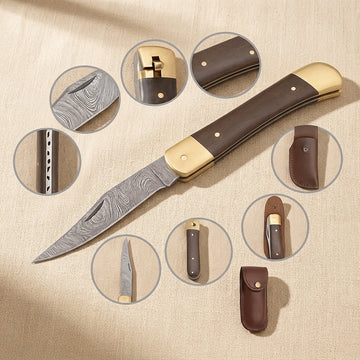
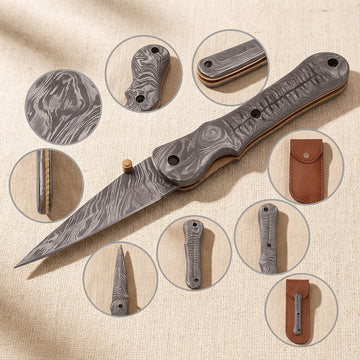
Modern Damascus steel is a pattern-welded laminate: typically 1095 high-carbon and 15N20 nickel-bearing steel, folded together through repeated heating, hammering, and acid-etching. The acid stage is what reveals the pattern — the two steels etch at different rates, leaving the contrasting bright/dark bands you see on the finished blade.
Important to know: it's not the same as the legendary "wootz Damascus" of medieval Syria (that material was crucible steel, not pattern-welded, and the technique was lost for centuries). Today's Damascus is its own thing — beautiful, functional, hand-made.
The four pattern types you'll see most
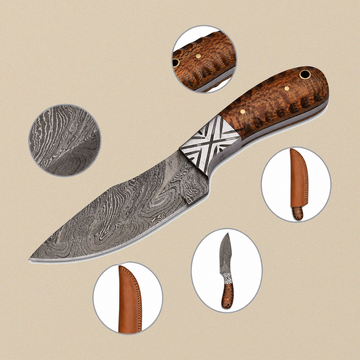
- Twist — the steel rod is twisted before forging, producing tight diagonal bands. Looks like rope or a barber's pole. The most common and most visually busy pattern.
- Fire (or feather) — long flowing waves down the blade, like flames. Made by repeatedly hammering grooves into the billet then grinding flat.
- Ladder — horizontal lines running across the blade. Made by milling regular grooves into the billet edges before final forge. Clean, precise look.
- Raindrop (mosaic) — circular spots scattered through the steel. Drilled into the billet then forge-welded. The hardest to make and most prized.
Layer count — what does "120 layers" mean?
Layer count is what you see in the pattern density. Each fold doubles the layer count: 7 folds = 128 layers, 8 = 256, 9 = 512. Most working knives sit at 120-300 layers. Higher counts (>500) tighten the pattern visually but add little structurally beyond ~300.
Don't get too hung up on it. Pattern beauty matters more than the absolute number, and a well-forged 120-layer blade outperforms a sloppy 1000-layer one.
Hardness — HRC numbers explained
Damascus blade hardness is given as HRC (Rockwell C). UK kitchen and utility blades typically run 56-62 HRC:
- 56-58 HRC — softer, easier to sharpen, better for chopping. Found on choppers and outdoor blades.
- 58-60 HRC — the sweet spot for fixed-blade utility knives and skinners.
- 60-62 HRC — harder edge, holds longer, slightly more brittle. Found on slicing knives and daggers.
Handle materials — what they actually feel like
- Pakkawood — laminated hardwood, water-resistant, low maintenance. Best beginner choice.
- Camel bone or buffalo horn — traditional, develops patina, slightly cool to the touch. Avoid prolonged water immersion.
- Micarta — phenolic-resin laminate, indestructible, grippy when wet. Modern preference for working blades.
- Brass + rosewood combination — heavier feel, classic look, traditional UK gun-room aesthetic.
- Mosaic pin handle — decorative pins set into the scales for collector pieces. Beautiful but harder to clean.
Sizing — choose by use case, not by ego
- 50-80mm blade — small craft, leather and detail work.
- 80-120mm blade — utility, outdoor, light hunting / skinning. The sweet spot for most working blades.
- 120-200mm blade — large hunters, daggers, kitchen blades.
- 200mm+ — collector or kitchen.
Blade length never makes a fixed-blade knife legal to carry in public — see the legal section below.
UK legal context — buy informed
GOV.UK sets out the basic rules on buying and carrying knives:
- It is illegal to carry most knives in public without a good reason, and illegal to sell most knives to anyone under 18. The exception to both rules is a folding pocketknife that has a cutting edge no longer than 3 inches (7.62 cm) and is not a lock knife. A fixed-blade knife is never covered by that exception, whatever its length.
- In England and Wales it is an offence to carry any bladed or sharply pointed article in a public place without good reason or lawful authority (Criminal Justice Act 1988, s.139). The only exception is a folding pocketknife that is not a lock knife and has a cutting edge of 3 inches (7.62 cm) or less.
- The Act gives carrying the knife for use at work, for religious reasons or as part of any national costume as examples of a good reason. If you are charged, a court decides whether your reason was good enough.
- Some knife types are banned outright: it is illegal to possess, sell or give them. GOV.UK lists them.
- Toolsmith sells knives to adults aged 18 or over only. How bladed orders are delivered is set out in our UK Knives & Axes Guide.
This is a summary, not legal advice. Primary sources: GOV.UK — Selling, buying and carrying knives and weapons and Criminal Justice Act 1988, section 139. If in doubt, don't carry: keep the knife at home unless you have a good reason to have it with you.
Caring for a Damascus blade
- Wipe the blade with a clean cloth after every use to remove acids and oils from your hand.
- If used on food (acidic juice, etc), wash with mild soap, rinse, dry immediately.
- Apply a thin film of camellia oil, mineral oil, or 3-in-1 every few months — Damascus's high-carbon layers will rust without protection.
- Sharpen with a coarse-to-fine stone progression (600 → 1000 → 3000 grit). Avoid powered grinders that will erase the pattern.
- Store in the leather sheath (away from prolonged moisture) or on a magnet rack — never in a damp drawer.
Why buy from a UK supplier
Our Damascus knives are made in Pakistan and ship from UK stock, so a UK order has no import customs to clear. We aim to dispatch orders placed before 2pm UK time, Monday to Friday, the same working day, and knives are sold to adults aged 18 or over only. See the current range in our Damascus knives collection, or browse the wider Damascus knives, axes and razors range.
Where to start
If this is your first Damascus piece:
- Pick a 50-80mm fixed-blade skinner — easy to handle, beautifully patterned and useful for craft and leather work.
- Camel bone or pakkawood handle for traditional feel; micarta if you'll actually use it.
- Twist or ladder pattern (visually distinctive without being overwhelming).
Our 76mm camel-bone skinner is exactly this profile — a good first Damascus.
Question about a specific piece, layer count, or pattern? Email info@toolsmithltd.co.uk — we'll send extra macro photos of the actual piece you're considering.
Related guides
- How to Sharpen Damascus Knives with Whetstones
- Mosaic Pins: A UK Guide to Selection and Installation
- D2 Tool Steel Knives: What UK Makers & Buyers Should Know
- Damascus Axes & Hatchets: A UK Buyer's Guide
- Skinner Knives: Blade Shapes, D2 vs Damascus & Field Care
Frequently asked questions
Which Damascus knife should I buy first?
A 50–80mm fixed-blade skinner is the ideal first piece: easy to handle, genuinely useful for craft and leather work, and beautifully patterned. Remember that the UK's 3-inch carry exception covers only non-locking folding pocketknives, never fixed blades. Choose a twist or ladder pattern for a distinctive look, with a camel bone or pakkawood handle for traditional feel — or micarta if the knife will see real work.
Does a higher layer count make a Damascus knife better?
Not really. Most working knives sit at 120–300 layers, and counts above roughly 300 tighten the pattern visually while adding little structurally. A well-forged 120-layer blade will outperform a sloppy 1,000-layer one, so judge the quality of the forging and the beauty of the pattern rather than chasing the biggest number on the listing.
Is it legal to own a Damascus knife in the UK?
Yes, as long as it is not one of the knife types banned outright (GOV.UK lists them). It is illegal to sell most knives to anyone under 18, and Toolsmith sells knives to adults aged 18 or over only. In England and Wales it is an offence to carry any bladed or sharply pointed article in a public place without good reason or lawful authority (Criminal Justice Act 1988, s.139). The only exception is a folding pocketknife that is not a lock knife and has a cutting edge of 3 inches (7.62 cm) or less.