Quick answer: For a first Damascus hatchet that will actually get carried, the 8–9 inch class with a wooden handle is the sweet spot — light enough for a belt or pack, capable of kindling, feathersticks and camp craft. For a camp woodpile tool, go to the 15.5-inch hatchet or a full axe for leverage. Sales are 18+, UK addresses only.
A hand-forged Damascus hatchet is one of those objects that gets bought twice — once for the pattern, and again, mentally, the first time it bites into seasoned oak and stays sharp. But between 8-inch camp hatchets and full-length axes, walnut and bull-horn handles, and UK law on bladed and pointed items, there are real decisions to make. This guide walks through them.
Hatchet or axe: size decides the job
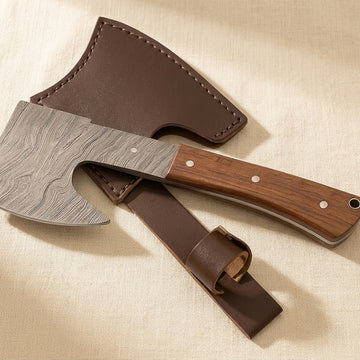
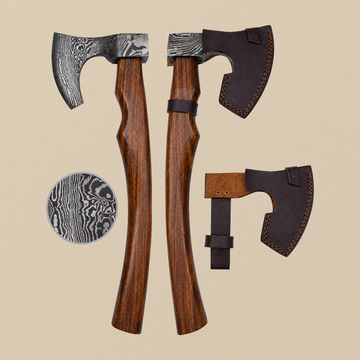
The line is simple: a hatchet is swung with one hand, an axe with two. Compact 8–9 inch (around 20–23 cm) hatchets live on a belt or in a pack — kindling, feathersticks, camp craft, game work. At the top of the hatchet class, a 15.5-inch model swings with real authority for limbing and splitting small rounds while still working one-handed. Beyond that you are into axe territory, where a longer haft adds leverage for felling cuts and heavier splitting. For a first buy that will actually get carried, the 9-inch class is the sweet spot; for a woodpile tool that stays at camp, go long.
What the Damascus edge brings
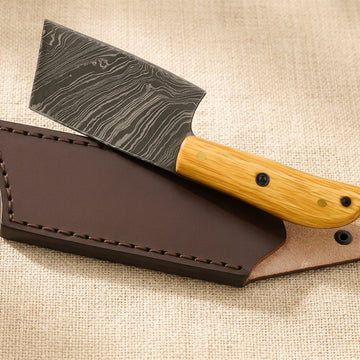
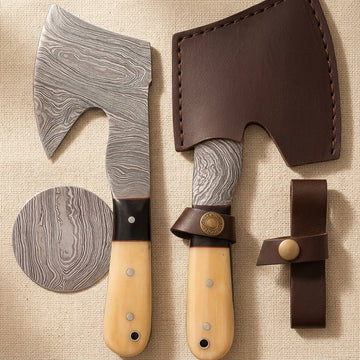
These heads are forge-welded from many alternating layers of steel — 246+ layers on some of our axes — then etched so the banding shows. The pattern is not just decoration: the lamination process produces a tough body that absorbs shock, around a hard cutting edge that takes and holds keen sharpness. In use that means a hatchet that resists chipping on knots but still shaves curls for a firelighter's featherstick. The same care rules as Damascus knives apply — the etched finish is a living surface, so it wants wiping dry and oiling rather than neglect.
Handles: walnut, exotic hardwoods, horn and bone
Most of the range hangs the head on walnut or exotic hardwood — the traditional choice, shock-absorbent, and easy to refinish with a little oil. Brass fittings and spacers dress the joint on premium models. Bull horn and bone handles turn a working hatchet into a display-grade piece; they are dense and beautiful but appreciate being kept out of prolonged damp. Whatever the material, check the head-to-handle fit stays tight and store the tool out of its sheath in a dry room — leather holds moisture against steel.
The sheath and the law
Every axe and hatchet here ships with a fitted leather sheath, and it earns its keep in transport and storage. On the legal side, UK rules treat axes as bladed articles: sales are 18+ with age verification on delivery, we ship them to UK addresses only, and carrying one in a public place requires a reasonable excuse — a camping trip with kit, yes; a glovebox resident, no. Between uses it belongs in your home or with your camp equipment. Our knives & axes guide covers the full policy.
Choosing in one minute
- Pack and belt work: 8–9 inch hatchet, wood handle — light, capable, carried.
- Camp woodpile: 15.5-inch hatchet or a full axe — leverage for splitting.
- Gift or display with working credentials: horn/bone handle, high layer count.
Each piece is individually forged, photographed and shipped from UK stock — browse the current axes and hatchets below.
Related guides
- Shop Damascus Axes & Hatchets →
- Choosing a Damascus Knife: A UK Buyer's Guide
- Damascus Steel Patina, Rust & Daily Care
- Damascus Knife Sharpening & Whetstones: A UK Guide
Frequently asked questions
What size Damascus hatchet or axe should I buy?
A hatchet swings with one hand, an axe with two. For a first buy that gets carried, the 8–9 inch (20–23 cm) class is the sweet spot: belt or pack carry for kindling, feathersticks, camp craft and game work. The 15.5-inch hatchet or a full-length axe adds the leverage for limbing, splitting and the camp woodpile.
Is the Damascus pattern on an axe head just decoration?
No. The heads are forge-welded from many alternating layers of steel — 246+ on some — which produces a tough, shock-absorbing body around a hard cutting edge that takes and holds keen sharpness. In use that means resisting chips on knots while still shaving featherstick curls. The etched finish is a living surface: wipe it dry and oil it.
What are the UK legal rules for buying and carrying an axe?
UK rules treat axes as bladed articles: sales are 18+ with age verification on delivery, shipped to UK addresses only. Carrying one in a public place requires a reasonable excuse — a camping trip with kit qualifies; a glovebox resident does not. Between uses it belongs at home or with your camp equipment, stored out of its leather sheath.