Quick answer: Most benches do well with three tweezers: a fine-point stainless soldering pair, cross-locking (reverse-action) tweezers that grip without being held, and a curved or grooved diamond tweezer for setting stones. Buy the soldering pair in titanium if you can — it barely conducts heat and solder will not stick. Add a leather-lined ring clamp early to protect finished work.
Ask a bench jeweller which tool they reach for most and "tweezers" rarely makes the list — yet a soldered joint, a set stone or a clean pickle lift all depend on holding work precisely, often near a flame. The right tweezer is the difference between a part that sits where you placed it and one that springs across the bench. This guide runs through the four tweezer types a UK jeweller actually uses, plus the locking clamps that free up a hand, and how to judge quality before you buy.
Soldering tweezers: the bench workhorse
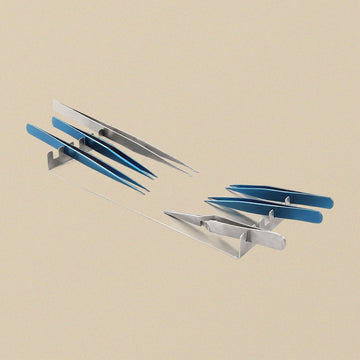
Fine-point soldering tweezers position pallions and hold small parts steady while you bring up heat. Because they live near the torch, the metal matters: stainless steel resists scale and pickle far better than mild steel, while titanium is the upgrade — lighter, it barely conducts heat back to your fingers and solder will not stick to it. Look for tips that meet along their full length with no daylight between them, and a sprung action that returns crisply.
Cross-locking (reverse-action) tweezers
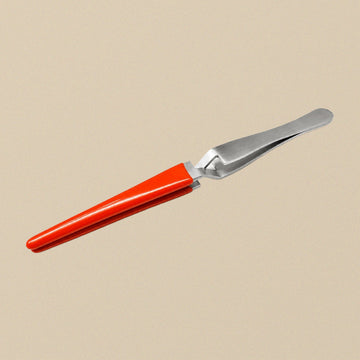
Cross-locking tweezers grip when relaxed and release when squeezed — so they hold a ring or a chain link closed without you holding them. They are indispensable for soldering jump rings and for any joint where you need both hands. Many have an insulated fibre grip so you can pick the piece straight out of a hot solder block. A pair with a soldering stand or "third hand" base turns one tweezer into a fixed clamp.
Diamond and stone-setting tweezers
Diamond tweezers have a fine groove or serration cut into the tips that cradles a small stone by its girdle, so it does not ping away when you place it in a setting. Curved-tip versions let you see past your fingers into the work. These want a softer, more precise spring than soldering tweezers — you are positioning, not gripping.
- Fine-point: general pickup, placing solder, lifting findings.
- Curved: working into bezels and around stones where a straight tip blocks the view.
- Fibre-grip / insulated: handling hot work straight off the block.
Clamps, ring clamps and third hands
A wooden ring clamp with a leather-lined jaw holds a ring while you file, set or polish, sparing the metal from marks. A third-hand base holds cross-locking tweezers at any angle for soldering, and a small pin vice or hand vice grips wire and tube for cutting and filing. None are glamorous, but each one returns a hand to you — and a held workpiece is a safe workpiece.
How to judge quality before you buy
Hold the tweezer to the light and check the tips close cleanly with no gap and no cross-over. Squeeze and release a few times: the action should be even and springy, not stiff or floppy. Inspect the tips under a loupe for grinding marks or burrs that will mar soft metal. Stainless and titanium cost more than mild steel for good reason near a flame — for soldering, it is money well spent.
Building a starter set
Most benches do well with three: a fine-point stainless soldering tweezer, a pair of cross-locking tweezers (with a stand if your budget stretches), and a curved or diamond tweezer for setting. Add a leather-lined ring clamp early — it protects everything you have already made. Buy the soldering pair in titanium if you can; you will feel the difference on every joint.
For where tweezers sit in the wider toolkit — pliers, saws, files and more — see our bench essentials guides, and browse the full range below.
Related guides
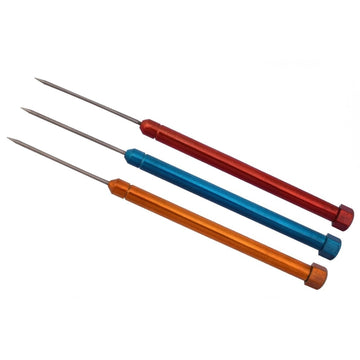
- Soldering Bench Accessories: Torch Stands, Third Hands & Titanium Picks
- Shop Tweezers & Clamps →
- Watchmaker Tweezers: AA, 3C, 5 — Anti-Magnetic, Brass & Carbon
- Soldering Silver for First-Time UK Bench Jewellers
- Pliers Identifier: 7 Plier Types Every Bench Jeweller Should Know
Frequently asked questions
What jeweller's tweezers do I need for a starter bench?
Three cover most work: a fine-point stainless soldering tweezer for placing solder and lifting findings, cross-locking tweezers for holding joints while both hands are busy, and a curved or diamond tweezer for stone setting. Add a leather-lined ring clamp early — it protects everything you have already made — and a third-hand base if your budget stretches.
Are titanium soldering tweezers worth it over stainless steel?
For soldering, yes. Titanium is lighter, barely conducts heat back to your fingers, and solder will not stick to it — you feel the difference on every joint. Stainless steel remains a sound choice and resists scale and pickle far better than mild steel, which is the one to avoid near a flame. Either way, check the tips meet with no daylight between them.
How do cross-locking tweezers work and when do I use them?
Cross-locking (reverse-action) tweezers grip when relaxed and release when squeezed, so they hold a ring or chain link closed without you holding them — indispensable for soldering jump rings and any joint needing both hands. Many have insulated fibre grips for lifting hot work straight off the block, and mounted in a third-hand base they become a fixed clamp.