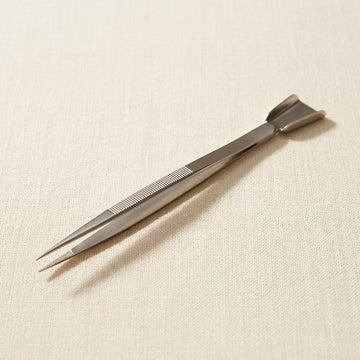
Quick answer: Build a five-pattern set: a Number 5 as the workhorse, a 3C for the finest placements, an AA reserved solely for hairsprings, brass tweezers for hands, dials and polished parts, and anti-magnetic carbon-tipped tweezers for balance work. A Vetus-based starter set costs about £40; upgrade the AA to a Dumont when budget allows. Never touch a hairspring with a Number 5.
Key difference: the Number 5 is the workhorse; the 3C and AA are progressively finer for tiny parts and hairsprings; brass and carbon tips protect finishes and avoid magnetism.
| Tweezer | Tips | Use for | Caution |
|---|---|---|---|
| Number 5 | Long, straight, very slim | About 80% of movement work: train wheels, bridges, pallet forks, screws | Never on a hairspring |
| 3C | Needle-fine points | The smallest parts, such as cap jewels | Not for handling screws |
| AA | Exceptionally fine, long and tapered | Hairsprings only | Dropping it will almost certainly misalign the tips |
| Brass | Soft, non-magnetic brass | Hands, dials, plated parts and finished cases; batteries | Will not hold a point like steel |
| Anti-magnetic carbon | Steel body with carbon or fibre tips | Work on or around the hairspring and balance | Less give at the very tip than steel |
Peer over the shoulder of any working watchmaker, and you’ll see a fan of tweezers laid out on their bench. Not one, not two, but often five, six, or more. This isn’t a sign of indecision; it’s a mark of professionalism. In horology, there is no single tweezer that can do every job. Using the wrong tool isn’t just inefficient, it’s actively dangerous. The wrong tweezer will scratch a mirror-polished escape wheel, permanently magnetise a delicate hairspring, or gouge a freshly lapped case. For the enthusiast moving from simple strap changes into their first Seiko NH35 or ETA 2824 service, understanding your tweezers is as fundamental as understanding how a balance wheel oscillates. This is your guide to building a working set that will serve you from your first movement to your fiftieth.
Why tweezers are graded by number, not size
When you first enter the world of watchmaking tools, the numbering system for tweezers can seem arcane. Unlike screwdrivers, which are measured in millimetres, tweezers follow a convention established by the great Swiss manufacturers like Dumont, and now adopted by Bergeon, Vetus, and others. This system (00, 0, 1, 2, 3, 3C, 4, 5, 7, AA) is a grading of the tip’s profile and fineness, not its overall length.
Think of it as a scale of finesse. The lower the number, the broader and more robust the tip. A Number 1, for instance, has strong, fairly blunt tips, ideal for gripping a rotor bearing or a case clamp screw without fear of it flexing. As you move up the scale, the tips become progressively finer and more delicate. A Number 5 has beautifully slim, straight tips, whilst the legendary AA tweezer has points so fine they are almost invisible to the naked eye.
You’ll also encounter “C” variants, most commonly the Number 3C. The 'C' denotes a profile that has been sharpened to a more acute, needle-like point compared to its standard counterpart. A standard Number 3 is a general-purpose fine tweezer, but a 3C is purpose-built for tasks requiring pinpoint accuracy, like positioning a cap jewel or picking up a single link from a chaine-fusée. It offers supreme precision but at the cost of fragility; use it to pry something and you’ll be left with a Number 3C that has become a Number 3.
The five-tweezer working bench set
Whilst a professional may have a dozen specialised tweezers, the core of any bench can be built with just five distinct patterns. This set will allow you to handle virtually every component in a standard mechanical watch, from the case screws to the hairspring.
Number 5 (General Bench)
This is your workhorse. The Number 5 is the first tweezer you’ll pick up and the last you’ll put down during a service. Characterised by its long, straight, and very slim tips, it offers the perfect balance of strength and precision for 80% of movement work. It’s the tool you’ll use to place train wheels, position bridges, handle pallet forks, and manoeuvre all but the most microscopic screws. Its strength allows you to apply a small, controlled amount of pressure, whilst its fine tips provide excellent visibility of the component you’re holding. If you could only have one stainless steel tweezer for movement work, this would be it.
Number 3C (Fine Point)
When the Number 5 feels a little clumsy, you reach for the 3C. Its needle-fine points are designed for the smallest and most fiddly components on the watch. Think of placing a 0.5mm cap jewel into its setting, picking a single hair out of a jewel sink, or guiding a tiny chronograph reset hammer into position. The 3C provides unparalleled control for placement, allowing you to see exactly where the tip is and to deposit the component with absolute certainty. It is, however, delicate. These are not for general screw handling; their fine points can be damaged by the torque required to even seat a screw in its thread.
AA (Extra-Fine)
The AA is not a general-purpose tweezer; it is a highly specialised instrument for a single, terrifyingly delicate component: the hairspring. The tips are exceptionally fine, long, and tapered, designed to have minimal contact area and apply almost zero pressure. Whether you are shaping a dog-leg, correcting a bent-overcoil, or manipulating the spring through the regulator pins, the AA allows you to touch the spring without kinking it. Its delicacy is also its weakness. It must be handled with reverence. Dropping it on the floor will almost certainly misalign the tips, and using it for any other task is a recipe for disaster. It is a scalpel, not a screwdriver.
Brass Tweezers (Non-Marring, Non-Magnetic)
All the tweezers above are made of hard steel, which will scratch softer materials. That’s where brass comes in. Brass is significantly softer than steel, meaning you can use it to handle polished watch hands, pristine dials, plated movement parts, and newly refinished cases without leaving a single mark. The tweezer itself may get scratched, but that’s its job—to sacrifice itself for the integrity of the watch part. They are also inherently non-magnetic, making them a safe choice for handling batteries (as they won't cause a short circuit) and for working near the balance assembly if you don't have carbon-tipped tweezers to hand.
Anti-Magnetic Carbon (Bergeon "AM" / Vetus)
Magnetism is the silent killer of good timekeeping. A magnetised hairspring will cause the coils to stick together, dramatically shortening the effective length of the spring and causing the watch to run minutes or even hours fast per day. Whilst "anti-magnetic" stainless steel exists, it is only resistant, not fully inert. The only way to be 100% safe is to use a tweezer with no ferrous material at the tip. These tweezers typically have a standard steel body for springiness, but feature tips made of a synthetic carbon or polymer fibre. They are completely, totally, and utterly non-magnetic. For any work on or around the hairspring and balance wheel, these are not a luxury; they are a necessity for professional results.
Materials: stainless vs brass vs carbon vs titanium
The material your tweezer is made from dictates its function, durability, and price. Understanding the differences is key to choosing the right tool for the job.
Stainless Steel: This is the default material for high-quality watchmaking tweezers. However, not all stainless steel is created equal. Premium Swiss brands use special alloys (like Dumont's 'Dumoxel' or 'Dumostar') that are chosen for a specific combination of properties. They are hard enough to be sharpened to a very fine point, they resist corrosion and acids used in cleaning, and most importantly, they have excellent 'spring back'. This means that when you squeeze the shanks and release them, they return to their original position perfectly, keeping the tips aligned. This is a quality you pay for, and it's noticeably absent in cheaper tools.
Brass: As discussed, brass is the material of choice for non-marring applications. It's soft, dense, and easy to shape. It won't hold a point like steel and will wear down over time, requiring occasional dressing with a file to keep the tips flat and true. Its complete lack of magnetic properties is a significant bonus. A good set of brass tweezers will save you from costly mistakes when handling delicate, finished components like hands and dials.
Carbon-Tipped or Fibre-Tipped: The ultimate solution for working on the regulating organ. These are composite tools, usually with stainless steel bodies providing the tension and replaceable carbon fibre tips providing the contact point. They offer zero magnetism and are also resistant to high temperatures and most chemicals. The feel is slightly different from steel—they have less 'give' at the very tip—but the peace of mind they provide when working on a hairspring is invaluable. For many, they have entirely replaced the AA-pattern steel tweezer for hairspring manipulation.
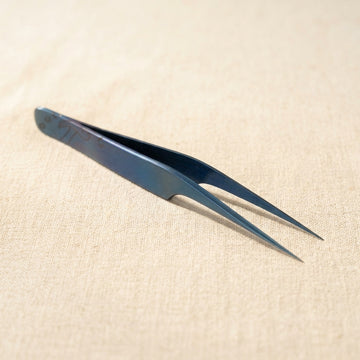
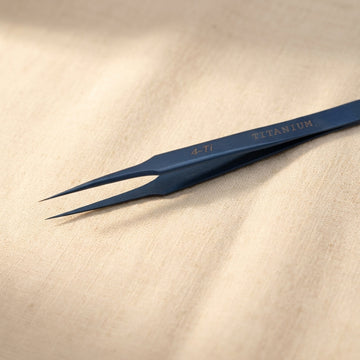
Titanium: The aerospace material of the tweezer world. Titanium is about 45% lighter than steel, exceptionally strong, and completely anti-magnetic. So why isn't everyone using it? The cost. A single titanium tweezer can cost more than a full set of Vetus steel tweezers. It also has a different feel—the lower weight can be off-putting to some, and it doesn't have the same 'springiness' as high-grade steel. It remains a niche choice, favoured by those who need its specific properties and are willing to pay a significant premium.
Brand reality: Dumont vs Bergeon vs Vetus vs Horotec vs budget tweezers
On the bench, the difference between a £5 tweezer and a £50 tweezer becomes immediately apparent. Here’s a frank assessment of the brands you’re likely to encounter in the UK.
Dumont (Swiss, since 1791): This is the gold standard. To hold a Dumont tweezer is to understand fine toolmaking. The finishing is flawless, the balance is perfect, and the proprietary steel alloys they use are engineered for a lifetime of use. The tips meet with a precision that has to be felt to be believed. They are an investment, with prices ranging from £40 to over £90 per tweezer, but for the career horologist or the serious enthusiast, they are a "buy once, cry once" purchase.
Bergeon (Swiss): If Dumont is the artist's brush, Bergeon is the master craftsman's chisel. A trade industry favourite, Bergeon tweezers are slightly more rugged and industrial in feel than Dumonts, but no less capable. They are built to withstand the rigours of a busy workshop day in, day out. Their range is vast, covering every conceivable pattern and material, including their excellent carbon-tipped "AM" series. Expect to pay £35-80 for a high-quality Swiss-made tool that will not let you down.
Vetus (Chinese, professional): Vetus has been a game-changer for students and enthusiasts. They offer professional-grade tools at a fraction of the Swiss price (£8-20). Whilst the final finish might not have the jewel-like quality of a Dumont, the most important aspects—the tip geometry and the quality of the steel—are excellent for the price. They hold a point well and offer great performance. It's no surprise they are a favourite of BHI (British Horological Institute) trainees. They allow you to build a full, functional set without a monumental investment.
Horotec: Another solid Swiss brand, Horotec produces a wide range of watchmaking tools. Their tweezers are generally considered good mid-tier options, reliable and well-made, though they are perhaps less specialised in tweezers than Dumont or Bergeon.
Budget tweezers (about £3–10): These are often bundled in starter kits. Check them before trusting them on a movement: the tips should meet cleanly along their length with no gap or cross-over, keep their shape under light pressure and come to a clean point. Soft steel tips bend, splay and lose their point quickly under serious bench use, and a splayed tip can slip and scratch a bridge in an instant. Tweezers that fail those checks are still fine for coarse work such as removing spring bars or handling case parts.
Toolsmith's range: our tweezers are made in Pakistan. The range includes titanium anti-magnetic tweezers in 3C, 4, 5, 5A, 5AR and 7 patterns, brass tweezers and stainless steel tweezers; current prices are shown below. Check any tweezer, ours included, against the points above before using it on a movement.
Why you should never use Number 5 on a hairspring
A common first-service mistake is to reach for a Number 5 to nudge a hairspring that sits slightly off-centre in the regulator pins, usually while re-seating the balance assembly. Next to the hairspring coil, the tip of a Number 5 is far too heavy: the slightest pressure can kink the spring and throw the coil out of flat, and a kinked hairspring can take hours to correct with a proper AA tweezer and a loupe. The AA tweezer exists for this exact reason. Its slender, delicate profile allows you to get between the coils and apply force so gently that the spring moves without bending. The Number 5 is a sledgehammer in this context; the AA is a surgeon's scalpel.
Sharpening and dressing tweezers
Even the best tweezers will wear over time. Tips can become rounded, bent, or splayed. A few minutes of maintenance can bring them back to life.
If the tips have splayed slightly or become blunt, they need dressing. Hold the tweezer so the outside face of one tip is perfectly flat against a fine diamond stone or Arkansas stone. With light pressure, draw the tweezer backwards a few times. Repeat on the other side, ensuring you maintain the original angle. The goal is to create two perfectly flat, sharp faces that meet without any gap. Check your work by holding the tips up to a light source; no light should pass through.
If the tips are aligned but don't meet with the right tension, you can gently squeeze the shanks about halfway down their length to bring them closer. Do this in small increments; it’s easy to go too far.
So, when is a tweezer beyond saving? If there is a visible bend or kink in the metal of the shanks, it will likely never hold its alignment again. If the tips are so splayed that dressing them would require removing a significant amount of material, it's time for a replacement. And crucially, if a steel tweezer has become heavily magnetised and you don't have a demagnetiser, it is a liability to your work and should be retired from movement service.
Magnetism: the silent enemy
Magnetism is a pervasive and frustrating problem in watchmaking. Your steel tweezers can easily pick up a magnetic charge from a multitude of sources on and around your bench: screwdriver bits, the motors in polishing machines, tool drawers with magnetic closures, even the speaker on your phone.
You’ll realise you have a problem when you try to place a tiny steel screw and it stubbornly clings to the end of your tweezer, refusing to drop into its hole. The real danger, however, is the transference of this magnetism to the watch's balance assembly. A magnetised hairspring is the most common cause of a mechanical watch suddenly running extremely fast. The magnetic charge causes the delicate coils to stick to one another, effectively shortening the spring and increasing its rate of oscillation.
The solution is two-fold. First, any steel tool that comes near a movement should be regularly demagnetised. This is done by passing the tool through the field of a watchmaker's demagnetiser. (You can learn more in our guide to demagnetisers). Second, and more effectively, you can solve the problem at the source by using the right tool for the job. For any work involving the hairspring, a set of anti-magnetic carbon or fibre-tipped tweezers is not optional. It is the professional standard and the only way to guarantee you are not introducing magnetism into the most sensitive part of the watch.
The enthusiast £40-90 first set
Building your first set can be daunting. Here are three recommended paths. Toolsmith does not sell the Vetus, Dumont or Bergeon tweezers named below; our own tweezers are shown with live prices at the end of this guide.
Budget Set (£40): This is the enthusiast's starting point, offering maximum capability for the price.
- Vetus Number 5
- Vetus Number 3
- Vetus AA
- A good quality brass tweezer
Standard Set (£70-90): The smart upgrade path. Spend your money where it matters most.
- Vetus Number 5 (The workhorse doesn't need to be Swiss)
- Dumont AA (Invest in the best for hairspring work)
- Bergeon Brass Tweezer
- Vetus 3C (for fine work)
Pro Set (£180+): For the career horologist or the no-compromise enthusiast.
- Dumont AA
- Dumont 3C
- Bergeon 5
- Bergeon Brass Tweezer
- Bergeon Anti-Magnetic Carbon Tipped Tweezer
Dispatch from UK stock
Toolsmith does not sell the Dumont, Bergeon, Vetus or Horotec tweezers discussed above; our own tweezers are made in Pakistan and shown below. Everything we sell ships from UK stock, and we aim to dispatch orders placed before 2pm UK time, Monday to Friday, the same working day.
Related guides
- Watch Repair Toolkit Under £60: Your First Set
- Watch Demagnetisers: A UK Guide to Buying and Using One
- Watchmaker's Loupe Buying Guide: 10× vs 20×
- Watchmakers' Screwdrivers: Sets, Sizes & Sharpening
- Jeweller's Tweezers & Clamps: Soldering, Locking & Diamond Types
- Shop all Tweezers & Clamps
- First Leather Watch Strap Build — UK Kit Walkthrough
Frequently asked questions
Which watchmaker tweezers should I buy first?
A budget set of around £40 covers your first services: a Vetus Number 5 as the workhorse, a Vetus Number 3 for fine work, a Vetus AA for hairsprings, and a good-quality brass tweezer for hands, dials and polished parts. The smart upgrade path is a Dumont AA — spend the extra where the most delicate component is at stake.
What do watch tweezer numbers like 5, 3C and AA mean?
The Swiss numbering system grades the tip's profile and fineness, not the tweezer's length. Lower numbers have broader, more robust tips; higher numbers get progressively finer. A 'C' suffix means the tip is sharpened to a more acute, needle-like point, and AA is the extra-fine pattern reserved for hairspring manipulation.
How do I stop my tweezers magnetising watch parts?
Pass steel tools regularly through a watchmaker's demagnetiser — they pick up charge from screwdriver bits, motors, magnetic drawer closures and even phone speakers. Better still, remove the risk at source: use carbon or fibre-tipped anti-magnetic tweezers for any work near the hairspring and balance, and brass tweezers, which are inherently non-magnetic.