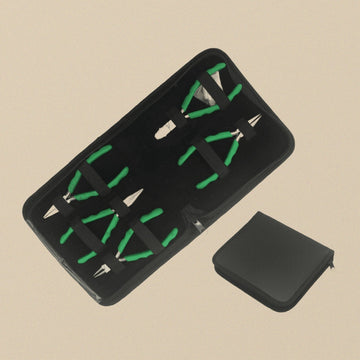
Quick answer: Start with the trio — round-nose for loops and wire forming, chain-nose for jump rings and pinching, flat-nose for gripping and sharp bends — around £30–£60 for a quality UK-supplied set. Add bent-nose and parallel-action pliers once you start hitting their use cases, and buy round-and-concave or crimping pliers only when a specific job calls for them.
Pliers are the most-confused jewellery tool. Round-nose and chain-nose look similar from across the bench. Flat-nose and parallel-action seem interchangeable until you try them. This is the field guide that should come with every starter kit.
1. Round-nose pliers
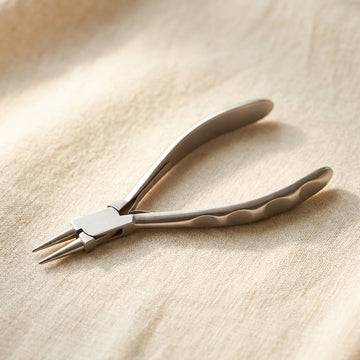
Two tapered cylindrical jaws. The dedicated tool for forming loops, jump rings and clean curves in wire. The taper means you can pick a diameter by gripping further up or down the jaw — small loops near the tip, larger loops near the joint.
Use it for: head pins, ear hooks, scroll work, jump-ring forming.
Don't use it for: gripping flat sheet (it'll mark the surface) or pulling wire taut.
2. Chain-nose pliers
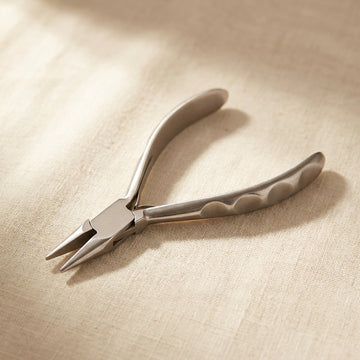
Tapered jaws with flat inside surfaces and a rounded back. The jewellery workhorse — pinches, opens jump rings, holds findings, gets into tight corners.
Use it for: opening/closing jump rings (one chain-nose in each hand, twist sideways not pull apart), pinching crimp beads, holding small components for soldering.
Don't use it for: wire forming (use round-nose) or as a hammer.
3. Flat-nose pliers
Wide rectangular jaws with flat inside surfaces. For gripping and right-angle bending. Different to chain-nose: flat-nose is for parallel work, chain-nose is for pointed work.
Use it for: bending sheet to a sharp angle, holding work flat in a vice grip, straightening bent wire by drawing it through the closed jaws.
Don't use it for: curved forming or accessing tight spaces.
4. Bent-nose (chain-nose with a 45° bend)
Same shape as chain-nose but the jaws angle off the handle axis. The angle keeps your fingers out of the way of fine work — you can see what you're pinching without your hand blocking the view.
Use it for: chain assembly, ear-wire bending, tight-corner pinching where straight chain-nose blocks the line of sight.
5. Parallel-action pliers
Jaws that stay parallel as they close (rather than pivoting on a single hinge, the jaws slide in linkage). Means even pressure across the work, no twisting.
Use it for: straightening wire, bending tabs square, holding work without crushing — anywhere even pressure matters more than power.
The killer feature: wire run through closed parallel-action jaws comes out dead straight.
6. Round-and-concave-nose pliers
One round jaw, one concave (half-pipe) jaw. The two jaws together form a near-perfect circle. This is the tool for forming larger ring shapes, anticlastic curves, and bangles without crushing the cross-section flat.
Use it for: bangle forming, anticlastic work, larger-diameter loops where round-nose alone deforms the wire.
7. Crimping pliers
Two-stage jaws specifically for closing crimp beads on beading wire. The first stage flattens the bead onto the wire; the second stage folds it into a U. Result: a strong, neat finish that clamps without cutting through the wire.
Use it for: beading wire ends, multi-strand chain finishing.
Don't substitute: using flat-nose to flatten a crimp bead works once and slips on the wire under load. Use proper crimping pliers.
What to buy first
A starting bench needs the trio: round-nose, chain-nose, flat-nose. Add bent-nose and parallel-action when you start hitting their use cases. Round-and-concave and crimping are job-specific — buy when needed.
- Trio (round + chain + flat): ~£30–£60 for a quality UK-supplied set
- Plus bent and parallel: ~£60–£120 for the bench-pro five
- Specialty (round-and-concave, crimping): ~£15–£30 each, when you need them
Mistakes that kill pliers
- Using them as a hammer. A single missed strike on the flat of the jaw cracks the heat treatment. Don't.
- Storing them loose with springs compressed. Spring loses tension. Store with jaws open.
- Cleaning with steel wool. Strips the protective finish. Wipe with a microfibre cloth, oil the joint occasionally.
What we stock
Toolsmith holds all seven plier types in UK stock — student-grade through bench-pro quality. Free UK delivery on every order, same-day dispatch target for orders before 2pm Mon–Fri.
Question about which pliers for a specific job? Email info@toolsmithltd.co.uk.
Related guides
- Jeweller's Saw Frames and Blades: Pick the Right Combo
- Watchmaker's Loupe Buying Guide: 10× vs 20× and Eye-Strain Tradeoffs
- Setting Up a Jewellery Bench: 12 Essentials UK Bench Jewellers Actually Use
- Polishing Compounds Demystified: Tripoli, Rouge, White Diamond and When to Use Each
Related guides
- Burs for Jewellery Making: Hart, Bud, Cup, Ball & Wheel Burs Explained
- Jeweller's Tweezers & Clamps: Soldering, Locking & Diamond Types
- Bench Organisation: Tool Racks, Stands & Storage
Frequently asked questions
Which pliers do I need to start making jewellery?
Start with the trio: round-nose for forming loops and jump rings, chain-nose for pinching and opening rings, and flat-nose for gripping and sharp bends — around £30–£60 for a quality UK-supplied set. Add bent-nose and parallel-action pliers once you hit their use cases, and buy crimping or round-and-concave pliers only when a specific job requires them.
What is the difference between chain-nose and flat-nose pliers?
Chain-nose pliers have tapered jaws with flat inner faces, built for pointed work — pinching crimps, opening jump rings and reaching tight corners. Flat-nose pliers have wide rectangular jaws for parallel work: bending sheet to a sharp angle, holding work flat and straightening bent wire. They look interchangeable across the bench, but flat-nose is for parallel work and chain-nose for pointed work.
How do I open a jump ring without damaging it?
Use two chain-nose pliers, one in each hand, and twist the ends sideways rather than pulling them apart. Pulling the ring open distorts the circle so it never closes cleanly, while a sideways twist lets the ends spring back into alignment. Save round-nose pliers for forming the rings in the first place — chain-nose is the tool for opening and closing them.