Quick answer: A first-opinion UK tray needs six scissor patterns, not one: a curved Metzenbaum 5.5" for soft-tissue dissection, a straight Mayo 5.5" for fascia and tough tissue, a curved Iris 4.5" for precision work, a Stevens tenotomy for fine blunt dissection, a Spencer suture scissor, and a Lister bandage scissor kept out of the sterile field. Budget £350–£700.
Every veterinary surgeon has felt it: that moment of frustration when the scissors in your hand just aren't right for the job. A surgical scissor is not a generic tool; it is an instrument of precision, shaped and engineered for a single purpose. Try to dissect a delicate mesenteric pedicle with a pair of heavy Mayo scissors and you’ll crush the very tissues you’re trying to preserve. Attempt to cut through the linea alba during a routine spay with a fine ophthalmic scissor and you’ll be lucky if you only bend the blades. Use a Mayo on a corneal flap and you risk perforating the globe. The reality of a well-equipped surgical tray is that it’s not about having one pair of scissors; it’s about having a library of at least six distinct patterns, each with its own role, feel, and limitations. For the Registered Veterinary Nurse (RVN) preparing the surgical pack, the final-year vet student, and the seasoned MRCVS, knowing which scissor goes where is fundamental to efficient, safe, and successful surgery.
Last updated: 18 May 2026.
The six pattern families
Understanding the fundamental differences between the main scissor families is the first step towards surgical fluency. Each pattern has a distinct anatomy—blade thickness, shank length, tip configuration—that dictates its function.
Mayo
Think of Mayo scissors as the heavy-duty workhorse of your surgical kit. Characterised by their substantial, semi-blunt blades and a shank-to-blade ratio of roughly 1:1, they are built for power and durability, not delicacy. Their robust construction is designed to cut through dense, tough connective tissues without faltering. This is your go-to instrument for transecting fascia, such as the linea alba or the external sheath of the rectus abdominis. They are also ideal for cutting through muscle bellies or trimming away large, fibrous portions of a tumour. In large animal and equine practice, their strength makes them indispensable for cutting heavy suture material that would destroy a finer blade. Available in both straight and curved patterns, the straight variant is typically used for cutting surface tissues or suture, whilst the curved version offers better manoeuvrability around muscle masses. Using a Mayo for delicate dissection is a mistake you only make once; they crush and traumatise fine tissues.
Metzenbaum
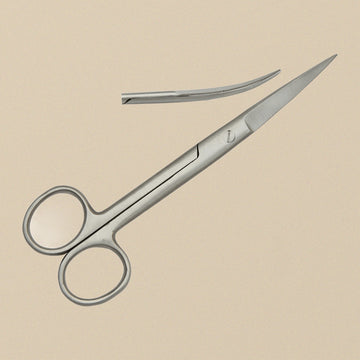
If the Mayo is the labourer, the Metzenbaum is the artist. These are the quintessential soft tissue dissection scissors and arguably the most frequently used instrument in small animal surgery. The defining feature of a Metzenbaum scissor is its long, slender shanks and comparatively short, delicate blades. This design (typically a 3:1 or 4:1 shank-to-blade ratio) allows the surgeon to make precise cuts deep within a body cavity whilst keeping their hands well clear of the surgical field, thus improving visibility. The blades themselves are fine and narrow, designed for the delicate persuasion of soft tissue dissection. They excel at separating tissue planes, isolating vessels and nerves, and excising soft, pliable masses. The 'Metz' is the instrument you reach for to create a window in the broad ligament during a bitch spay, to dissect out a bladder from surrounding adhesions, or to delicately separate subcutaneous fat from underlying muscle. They should be guarded jealously and used exclusively for soft tissues. Cutting suture or tough fascia with them is surgical sacrilege that will instantly dull their fine edges.
Iris
Named for their original use in ophthalmic surgery on the iris of the eye, these scissors represent the pinnacle of surgical precision. Iris scissors are small, typically around 4.5 inches, and are distinguished by their extremely fine, sharp, and pointed blades (a sharp/sharp or SS tip is common). They are designed for microsurgical applications where every millimetre matters. In general practice, they are essential for any procedure involving the eye, such as creating conjunctival flaps or trimming prolapsed nictitating membrane glands. Their utility extends beyond ophthalmology; they are perfect for any task requiring minute, precise cuts in delicate tissue. This could include vascular surgery in exotic species, revision of small skin flaps in plastic and reconstructive procedures, or even the careful dissection of nerve bundles. They are exceptionally sharp and unforgiving, demanding a steady hand and a clear understanding of their limitations.
Stevens tenotomy
At first glance, Stevens tenotomy scissors appear similar to Iris scissors, but there are subtle, important differences. They are also designed for fine, delicate work but are often slightly longer and feature slender, narrow blades that typically terminate in a blunt-blunt (BB) tip. As their name suggests, they were originally developed for tenotomy—the surgical cutting of a tendon. The blunt tips allow for the safe dissection and isolation of a tendon from its surrounding sheath and neurovascular structures before it is cut. In modern veterinary practice, their role has expanded. They are favoured for fine dissection in confined spaces, such as in neurosurgery or intricate plastic surgery. The combination of long, thin shanks and delicate but blunt tips makes them an excellent tool for spreading and separating tissue planes without the risk of inadvertent puncture posed by the sharp tips of an Iris scissor.
Suture scissors
These scissors have one job and one job only: to cut suture material. It may seem extravagant to dedicate a specific instrument to this task, but it is essential for preserving the integrity of your expensive dissection scissors. Suture material, particularly braided polyester or monofilament nylon, is surprisingly abrasive and will rapidly dull the finely honed edges of a Metzenbaum or Iris scissor. Suture scissors are built to be robust, not sharp in the same way as a dissection scissor. The most common variant is the Spencer suture-removal scissor, which features a small, curved notch or hook on one blade. This clever design allows the user to easily snag the suture, lift it away from the skin, and cut it cleanly without jabbing the patient or leaving a dangerously short tag.
Bandage scissors (Lister, Universal)
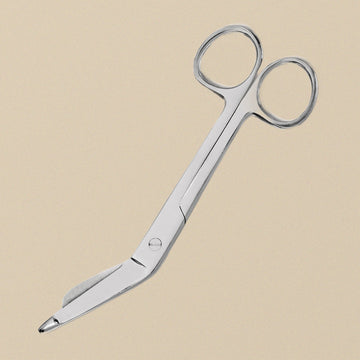
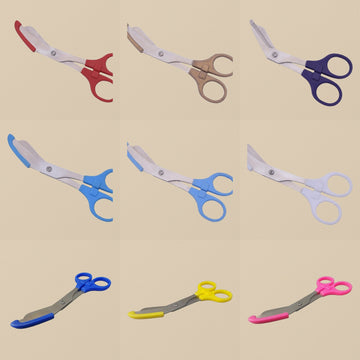
Bandage scissors are utility instruments, not surgical instruments, and must never enter the sterile field. The most common pattern, the Lister bandage scissor, is easily identified by its angled blades and the flattened, blunt probe-tip on the lower blade. This design is a masterclass in safety; the probe tip can be slid between the patient’s skin and the bandage material without any risk of cutting or gouging the skin. They are designed for shearing through layers of cotton wool, conforming bandage, and adhesive dressings. Universal Tuff-Cut shears are another variant, built to cut through almost anything in an emergency—from a thick leather collar to a patient’s winter coat. They belong in the prep room, the consult room, and the emergency crash trolley, but never on the mayo stand.
Straight vs curved
The curvature of a scissor’s blades is not an aesthetic choice; it is a functional one that dramatically alters how the instrument is used.
Straight blades are designed for cutting along a direct line of sight. They are at their best when making long, straight cuts on a flat surface or when transecting tissue that is under tension. A straight Mayo scissor is perfect for cutting the linea alba once it has been elevated, or for trimming a sheet of surgical mesh to size. Straight suture scissors provide a clean, perpendicular cut on a suture tail. The action is direct and unambiguous.
Curved blades, however, open up a world of surgical possibility. The curve allows the tips to follow the natural contours of organs and tissues, enhancing visibility and control. Their most important function is in blunt dissection. A surgeon can introduce the closed tips of a curved Metzenbaum into a tissue plane, then gently open the blades. This action doesn't cut; it separates, gently teasing apart the natural fascial planes with minimal trauma and bleeding. The curve also allows the surgeon to work around structures, cutting tissue on the far side of a vessel or nerve while the curve of the blade protects that vital structure. This is why the curved Metzenbaum is the most-reached-for scissor on the soft-tissue tray. It allows the surgeon to see the tips of the blades at all times, even when working deep in the abdomen or chest, providing a level of safety and precision that a straight scissor simply cannot match.
Blade tip: blunt-blunt, sharp-sharp, blunt-sharp
The configuration of the blade tips is another critical feature that defines a scissor's role and dictates its safe use.
Blunt-blunt (BB) tips are the safest configuration for dissection in proximity to vital structures. When performing blunt dissection, the closed, rounded tips can be pushed through areolar tissue, pushing aside vessels and nerves rather than piercing them. Most Metzenbaum and Stevens tenotomy scissors are BB for this very reason. They are designed to minimise iatrogenic trauma and are the preferred choice for deep dissection where visibility may be compromised.
Sharp-sharp (SS) tips are designed for aggressive cutting and maximum precision at the very tip of the instrument. They are made to pierce tissue with minimal effort, allowing the surgeon to initiate a cut in a precise location. Iris scissors are the classic example of an SS configuration. This ability to pierce and cut is invaluable in ophthalmic or microsurgery but comes with a significant trade-off: an increased risk of inadvertently puncturing a nearby vessel, nerve, or organ. They demand excellent visibility and a steady hand.
Blunt-sharp (BS) tips offer a compromise between safety and cutting precision. This configuration is common in general-purpose or utility scissors. The sharp blade performs the cutting action, whilst the blunt lower blade can be slid underneath the tissue to be cut, protecting the underlying structures. Some suture scissors utilise this pattern, allowing the blunt tip to slide safely under a suture close to the skin.
Steel and quality grades
Not all stainless steel is created equal. The quality of the metal used to forge a surgical scissor directly impacts its edge retention, corrosion resistance, and overall lifespan. For a UK practice, understanding the hierarchy of materials is key to making a sound investment.
German stainless steel is the undisputed benchmark for surgical-grade instruments. Forged from specific alloys like 420A or 17-4 PH martensitic stainless steel, these instruments are designed to withstand the rigours of repeated use and sterilisation. The steel is hard enough to hold a razor-sharp edge through many procedures, yet possesses enough chromium to resist the corrosion and pitting that can occur during the high-temperature, high-pressure environment of an autoclave. An instrument made from proper German steel cleans easily, maintains its alignment, and provides a tactile feedback that cheaper alternatives lack.
Pakistani imports occupy a vast spectrum of quality. The city of Sialkot is a global hub for surgical instrument manufacturing, producing everything from world-class instruments for major German brands to mass-market, budget-grade tools. The best Pakistani instruments are excellent and offer fantastic value, but the lower end of the market can be plagued by poor quality control, softer steel that won't hold an edge, and a susceptibility to rust. As a buyer, due diligence is essential. Check for CE marking, ISO 9001 or 13485 certifications, and buy from a reputable UK supplier who stands behind their products. For high-turnover items like bandage scissors or a second-tier spay kit, a good quality Pakistani instrument can be a very sensible economic choice.
Tungsten-carbide-insert tips (TC) represent a significant upgrade in cutting technology. These scissors feature standard stainless-steel bodies, but the cutting edges themselves are made from micro-bonded inserts of tungsten carbide, one of the hardest materials used in manufacturing. These instruments are easily identified by the gold-plated finger rings. The TC edge is exceptionally hard and durable, lasting 3-5 times longer than a standard stainless-steel edge. For a high-volume practice performing multiple surgeries daily, the £25-40 premium for TC scissors is a sound investment. The cost is quickly recouped through drastically reduced sharpening frequency and replacement costs, ensuring a consistently sharp, reliable cutting edge is always available.
Brand reality: Aesculap vs Sklar vs Premier vs imports
Navigating the marketplace of surgical brands can be confusing. In the UK, practices typically operate on a tiered system, matching the brand investment to the instrument's intended use.
Aesculap (a B. Braun company) sits at the apex. These German-made instruments are the gold standard, found in referral centres and specialist surgical suites. The balance, feel, and longevity are unmatched. An Aesculap scissor, costing anywhere from £80 to over £220, is a career investment. For the general practitioner, they are a luxury, but for the surgical specialist, they are a non-negotiable tool of the trade.
Sklar Instruments, a US company often utilising German manufacturing (OEM), represents the mid-premium tier. Costing between £40 and £100, Sklar instruments offer excellent quality, durability, and feel without the top-tier price tag of Aesculap. They are a popular choice for practices that value high-quality, reliable instruments and are willing to invest in longevity.
World Precision Instruments (WPI) is a notable brand that has carved out a niche in specialty instruments, particularly for ophthalmic, neurosurgical, and research applications. They are a go-to source for ultra-fine scissors like Iris and Stevens tenotomy patterns.
Premier UK and similar trade brands represent the dependable mid-range. These are the workhorses of many first-opinion UK clinics. They offer good quality steel, reliable performance, and a price point that makes it feasible to fully equip multiple surgical kits. They hit the sweet spot between affordability and quality for most routine procedures.
Pakistani imports, as discussed, form the budget tier (£8-25). This is where most practices source their non-critical, high-loss items. It makes perfect economic sense to use an £8 pair of Lister bandage scissors that will be used and abused in the prep area, or to equip a "floating" secondary spay pack with budget scissors. This is the core logic of most UK clinics: run premium or mid-range (e.g., Sklar or Premier TC) Metzenbaums for critical soft tissue work, and use budget imports for bandage and suture scissors.
The six-scissor first-opinion bench tray (UK £350-700)
For a new practice, a final-year student building their first kit, or a practice manager looking to standardise, this is a sensible and highly functional starting point. The price range reflects the choice between mid-range and premium brands.
- 1 × Curved Metzenbaum 5.5": The undisputed workhorse for all soft tissue dissection. The curve and delicate blades are essential for 90% of abdominal and thoracic procedures.
- 1 × Straight Mayo 5.5": The heavy lifter. For cutting the body wall, tough fascia, and other non-delicate tissues. Its robustness saves your Metzenbaums from abuse.
- 1 × Curved Iris 4.5": The precision specialist. Essential for any ophthalmic work, removal of tiny skin masses, or any procedure requiring minute, accurate cuts.
- 1 × Stevens tenotomy: The fine-dissection alternative. Perfect for delicate blunt dissection around nerves and vessels where the sharp points of an Iris scissor would be a liability.
- 1 × Spencer suture scissor: The protector of your investment. Used exclusively for cutting suture, its notched tip makes suture removal safe and simple.
- 1 × Lister bandage scissor 5": The utility player. This lives outside the sterile field, used for cutting dressings, drapes, and anything else that doesn't involve cutting the patient.
Sterilisation
Proper care and sterilisation are not just about infection control; they are about protecting your financial investment and ensuring patient safety. A poorly maintained instrument is a dangerous instrument.
In the UK, the standard autoclave cycle for surgical instruments is 134°C for a minimum of 3 minutes, but often run for 18 minutes on a wrapped cycle to ensure dryness. However, sterilisation starts before the autoclave. Instruments must be meticulously pre-cleaned, ideally in an ultrasonic cleaner, to remove all blood, protein, and debris. Autoclaving an unclean instrument will bake this material onto the surface, promoting corrosion and rendering the instrument impossible to truly sterilise. After cleaning and before bagging, hinges should be treated with a water-soluble instrument lubricant or "Instrument Milk". This prevents the metal-on-metal friction that leads to stiff hinges and eventual seizure.
Crucially, never bag damp instruments. The residual moisture, when super-heated in the autoclave, will cause water marks that quickly become pits of corrosion, permanently damaging the instrument's surface. Ensure your autoclave has an effective drying cycle or that instruments are thoroughly air-dried before packing.
Finally, every instrument should be inspected by the RVN or tech before it is re-bagged. Check that the tips align perfectly. Run the blades gently over a piece of gauze to feel for burrs or roughness. Open and close the scissors to ensure the hinge play is smooth but not loose.
Sharpening and dressing
Even the highest quality scissor will eventually become dull. A sharp cut is clean and heals quickly; a dull cut crushes tissue, causing more trauma, swelling, and a higher risk of post-operative complications.
For most clinics, the most reliable and cost-effective solution is a commercial sharpening service. These specialists can professionally regrind the blade edge to the correct angle, check and realign the tips, and service the hinge. At a cost of £3-6 per scissor annually, it is an essential part of a practice's maintenance schedule.
Whilst some light in-house dressing on a fine diamond plate is possible for robust scissors like Mayos or Listers to remove a minor burr, it should be approached with caution. Ophthalmic scissors like Iris and fine dissection scissors like Metzenbaums should always go to a professional service. An incorrect sharpening angle can ruin the scissor permanently.
Knowing when to retire an instrument is also key. A scissor should be binned if it has a visible chip in the blade (which can break off in the patient), if the blades are bent and can no longer be perfectly aligned, or if the hinge is loose beyond adjustment. At this point, it has become a liability.
Common practice mistake: using bandage scissors on the sterile field
It is a sight that makes experienced surgeons and nurses cringe: a pair of Lister-pattern bandage scissors being used to cut drapes or, worse, tissue within the sterile field. These scissors are fundamentally unsuited for surgery. Their blades are thick and designed to shear, not slice, which causes significant crush artefact in soft tissues. Their probe tip, a brilliant safety feature for removing dressings, makes them clumsy and imprecise for surgical work. They are a non-sterile, utility tool. Keep them in the prep room where they belong.
UK-stocked: same-day dispatch
When a critical instrument breaks or is dropped mid-surgery, you need a replacement fast. At Toolsmith Ltd, we hold extensive UK stock of all major scissor patterns, ready for same-day dispatch to get your clinic back up and running without delay.
Related guides
- Your First Vet Surgery Kit: 12 Essential Instruments
- UK Veterinary Hemostats — 5 Must-Have Forceps
- Veterinary Needle Holders: Mayo-Hegar, Olsen-Hegar & Castroviejo
- Reflex Hammers Explained: Taylor, Buck, Babinski & Queen Square
- Laryngoscopes: Macintosh vs Miller, Conventional vs Fibre-Optic
- Embroidery & Fancy Scissors: A UK Maker's Guide
- Surgical Scalpels, Gigli Saws & Bone Instruments: A UK Guide
- Shop all Surgical Instruments
Frequently asked questions
What surgical scissors do I need for a first veterinary kit?
Six patterns cover a first-opinion practice: a curved Metzenbaum for soft-tissue dissection, a straight Mayo for fascia and tough tissue, a curved Iris for ophthalmic and fine cuts, a Stevens tenotomy for delicate blunt dissection, a Spencer suture-removal scissor, and a Lister bandage scissor for dressings only. Mid-range to premium versions of that tray run £350–£700.
What is the difference between Mayo and Metzenbaum scissors?
Mayo scissors are the heavy-duty workhorse — substantial semi-blunt blades and a roughly 1:1 shank-to-blade ratio, built for fascia, muscle and tough tissue. Metzenbaums have long slender shanks and short delicate blades for precise soft-tissue dissection deep in a body cavity. Never cut suture or tough fascia with a Metzenbaum — it instantly dulls the fine edges.
Are tungsten carbide (gold-ring) scissors worth the extra cost?
For a high-volume practice, yes. Tungsten carbide cutting edges last three to five times longer than a standard stainless-steel edge, and the £25–£40 premium is quickly recouped through drastically reduced sharpening and replacement costs. For utility items like bandage scissors, budget stainless is the sensible economic choice instead.