Quick answer: Follow the four-blade rule: a quality straight, curved, thinning and chunker set equips you for 90% of the dogs that come through a UK salon. A 7-7.5 inch scissor is the all-rounder size, and realistic budgets are £35-£80 per professional pair — £180-£320 for the set of four. The £12 Amazon multi-packs are not professional tools.
Key difference: straight and curved scissors cut and shape; thinners blend and soften; chunkers remove bulk and add texture.
| Type | Blades | Use for |
|---|---|---|
| Straight | Straight blades: 7–8 inches for skirts, 5.5–6.5 inches for pads | Setting patterns, clean lines and most length removal |
| Curved | Curved blades; 7.5 inches is a versatile size | Rounded shapes, heads, paws and topknots |
| Thinning (blender) | One solid blade and one with fine teeth, typically 35–50 | Softening and blending lines; a finishing tool |
| Chunker | Fewer, wider teeth, typically 14–25 | Removing bulk and adding a plush texture on dense, curly coats |
For any professional groomer in the UK, from a newly qualified Level 2 to a seasoned salon owner, your scissors are the most fundamental extension of your skill. The right steel in your hand translates your knowledge of breed standards and anatomy into a flawless finish. But with a bewildering array of options, where do you start? It boils down to the four-blade rule. For 90% of the dogs that walk through your door, your core toolkit will be a quality set of straight, curved, thinning, and chunker scissors. Everything else is for highly specialised work or personal preference. Get these four right, and you’re equipped for business.
The four blade types explained
Understanding the specific job of each scissor type is non-negotiable. Using a curved blade where a straight is needed, or a thinner where a chunker would be better, is the difference between a professional finish and a home-groom job. Let’s break them down.
Straight
This is your workhorse. The straight scissor is the foundation of your grooming, used for setting patterns, establishing clean lines, and tackling the bulk of length removal. On a drop-coated breed like a Yorkshire Terrier or a Shih Tzu, a long, straight scissor (7-8 inches) is essential for creating those sharp, perfect skirts. On a Poodle, it's your primary tool for blocking in the main body shape before you start the detailed finishing. They are also your go-to for practical tasks like trimming the hair between pads (with a shorter, safer 5.5" or 6.5" model) and tidying up sanitary areas. A good quality straight scissor should feel balanced and cut cleanly from pivot to tip without folding the hair. It’s the tool you’ll use on almost every single dog, so investing in a quality pair is one of the smartest decisions you can make.
Curved
Where straight scissors create lines, curved scissors create shape. They are indispensable for following the natural contours of a dog's body and creating the soft, rounded finishes that define many breed standards. Think of a Bichon Frise’s perfectly spherical head, the angulation on a Poodle's hocks, or the neatly rounded paws on a well-finished Spaniel. These are all achieved with a curved scissor. The curve of the blade allows you to scissor into the coat, creating a seamless, natural shape that a straight blade would struggle to replicate without leaving harsh lines. They are also brilliant for topknots and faces, allowing you to shape the hair around the dog's skull and jawline safely and efficiently. Many groomers find a 7.5" curved scissor to be an incredibly versatile tool, suitable for everything from body contouring on a Bedlington to finishing the tail on a Golden Retriever.
Thinning
Often called blenders, thinning scissors are the secret to a flawless, natural-looking groom. They have one solid blade and one blade with fine teeth, typically between 35 and 50. Their job is not to remove bulk, but to soften and blend. When you transition from a clipped area (like a #5F blade on a Spaniel's back) to a longer, scissored skirt, thinning scissors erase the line, creating an invisible transition. They are also used to soften harsh scissor marks, thin out overly dense areas like behind the ears without altering the length, and for delicate work around the eyes to achieve a soft expression. The key is technique: you use them to cut into the ends of the hair, breaking up solid lines. Using them to chop into the bulk of the coat will result in a choppy, uneven finish. They are a finishing tool, not a shaping tool.
Chunker
Chunkers, sometimes called texturisers or fish-tail scissors, look like thinners on steroids. They have far fewer, wider teeth (typically 14-25) and are designed to remove a significant amount of hair with each cut. This makes them exceptionally useful for a few key tasks. On dense, curly coats like Poodles and Doodles, they are a game-changer. They can quickly remove bulk after the initial block-in, saving time and wrist strain. More importantly, they create a soft, plush, teddy-bear texture that is very difficult to achieve with straight scissors alone. They don't leave the subtle finish of a thinner; instead, they create texture and a less "perfectly scissored" look, which is highly desirable in modern styles like the Asian Fusion groom. They are brilliant for shaping a Poodle's leg or a Doodle's head, but be warned: used incorrectly, their aggressive cutting action can leave noticeable gaps in the coat.
By coat type
The right tool depends entirely on the coat in front of you. Using a fine-finishing scissor on a matted double coat is a recipe for a ruined edge. Here’s a practical guide for common UK coat types.
Double-coated (German Shepherd, Golden Retriever, Pomeranian)
For these breeds, the majority of the work is done before you even pick up your scissors. A high-velocity dryer, undercoat rakes, and slicker brushes are your primary tools for removing the dense, packed undercoat. Scissoring is purely for finishing. A 7.5" or 8" straight scissor is perfect for tidying the feathering on the legs and belly of a Retriever or Setter. It’s also used to shape the trousers (britches) and create a neat outline. For the feet, a good curved scissor will help you create that tight, cat-like paw shape. Thinning scissors are invaluable for blending the longer furnishings on the legs into the shorter body coat, ensuring there are no obvious lines.
Curly (Poodle, Bichon Frise, Doodle-Crosses)
This is where your scissor collection truly earns its keep. A dense, curly coat is demanding on steel, so quality is paramount. You will need a robust 7" to 8" straight scissor for the initial shaping and setting of lines on the body and legs. A curved scissor of a similar length is non-negotiable for creating the topknot, shaping the chest, and setting the angulation on the rear legs. For the modern, plush finish popular on Doodles and Poodles, a chunker is your best friend. It breaks up the curls to create a soft, uniform texture while removing bulk. Finally, a good 40-tooth thinner is essential for blending around the face, ears, and tail set to achieve that perfect, seamless finish.
Wire-haired (Schnauzer, Border Terrier, Airedale)
The first rule of wire coats is that, for breed standard and to maintain correct harsh texture and colour, the body should be hand-stripped, not clipped or scissored. However, scissors are absolutely essential for the furnishings. For a Schnauzer, you'll need a precise straight scissor (around 6.5") to shape the sharp angles of the beard and the distinct eyebrows. Thinning scissors are crucial for blending the stripped jacket into the longer skirt and leg furnishings. For terriers, a good pair of straights will help you tidy up the legs and underline, while thinners can soften any unruly areas without compromising the wiry texture too much. It's about neatening the silhouette, not restyling the entire dog.
Silky (Yorkshire Terrier, Maltese, Shih Tzu)
Silky, or drop, coats are unforgiving. Every single scissor mark will show, so precision and sharpness are key. A high-quality 6" to 7" straight scissor is the primary tool here. You need a blade that cuts cleanly all the way to the tip to create those razor-sharp, floor-length skirts and fringes. A shorter, fine-bladed curved scissor or a pair of ball-tip safety scissors are essential for safely trimming around the eyes and muzzle. Thinning scissors should be used very sparingly, perhaps just to soften the very ends of the hair on the body or to blend the topknot into the neck, as they can easily create a "chewed" look on this type of hair.
Cat coats
Grooming cats is a different discipline entirely, and safety is the absolute priority. Cat skin is incredibly thin, loose, and easy to nick. For this reason, shorter scissors (5.5" to 6.5") are strongly recommended as they offer far greater control. Curved scissors are particularly useful for navigating the contours of a cat's body, especially when tidying up a lion clip around the mane or legs. You rarely, if ever, need chunkers on a cat; the risk of catching the skin between the wide teeth is too high. Most work involves clippers, but for finishing the pom-pom on the tail or neatening the ruff, a small, sharp pair of curves is the professional's choice.
Size matters more than you think
Choosing the right size of scissor is just as important as choosing the right type. The size, measured from the tip of the blade to the end of the finger ring, dictates its function and ergonomics.
- 5.5" - 6.5": These are your detail scissors. They provide maximum control for intricate and high-risk areas. Perfect for trimming around eyes (ball-tip models are a must for safety), shaping the corners of the mouth, tidying the inside of ears, and scissoring the hair between the pads of the feet. The short blade means less can go wrong with a single cut.
- 7.0" - 7.5": The all-rounder. If a new groomer can only afford one good pair of straights or curves to start, this is the size to get. It’s long enough to be efficient on the body of a medium-sized dog like a Cocker Spaniel but small enough to still be nimble for shaping legs and heads. A 7.5" scissor is a true workhorse in any salon.
- 8.0" and above: These are for body work on large dogs. When you're scissoring the entire body of a Standard Poodle or a large Goldendoodle, an 8" or 8.5" scissor allows you to remove more coat with each pass. This creates a smoother, more uniform finish and significantly reduces your scissoring time. However, they require a steady, confident hand and can cause wrist fatigue if you’re not used to their weight and balance.
Japanese vs German steel
The steel is the soul of the scissor. The two main types you'll encounter are Japanese and German, and they have distinct properties. Japanese steel (like 440C, VG-10, ATS-314) is generally harder. This hardness allows it to be honed to an incredibly sharp, fine edge, known as a convex or clamshell edge. This edge slices through hair like butter and holds its sharpness for a very long time, making it a favourite for finishing work. The trade-off is that it can be more brittle and susceptible to damage if dropped. German steel is typically a bit softer and more durable, often used for bevel-edged scissors. It’s tougher and more resistant to nicks, but may not achieve the same razor-sharpness as top-tier Japanese steel. For a student or a busy salon doing a lot of prep work, German-style scissors can be a robust, cost-effective choice. For the professional focused on the perfect finish, Japanese steel is usually the preferred option.
- 440C: A fantastic, high-carbon stainless steel. It’s the benchmark for quality, professional-grade scissors. Holds a great edge and is durable.
- VG-10: A step up. This Japanese "super steel" is often blended with cobalt, which adds strength and allows for incredible edge retention. Superb for fine finishing.
- ATS-314: The pinnacle for many. A premium Japanese steel from Hitachi, known for its extreme hardness and ability to hold a razor edge through countless grooms. An investment for the serious professional.
Left-handed groomers
This is not a myth or a marketing gimmick: if you are left-handed, you absolutely must use true left-handed scissors. A true left-handed scissor is a mirror image of a right-handed one. The blades are reversed, so the top blade is on the left. This allows a left-handed user to see their cutting line and use a natural closing motion. Using right-handed scissors in your left hand forces you to push your thumb out and pull your fingers in to make the blades meet. This unnatural pressure causes immense hand and wrist fatigue, leads to a poor, hair-folding cut, and will permanently damage the scissor blades. Don't "make do". Investing in proper left-handed scissors is a critical investment in your career, your comfort, and the quality of your work.
Care: the 5-minute weekly routine
Your scissors are an expensive investment. A simple care routine will protect them, prolong their life, and save you money on sharpening and replacements.
Daily (End of Day): First, carefully wipe the blades with a soft, damp cloth (a small piece of chamois leather is ideal) to remove hair and product residue. Never use a dry paper towel, which can leave lint. Then, open the scissors and apply one drop of high-quality scissor oil to the pivot point. Open and close the blades several times to work the oil into the mechanism, pushing out any trapped hair. Finally, wipe the excess oil from the blades and store them safely in a case, ensuring they cannot be knocked over.
Weekly: Perform the daily clean and oil, then check the tension. Hold one handle with the finger rest pointing up, and lift the other handle until the blade is at a 90-degree angle to the other. Let it go. The blade should drop and close about two-thirds of the way. If it slams shut, it’s too loose. If it barely moves, it’s too tight. Adjust the tensioner screw in small increments until it's correct. Proper tension is vital for a clean cut and prevents the blades from wearing unevenly.
Annually: Send your scissors to a specialist, reputable blade sharpener. Not a knife sharpener, not a mobile service that uses a grinding wheel. A professional will dismantle, clean, and hone your scissors on the correct equipment to restore the factory edge without removing excess steel.
Budget reality
Let's be blunt. The £12 multi-scissor packs you see on Amazon are not professional tools. They are made from poor quality steel that will not hold an edge, the tension systems are unreliable, and they will fold and chew hair, causing you immense frustration and producing a substandard finish. For a single pair of reliable, professional-grade scissors that will serve you well, you should expect to budget between £35 and £80. Premium, high-performance scissors from top brands can easily cost £150 to £300 or more.
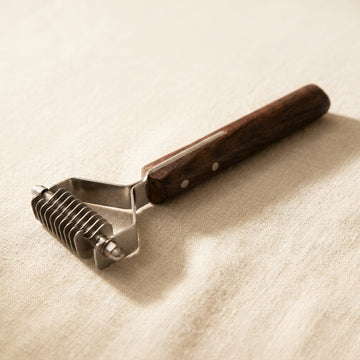
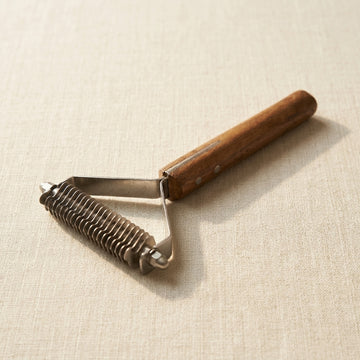
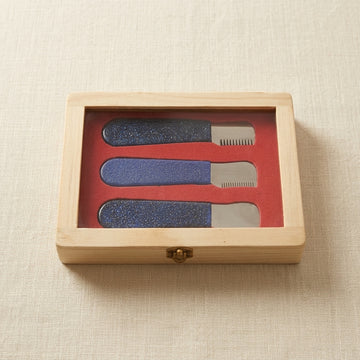
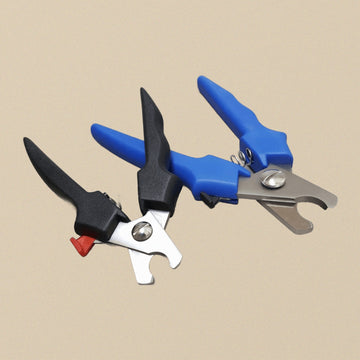
For a new groomer building their first professional kit based on the four-blade rule, a realistic budget for a quality set of a straight, a curved, a thinner, and a chunker would be in the range of £180 to £320. It may seem like a significant outlay, but these are the primary tools of your trade. Like a chef's knives or a mechanic's spanners, investing in quality tools from a reputable supplier pays dividends in performance, longevity, and the quality of your finished work. Toolsmith does not currently sell grooming scissors; the hand grooming tools we do stock are shown below.
Related guides
- Farrier Tool Maintenance — Weekly Routine (UK)
- Embroidery & Fancy Scissors: A UK Maker's Guide
- Pet Nail Care: Clippers, Grinders & Styptic
- Shop all Pet Grooming Tools
- Dog Grooming Clippers and Blades: A UK Buying Guide by Coat Type
- Aquascaping Tools: A UK Guide
Frequently asked questions
Which grooming scissors do I need to start as a professional dog groomer?
Four types: a straight scissor for lines, pattern-setting and bulk length removal; a curved scissor for shaping heads, paws and body contours; thinning scissors (35-50 teeth) for blending clipper lines and softening scissor marks; and a chunker (14-25 wide teeth) for removing bulk and creating plush texture on curly and Doodle-type coats. Everything else is specialist.
What size grooming scissors should I buy first?
Start at 7.0-7.5 inches — long enough for body work on a medium dog like a Cocker Spaniel, nimble enough for legs and heads. Keep a 5.5-6.5 inch pair for high-risk detail around eyes, pads and ears, and only add 8-inch-plus scissors once you're regularly scissoring the full bodies of large dogs.
Do left-handed groomers really need left-handed scissors?
Yes — this is not a marketing gimmick. True left-handed scissors are a mirror image, with the top blade on the left, so you can see your cutting line and close the blades naturally. Using right-handed scissors in the left hand causes immense hand and wrist fatigue, a poor hair-folding cut, and permanent damage to the scissor blades.