Quick answer: For general small-animal practice, buy tungsten carbide (gold-handled) Mayo-Hegar needle holders in two sizes — they cover the vast majority of suturing. Add an Olsen-Hegar if you want to place, tie and snip with one instrument, and a Castroviejo only for ophthalmic or fine reconstructive work. TC jaws grip better, last far longer and can be re-jawed when worn.
Key difference: an Olsen-Hegar is a Mayo-Hegar with cutting blades in the jaws; a Castroviejo is a tweezer-grip holder for fine work.
| Pattern | Design | Best for | Watch out for |
|---|---|---|---|
| Mayo-Hegar | Ring handles, ratchet lock, box joint, short stout jaws | Routine soft-tissue surgery: spays, neuters, lump removals, closure | — |
| Olsen-Hegar | A Mayo-Hegar with cutting blades built into the jaws behind the tip | Placing, tying and snipping suture with one instrument in solo or fast-paced surgery | It is possible to cut the suture you meant to tie |
| Castroviejo | No ring handles: squeezed like tweezers, with a fine spring body, small locking catch and slender jaws | Ophthalmic and fine reconstructive work with fine suture (5/0 and finer) | Overkill for a spay |
The needle holder is the instrument that places every suture in your clinic — from a routine bitch spay to a delicate eyelid repair. It does an unglamorous job perfectly or it makes closure a fight: a holder that lets the needle rotate in its jaws turns neat suturing into guesswork, and one with worn jaws drops the needle at the worst moment. For an instrument used in almost every surgery, the choice of pattern, jaw material and size is too often left to whatever came in the kit. This guide sets out the three patterns UK small-animal practices actually use, explains why the gold-handled ones cost more and last longer, and covers the care that decides whether a needle holder serves for fifteen years or fails in eighteen months.
What a needle holder actually does
A needle holder grips a curved surgical needle securely so the surgeon can drive it through tissue and place a suture with control. That sounds simple, but it asks two things at once: the jaws must hold the needle absolutely still against the rotational force of passing it through tissue, yet release cleanly when you reposition. A locking ratchet in the handle holds the grip without you squeezing, and a precision box joint keeps the jaws aligned under load. Get either wrong and the needle turns, slips, or won't release — and your suturing suffers for it.
The three patterns you'll meet
Mayo-Hegar — the workhorse
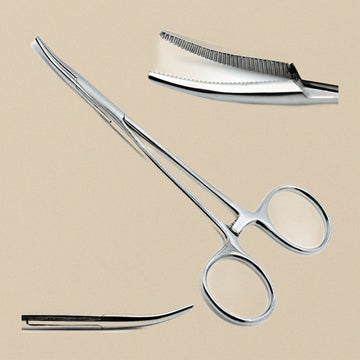
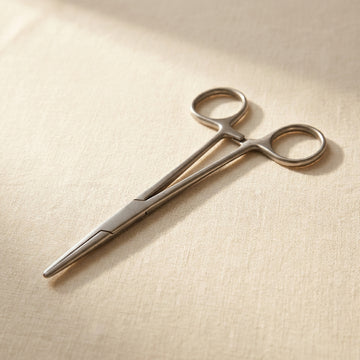
The default needle holder in most small-animal practice. It looks like a heavy pair of locking forceps: ring handles, a ratchet lock, a box joint, and short, stout jaws. The ratchet means you clamp the needle, the jaws stay locked, and your hand is free to drive it. It's robust, versatile, and handles the bulk of routine soft-tissue surgery — spays, neuters, lump removals, routine closure. If you buy one needle holder, it's a Mayo-Hegar. It pairs naturally with the rest of a general kit alongside your haemostats and surgical scissors.
Olsen-Hegar — holder and scissors in one
An Olsen-Hegar is a Mayo-Hegar with cutting blades built into the jaws, just behind the needle-gripping tip. The advantage is obvious in solo or fast-paced surgery: you place the suture, tie it, and snip the ends with the same instrument — no reaching for separate scissors, no swapping. For a sole charge vet closing efficiently, it saves real time across a list.
The trade-off is equally real: because the blades sit right there, it's possible to cut the suture you meant to tie if you grip in the wrong spot. It takes a little familiarity to use confidently. Many practices keep both — Olsen-Hegars for quick routine closure, Mayo-Hegars where they want zero cutting risk.
Castroviejo — fine and delicate
A completely different design for completely different work. The Castroviejo has no ring handles — it's squeezed like tweezers, with a fine spring body and a small locking catch, and very slender, precise jaws. It's built for ophthalmic surgery, fine reconstructive work, and anywhere you're handling tiny needles and very fine suture (think 5/0 and finer). The squeeze-grip lets you make minute, controlled placements that ring handles can't. Overkill for a spay; essential for an eyelid or corneal repair. If your clinic does ophthalmic or fine work, it's not optional.
Tungsten carbide vs plain stainless jaws
This is what the gold handles signify. A premium needle holder has tungsten carbide (TC) inserts in the jaws — small replaceable plates of very hard carbide, finely textured to grip the needle. Gold-plated ring handles are the universal trade signal that an instrument carries TC inserts.
- Grip: TC inserts hold a needle far more securely than plain steel jaws, with less rotation and slip.
- Lifespan: carbide is extremely hard, so the gripping surface wears far more slowly than stainless. A plain-jaw holder goes smooth and starts dropping needles; a TC holder keeps its bite for years.
- Replaceable: when TC inserts eventually wear, a quality holder can be re-jawed rather than scrapped — the inserts are replaced and the instrument is as good as new.
- Cost: TC holders cost more up front, but for an instrument used in nearly every surgery, the longer life and better grip pay for themselves. Plain-stainless holders make sense as backups, for teaching, or for low-volume use.
Sizes — and matching holder to needle
Needle holders come in a range of lengths, typically from around 12cm up to 18cm and beyond. The principle is simple: match the holder to the needle and the depth of the wound. A small holder for fine needles and superficial closure; a longer, heavier holder for larger needles and working deeper in the body cavity. A holder that's too big for a fine needle crushes or bends it; a holder that's too small for a heavy needle won't hold it and strains the jaws. Most small-animal practices keep two or three sizes to cover routine work plus finer and deeper jobs.
Quality markers: the box joint and ratchet
Two details separate an instrument that lasts from one that loosens:
- Box joint: the better joint construction (one arm passes through a slot in the other) keeps the jaw tips precisely aligned under load. A sloppy joint lets the tips splay and the needle escape. Check that a new holder's tips meet cleanly with no side-to-side play.
- Ratchet: the lock should engage crisply through its stages and release cleanly with a slight squeeze and twist. A ratchet that springs open under load or jams is a holder that will let you down mid-surgery.
Hold a candidate holder, lock it on a needle, and feel for any rotation — a quality instrument grips a needle dead still.
Choosing for your clinic
- General small-animal practice: TC (gold-handled) Mayo-Hegars in two sizes cover the vast majority of work; add Olsen-Hegars if your team likes to close-and-cut single-handed.
- Ophthalmic or fine reconstructive work: a Castroviejo is essential — ring-handled holders can't place fine suture with the needed delicacy.
- Building a first surgical kit: the needle holder is one of the core dozen instruments — our 12 essentials for a small-animal surgery kit shows how it fits with the scissors, forceps and haemostats around it.
Care: what kills a needle holder, and how to avoid it
Needle holders fail for predictable, preventable reasons. Protect the jaws and they last a clinical lifetime:
- Never use them on orthopaedic wire or anything but suture needles. Clamping a needle holder on cerclage wire or hard objects chips and crushes the TC inserts — that's the single fastest way to ruin one. Use wire-specific instruments for wire.
- Match the needle size. Forcing a heavy needle into a fine holder, or a fine needle into a heavy one, damages jaws and bends needles.
- Clean before sterilising. Blood and tissue dried into the box joint and ratchet cause corrosion and stiffness. Clean promptly, paying attention to the joint, and lubricate the joint with instrument milk before autoclaving.
- Autoclave correctly, ratchet open. Sterilise with the ratchet on the first click or fully open, not locked closed — locking under heat stresses the joint and box. Follow your practice's validated autoclave cycle.
- Inspect and re-jaw. Check the gripping surface periodically; when a TC holder starts to slip, have it re-jawed rather than replaced.
Dispatch from UK stock
Toolsmith does not currently sell needle holders; we stock other surgical instruments such as mosquito forceps, dressing forceps and scalpel handles. Everything we sell ships from UK stock, either packed by us or through Amazon's UK fulfilment centres. We aim to dispatch orders placed before 2pm UK time, Monday to Friday, the same working day; later orders go out from the next working day. Most UK orders arrive 2–3 working days after dispatch, and UK delivery is free.

Related guides
- UK Veterinary Haemostats: 5 Must-Have Forceps
- Surgical Scissors: Mayo, Metzenbaum & Iris Explained
- Small-Animal Vet Surgery Kit: 12 Essentials
- Surgical Scalpels, Gigli Saws & Bone Instruments: A UK Guide
- Kidney Dishes, Trays & Instrument Boxes: A UK Clinic Guide
- Shop all Surgical Instruments
Frequently asked questions
What needle holder do I need for small-animal surgery?
A Mayo-Hegar is the default choice — robust, ratchet-locked and suited to routine spays, neuters and closures. Most UK practices keep two or three sizes, matching the holder to the needle and wound depth. Choose tungsten carbide jaws (signalled by gold handles) for surer grip and a much longer working life.
What is the difference between a Mayo-Hegar and an Olsen-Hegar needle holder?
An Olsen-Hegar is a Mayo-Hegar with cutting blades built into the jaws behind the needle-gripping tip, so you can place a suture, tie it and snip the ends with one instrument. It saves real time in solo surgery, but it is possible to cut the suture you meant to tie, so many practices keep both patterns.
How should needle holders be cleaned and sterilised?
Clean promptly after use, paying attention to the box joint and ratchet, lubricate the joint with instrument milk, and autoclave with the ratchet fully open or on the first click only. Never clamp them on orthopaedic wire — it chips the tungsten carbide inserts. When TC jaws eventually slip, have the holder re-jawed rather than replaced.