Quick answer: If you buy one forming stake, make it a double-horn T-stake: a round horn for raising and planishing curves, a square-edged horn for crisp angles, held in a vice at working height. A sensible buying order runs steel bench block and rawhide mallet first, then the T-stake, then a dapping block, then micro-forming wheel stakes.
Hammers get the glory, but in silversmithing the stake underneath does half the forming. A stake is a polished steel shape you work metal over — every curve you want in the piece exists first on a stake somewhere. The full traditional stake library is enormous; the good news is that a small, well-chosen set covers a remarkable range of bowls, bangles, spouts and folds. Here is how the main types earn their bench space.
The T-stake: the silversmith's workhorse
A double-horn T-stake puts two different profiles on one tool — typically a round taper on one horn and a square-edged taper on the other, around 120 mm across the head. The round horn raises and planishes curves (bangles, cuffs, cylinder seams); the square horn sets crisp angles and folds. Held in a vice, it becomes a miniature anvil at exactly working height. If you buy one forming stake, this is the one.
Wheel stakes and micro-forming
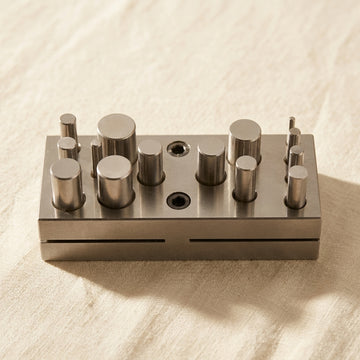
A micro-forming set — ours packs eight polished wheel stakes and four mandrels in a wooden stand — scales the same idea down for jewellery-sized work. Each wheel offers a different radius edge to planish over, so a small dish, a ring shank or a curved earring blank finds its exact counter-form without improvising on a mandrel that is nearly right. The wooden stand matters more than it looks: stakes that live in a drawer get dinged, and every ding prints into your silver.
Dapping blocks and bench blocks
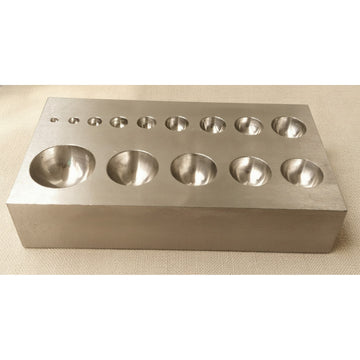
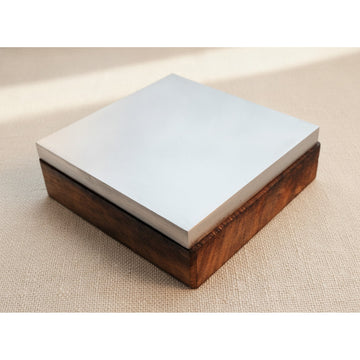
The dapping (doming) block — a steel block with graduated half-sphere depressions, 14 sizes on our 125 × 65 mm flat pattern — is the fast route to perfect domes, from earring cups to hollow beads, struck with matching punches. The plain steel bench block (76 mm square on a hardwood base that tames the ring) is the everyday flat: wire flattening, riveting, stamping and light forging all happen on it. Neither is strictly a stake, but they complete the forming station.
Pairing stakes with hammers
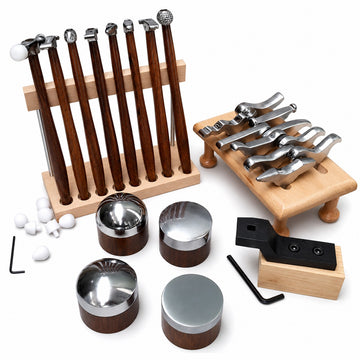
The rule of thumb: steel hammer on steel stake only when the metal is between them, or you print hammer marks into your polished stake face. For moving metal fast, use a rawhide or nylon mallet over the stake; save the polished planishing hammer for the final passes where every facet should kiss, not crush. A texturing and forming set — eight hammers and fourteen interchangeable stakes with hardwood handles and stands — is a cost-effective way to acquire the pairings in one go rather than piecemeal.
A buying order that works
- First: steel bench block + rawhide mallet — flat work and truing.
- Second: double-horn T-stake — curves and corners in one tool.
- Third: dapping block and punches — domes on demand.
- Fourth: micro-forming wheel stakes — refinement radii for small work.
Keep every working face polished and lightly oiled; a stake's finish is transferred to everything formed on it, which is the whole point.
All forming tools above ship from UK stock with same-day dispatch — browse the hammers, stakes and blocks range below.
Related guides
- Bangle & Bracelet Mandrels: Wooden, Oval & Stepped Formers
- Shop Hammers, Stakes & Forming Blocks →
- Chasing, Repoussé & Forming Hammers: A UK Silversmith's Library
- Doming & Dapping in Jewellery: A UK Guide
- Bench Blocks: Rubber vs Steel
Frequently asked questions
Which forming stake should I buy first for silversmithing?
The double-horn T-stake, around 120 mm across the head — a round taper on one horn raises and planishes bangles, cuffs and cylinder seams, while the square-edged taper on the other sets crisp angles and folds. Held in a vice it becomes a miniature anvil at exactly working height, covering most forming jobs on one tool.
Can I hit a steel stake with a steel hammer?
Only when the metal is between them — otherwise you print hammer marks into the polished stake face, and every ding is transferred into everything formed on it afterwards. Move metal fast with a rawhide or nylon mallet over the stake, and save the polished planishing hammer for the final passes. Keep working faces polished and lightly oiled.
What else do I need besides stakes for a forming station?
A steel bench block — 76 mm square on a hardwood base that tames the ring — handles wire flattening, riveting, stamping and light forging. A dapping block with graduated half-sphere depressions and matching punches gives perfect domes for earring cups and hollow beads. Micro-forming wheel stakes then add the exact small radii for jewellery-scale refinement.