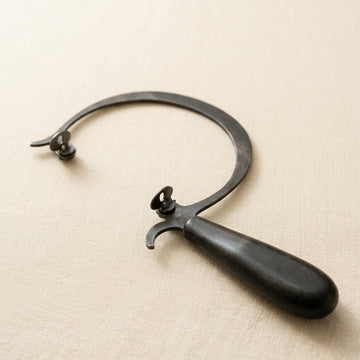
Quick answer: For most UK studio work, buy one 75 mm (3-inch) jeweller's saw frame — adjustable for blade length — and match blades to metal thickness: 4/0 or 6/0 for 0.4 mm sheet, 2/0 or 3/0 for 0.6 mm, 1 or 2 for 1 mm. Stock a dozen each of 2/0, 1 and 4 blades, spiral blades for wood or bone, and a beeswax block.
Key difference: choose a blade where three teeth touch the metal at the thickness you are cutting.
| Sheet thickness | Blade size |
|---|---|
| 0.4 mm | 4/0 or 6/0 |
| 0.6 mm | 2/0 or 3/0 |
| 1 mm | 1 or 2 |
| 1.5 mm and up | 4 to 6 |
The piercing saw is the most-used tool on a working jeweller's bench, but it's also the one beginners get most wrong. Wrong frame depth, wrong blade TPI, wrong tension — any of those and you're either snapping blades or tearing through detail you should be cutting cleanly. This guide covers what actually matters when you're picking one for UK studio work.
Frame depth — match it to your work, not the other way round
The frame depth (the throat) sets the maximum distance you can cut from the edge of a sheet. Standard jeweller's frames are 50 mm (2"), 75 mm (3") or 100 mm (4") deep. A 75 mm frame is the bench standard — enough reach for pendant work and most fabrication, not so deep that the frame flexes during a cut.
Go bigger only when you actually need it. A 100 mm frame on small piercings makes the saw harder to control because the extra leverage amplifies hand wobble.
Blade size: what the numbers mean
Saw blades are graded by number, from 8/0 (finest) up through 6/0, 4/0, 2/0, 1, then 1, 2, 3 up to 14 (coarsest). The smaller the number — and the more zeros — the finer the blade. A useful rule of thumb: pick a blade where three teeth touch the metal at the thickness you're cutting.
- 0.4 mm sheet → 4/0 or 6/0
- 0.6 mm sheet → 2/0 or 3/0
- 1 mm sheet → 1 or 2
- 1.5 mm and up → 4 to 6
If the cut is chattering or you're losing teeth on the blade, you've gone too fine. If the cut is rough and tearing, you've gone too coarse.
Wood and bone — different rules
Spiral blades (saw rod blades) cut wood and bone where a flat blade would burn or jam. They cut in any direction without rotating the work. Slower than a flat blade on metal, faster on softwoods, and the only sensible choice for bone or horn detail work.
If you're piercing decorative inlays or doing combined wood+silver work, keep a packet of spiral blades and a packet of standard #2 blades on the bench.
Tension and grip — where blades go to die
Most snapped blades aren't the saw's fault. The two real failure modes:
- Loose tension. A correctly tensioned blade gives a clear ping when plucked. A dull thud means it's loose — and it'll bend, then snap on the next cut. Tighten the bottom screw, then bow the frame slightly when seating the top to add tension.
- Twisting grip. Saw vertically. Don't lean the frame into a curve. Turn the work, not the saw. A blade pushed sideways through metal is a blade about to break.
Common bench mistakes
Three common beginner patterns:
- Cutting on the up-stroke. The teeth point downward — cut on the down-stroke only, lift cleanly. Pushing up against the teeth dulls them in minutes.
- Lubricating with anything thick. Use beeswax, micro-lubricant or a touch of saw lube. Soap clogs the gullets, oil drags fingers — neither is the answer.
- Replacing blades too rarely. A blade with rounded teeth pushes harder than it cuts and overheats your work. New blades cost pennies. Swap them.
What to keep on the bench
For a small UK studio, our minimum stocking advice:
- One 75 mm jeweller's saw frame (adjustable for blade length is worth the small extra cost)
- A dozen each of #2/0, #1 and #4 blades
- One packet of spiral blades for occasional wood or bone
- Beeswax block
That's the lot. The rest is technique.
What we stock
Toolsmith stocks jeweller's and dental lab saw frames, bench pins with saw vices and saw-blade storage stands; we do not currently sell saw blades. Free UK delivery on every order; we aim to dispatch orders placed before 2pm UK time, Monday to Friday, the same working day.
Question about saw setup or which blade for a specific job? Email info@toolsmithltd.co.uk.
Related guides
- Watchmaker's Loupe Buying Guide: 10× vs 20× and Eye-Strain Tradeoffs
- Setting Up a Jewellery Bench: 12 Essentials UK Bench Jewellers Actually Use
- Pliers Identifier: 7 Plier Types Every Bench Jeweller Should Know
- Polishing Compounds Demystified: Tripoli, Rouge, White Diamond and When to Use Each
Frequently asked questions
What jeweller's saw frame do I need for general bench work?
A 75 mm (3-inch) deep frame is the bench standard — enough throat for pendant work and most fabrication without the flex of a deeper frame. Pay the small extra for an adjustable frame that takes shorter blades. Only move to 100 mm when a job genuinely needs the reach, because the extra leverage amplifies hand wobble on small piercings.
Which saw blade size should I use for each metal thickness?
Follow the three-teeth rule: choose a blade where three teeth touch the metal you're cutting. In practice that means 4/0 or 6/0 for 0.4 mm sheet, 2/0 or 3/0 for 0.6 mm, 1 or 2 for 1 mm, and 4 to 6 for 1.5 mm and up. Chattering means too fine; rough, tearing cuts mean too coarse.
Why do my jeweller's saw blades keep snapping?
Almost always tension or grip, not the saw. A correctly tensioned blade pings when plucked — a dull thud means it's loose and will bend, then snap. Saw vertically, cut on the down-stroke only, and turn the work rather than leaning the frame into curves. A blade pushed sideways through metal is a blade about to break.