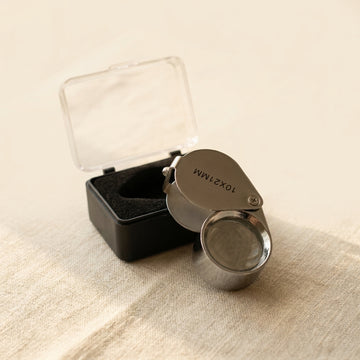
Quick answer: Start with a 10× loupe — it is the workhorse magnification for watch movement assembly and general inspection. A 20× halves your working distance, cuts the field of view to roughly a quarter and dims the image, so save it for brief pivot and jewel checks. Buy the lowest magnification that shows what you need, and budget for a bright bench lamp too.
Key difference: a 20× loupe halves the working distance of a 10× and cuts the field of view to roughly a quarter, so 10× is the everyday workhorse.
| Magnification | Use it for | How long |
|---|---|---|
| 3×–5× | General inspection, casing, dial work, jewellery setting | Comfortable for hours |
| 10× | Watch movement assembly, escapement work, balance pivot inspection | The workhorse; most repairers settle here |
| 15×–20× | Pivot polishing, jewel inspection, fine engraving | Briefly; switch back to 10× for assembly |
| 30× and higher | Diagnostics only | Not a bench tool |
If you've ever bought a watchmaker's loupe based on the highest magnification number on the packet, you've probably ended up squinting through it for ten minutes and putting it down. Higher magnification isn't better — it's narrower, dimmer and more fatiguing. This guide covers which loupe UK clockmakers and watch repairers should start with.
What the magnification number actually means
A 10× loupe magnifies an object ten times its real size. A 20× makes it twenty times. Sounds linear; it isn't. The cost is:
- Half the working distance — your eye has to be much closer
- Roughly a quarter of the field of view
- Less light reaching your eye, so you need a brighter lamp
- Faster eye fatigue from the constraint
Doubling magnification quarters the comfort, in other words. The good loupe for a job is the lowest magnification that lets you see what you need.
What to use when
- 3×–5× — general inspection, casing, dial work, jewellery setting. Comfortable for hours.
- 10× — the workhorse for watch movement assembly, escapement work, balance pivot inspection. Most repairers settle here.
- 15×–20× — pivot polishing, jewel inspection, fine engraving. Use briefly; switch back to 10× for assembly.
- 30× and higher — diagnostic only. Mount-and-look-at-it tools, not bench tools.
Monocular eye loupe vs binocular headset
A traditional monocular eye loupe (the kind that wedges in your eye socket) is light, fast to swap, and trains one eye to relax while the other works. A binocular headset (Optivisor-style) uses both eyes — much less fatiguing for long sessions — but only goes up to about 4× without supplementary lenses, and gets in the way of bench lamps.
Many working watchmakers use both: a binocular for casing, dial setting and broad work; a monocular dropped in for movement assembly. Buy the headset first if you're starting out and adding the eye loupe second when you need finer focus.
Working distance — the spec nobody quotes
Working distance is how far your eye sits from the lens, and how far the lens sits from the work. A 10× loupe with a long-focal-length lens lets your hands work without bumping the loupe; a short focal length forces you nose-down on the watch.
If you wear glasses, this matters more — you need clearance for the frames. Look for "long working distance" or "for spectacle wearers" in the listing.
Lighting matters more than you think
A 20× loupe under a 5W LED desk lamp gives you a dim, narrow tunnel. The same loupe under a 10W ringlight or a colour-corrected bench lamp shows everything. Budget half what you spend on the loupe on the lamp — you'll see more.
Common mistakes
- Buying 20× as a first loupe. Goes back in the drawer within a week. Start at 10×.
- Using a magnifier-on-stick instead of a loupe-on-eye. The eye/lens distance shifts as you move; you lose focus constantly.
- Storing a quality loupe loose. One scratch on the lens and the optics are degraded forever. Use the case it came in.
What we stock
Toolsmith stocks a 10× jeweller's loupe with a 21 mm lens; we do not currently sell binocular headsets or higher-magnification eye loupes. Free UK delivery on every order; we aim to dispatch orders placed before 2pm UK time, Monday to Friday, the same working day.
Question about which loupe for which work? Email info@toolsmithltd.co.uk.
Related guides
- Jeweller's Saw Frames and Blades: Pick the Right Combo
- Setting Up a Jewellery Bench: 12 Essentials UK Bench Jewellers Actually Use
- Pliers Identifier: 7 Plier Types Every Bench Jeweller Should Know
- Polishing Compounds Demystified: Tripoli, Rouge, White Diamond and When to Use Each
Related guides
Frequently asked questions
What magnification loupe should I buy for watch repair?
Start at 10× — it is the workhorse for movement assembly, escapement work and balance pivot inspection, and where most repairers settle. Use 3×–5× for casing, dial work and general inspection, keep 15×–20× for brief pivot polishing and jewel checks, and treat 30× and above as diagnostic tools rather than bench tools. The right loupe is the lowest magnification that shows what you need.
Should I buy a monocular eye loupe or a binocular headset?
Ideally both, in stages. A binocular Optivisor-style headset uses both eyes and is far less fatiguing for long sessions, but only reaches about 4× without supplementary lenses — buy it first if you are starting out. Add a monocular eye loupe second for finer focus on movement assembly; it is light, fast to swap and trains one eye to relax while the other works.
Why is a 20× loupe harder to use than a 10×?
Doubling magnification roughly quarters the comfort: a 20× halves the working distance, cuts the field of view to about a quarter, passes less light to your eye and fatigues it faster. It also demands a much brighter lamp. That is why 20× belongs in short bursts for pivot and jewel inspection, with the 10× doing the day-to-day assembly work.