Quick answer: Seven tools cover it for under £60: a spring-bar tool, 10x loupe, snap-back case opener, case-back wrench, precision screwdriver set (0.6-1.6 mm), non-magnetic curved tweezers and a brass movement holder. That handles roughly 95% of routine collection maintenance — battery swaps, strap changes and bracelet resizing — but leave full services, chronographs and vintage pieces to a professional.
Let's do some quick maths. Your favourite quartz watch stops ticking. You take it to the high-street jeweller. They quote you £25, maybe £30, and tell you to come back in an hour. You do this twice, and you've spent £50-£60. For that same amount, you could own a complete, foundational toolkit that empowers you to perform dozens, if not hundreds, of battery swaps, strap changes, and bracelet adjustments yourself. It’s not just about saving money; it’s about the satisfaction of understanding and maintaining the watches you love. This isn't about becoming a master horologist overnight. It's about taking the first, most important step. Here is the exact, no-nonsense, seven-tool kit that will get you started for under £60.
What £60 actually buys
Let's be perfectly honest from the outset. A £60 toolkit is not going to turn your kitchen table into a Swiss-grade watchmaking atelier. We need to manage expectations. This is an enthusiast-level kit, designed for the vast majority of common jobs you'll face as a collector. It's the gateway to a deeply rewarding hobby.
So, what are the limitations? You won't have a dust-proof bench with laminar flow, which means you need to be mindful of working in a clean, well-lit space. You won't have a professional timegrapher for regulating the accuracy of a mechanical movement down to the second. You also won't have a heavy-duty, lever-operated case press for snapping on stubborn case backs with perfect, even pressure. These are tools for the seasoned professional, costing hundreds or even thousands of pounds.
But here’s what your £60 does buy you: capability and confidence. It gives you everything you need to confidently tackle around 95% of the routine maintenance for a typical watch collection. We're talking about every battery swap on your quartz watches, from a simple Timex to a Tissot PRX. It covers every strap and bracelet change you could ever want to do, allowing you to change your watch's look in minutes. It lets you resize bracelets, inspect movements for obvious issues, and get up close and personal with the tiny, fascinating world inside your watch. For the budding enthusiast, this kit is the key that unlocks the case back and starts a lifelong journey.
The seven-tool under-£60 kit
We've carefully selected these seven tools to give you the maximum utility for your budget. Each one is a cornerstone of basic watch repair, and buying them as a set ensures you have no gaps in your initial capabilities.
Spring-bar tool (£6-10)
This is arguably the most-used tool in any watch enthusiast's collection. Its job is simple: to compress the tiny, spring-loaded pins (spring bars) that hold your strap or bracelet to the watch case's lugs. A good one, like our Bergeon-style model, will have two ends: a small fork for engaging with the spring bar's shoulder, and a pin pusher on the other end for drilled lugs or pushing out bracelet pins. Why is it essential? Because trying to use anything else—a small screwdriver, a knife—is the fastest way to scratch your watch lugs and send a spring bar flying across the room, never to be seen again. For under a tenner, this tool saves you a world of frustration and potential damage. It's the first tool you should buy, period.
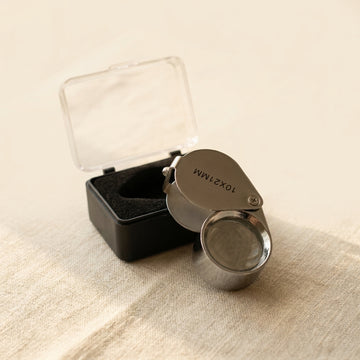
Watchmaker's loupe 10x (£8-12)
The world inside a watch is microscopic. Screws are the size of a grain of sand, and the text on a battery is unreadable to the naked eye. A watchmaker's loupe is your window into this world. We recommend a 10x magnification as the perfect starting point. It's powerful enough to let you see battery numbers, inspect the tip of a screwdriver for a clean edge, and even marvel at the balance wheel of a mechanical movement, but it’s not so powerful that the field of view becomes too narrow or the focal length impossibly short. Learning to hold it in your eye socket, hands-free, is a classic watchmaker's skill. It allows you to bring both hands to the task, providing the stability you need for delicate work. Don't even think about opening a watch without one.
Snap-back case opener (£8-12)
Many quartz watches, especially dress watches and older models, have a "snap-back" case. This is a simple pressure-fit lid. To open it, you need a specialised tool that acts like a very precise, blunted knife. A good opener has a carefully profiled edge designed to fit into the tiny pry-tab or seam on the case back without slipping and gouging the steel. Some people recommend a sticky ball opener, which can work on looser backs, but for a guaranteed result, a proper case back knife is essential. It provides the leverage needed to safely "pop" the back off. Paired with a case holder, it makes the process safe and repeatable.
Case-back wrench with adjustable pins (£10-15)
This is the counterpart to the snap-back opener and is used for the screw-down case backs found on most dive, field, and sports watches. These case backs have a series of notches or holes around their circumference. The wrench, often called a JAXA-style wrench, has three adjustable prongs with interchangeable tips (pins) that you line up with these notches. By turning the handle, you can apply even, consistent torque to unscrew the back without scratching it. A cheap kit will come with various pin styles (round, square, flat, triangular) to fit the vast majority of watches from brands like Seiko, Citizen, Rolex, and Omega. This tool is non-negotiable for any watch with a stated water resistance rating.
Precision screwdriver set, 0.6-1.6mm (£12-18)
The screws inside a watch are unlike any others in your house. They are tiny, have very fine slots, and are often made of soft steel. Using the wrong size screwdriver is a cardinal sin; it will mangle the screw head instantly, turning a simple battery change into a disaster. A proper watchmaker's screwdriver set is critical. You need a range of sizes, typically from 0.6mm to 1.6mm. The key is to select the driver blade that fills the screw slot perfectly in both width and thickness. This ensures the force is applied to the sides of the slot, not the top edges, preventing damage. A set that comes in a weighted, rotating stand is not just for show; it makes one-handed selection of the right size quick and easy. This is one of the higher-cost items in the kit, and for good reason—precision here is everything.
Non-magnetic curved tweezers (£4-8)
You will be handling tiny, delicate, and often metallic components. Your fingers are too clumsy, oily, and will block your view. A good pair of tweezers is essential. We specify "non-magnetic" because the last thing you want to do is magnetise a steel component in your watch, especially the hairspring in a mechanical movement, which would wreck its timekeeping. Brass or anti-static stainless steel is ideal. We also recommend a pair with fine, curved tips. The curve allows you to approach a component, like a battery, from a better angle and with more control, without your hand obscuring your view through the loupe. They are perfect for picking up and placing batteries, tiny screws, and gaskets.
Brass movement holder (£6-10)
This is the unsung hero of the beginner's toolkit. When you've got the case back off, you need a stable platform to work on the watch. A movement holder is a small, adjustable vice that gently but firmly grips the watch case by its sides. Why is this so important? It frees up both of your hands for the actual work—one to hold a tool, the other to steady it. It prevents the watch from sliding around on your table, which is how cases get scratched and movements get shocked. We recommend a brass holder because brass is a softer metal than the stainless steel of your watch case, meaning it's highly unlikely to leave a mark. It's a simple, cheap tool that elevates your work from fumbling to focused.
Two things to buy RIGHT after
Once you've mastered the basics with your £60 kit, you'll inevitably get curious about what's next. Here are the two logical upgrades to consider when you're ready to expand your skills.
Hand lifters and setters (£15-25): If you get interested in changing dials or hands, perhaps as part of a Seiko modification project, you'll need these. Hand lifters are like two tiny, precise pry bars that get under the hands to lift them off their posts without bending them or scratching the dial. Hand setters are pin-vises with nylon tips that allow you to press the hands back onto their posts with controlled pressure. This is the next level of cosmetic work.
Mainspring winder set (£50+): This is a significant step up and is purely for servicing mechanical movements. The mainspring is the engine of the watch, and safely removing it from and returning it to its barrel is impossible without a dedicated winder set. This is a clear dividing line; when you buy this tool, you are committing to learning the complex art of mechanical watch servicing. It’s a fantastic goal, but not one to be taken lightly.
Battery swap: 8-minute routine at home
With your new kit, a battery change becomes a simple, satisfying task that takes less than ten minutes. Follow these steps:
- Open the case: Place the watch in your movement holder. Select the correct tool for the case back—the wrench for screw-downs, the knife for snap-backs—and carefully open the watch. Place the case back somewhere clean.
- Identify the cell: Use your 10x loupe to read the code on the old battery (e.g., SR626SW or 377). Write it down or take a photo. This is the most critical step.
- Release the clamp: Observe how the battery is held in. It's usually by a small metal clamp held by a tiny screw. Use the correct-sized precision screwdriver to loosen (you often don't need to fully remove) the screw and pivot the clamp away.
- Swap the cell: Use your non-magnetic tweezers to remove the old battery and insert the new one. Avoid touching the new battery's flat surfaces with your fingers, as skin oils can interfere with conductivity.
- Reseal: Secure the battery clamp, check the rubber gasket around the case edge is clean and correctly seated, then replace the case back. For snap-backs, press it on firmly with your thumbs, often with a satisfying click. For screw-backs, tighten until it is "finger-tight" plus a small extra nudge—don't overtighten.
- The "Pressure Test": A professional would now use a pressure tester to guarantee water resistance. You don't have one. Be honest with yourself: if it's a valuable dive watch, consider getting it professionally tested. For most other watches, a visual check of the gasket is sufficient, but it's wise to be cautious around water until you're confident in your work.
Strap change: avoiding the scratched-lug rookie mistake
Changing a strap is the easiest way to give a watch a new personality, but it's also the easiest way to inflict its first scar. The dreaded "rookie scratch" on the back (or worse, the front) of the lugs is entirely avoidable.
The secret is control and protection. First, consider placing a small piece of masking tape over the lug face to act as a protective barrier. Now, take your spring-bar tool and use the forked end. Instead of trying to pry or lever the spring bar out, focus on a direct pushing motion. Engage the fork with the shoulder of the spring bar and apply pressure directly towards the centre of the strap, compressing the spring. As you compress it, gently twist your wrist to guide the spring bar out of the lug hole. The movement should be deliberate and controlled. Rushing is what causes the tool to slip and scratch the polished steel. With a little practice, it becomes second nature.
What you should NOT try on a £60 kit
Confidence is a good thing, but overconfidence can be destructive. This starter kit is excellent, but it is not the right equipment for highly complex jobs. For the sake of your watches, please take the following tasks to a qualified professional:
- Full automatic service: A mechanical movement is an intricate machine with over 100 parts. A full service involves complete disassembly, ultrasonic cleaning, inspection for wear, reassembly, and lubrication with 4-7 different specialised oils. It requires immense skill and tools far beyond this kit.
- Chronograph repair: A chronograph is a "complication," and its movement is exponentially more complex than a simple three-hander. Attempting to diagnose or fix a non-functioning chronograph without expert training is a recipe for a bag of very expensive spare parts.
- Vintage restoration: Older watches are delicate. Parts can be brittle, and replacements are often impossible to find. A vintage piece deserves the gentle, experienced touch of a watchmaker who specialises in that era or brand.
UK-stocked, fast dispatch
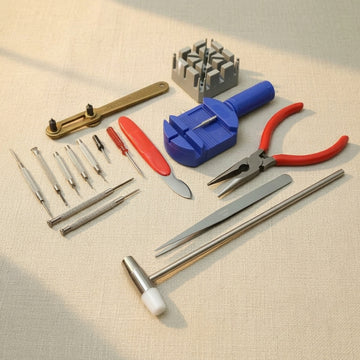
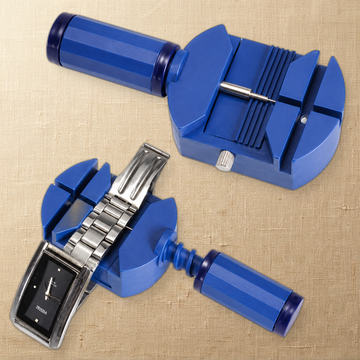
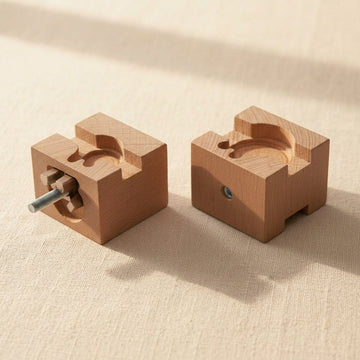
Toolsmith stocks some of these tools — a 10× loupe, tweezers, a wooden watch case holder and a 16-piece watch repair kit with pin remover and strap adjuster — but not precision screwdriver sets, case-back wrenches or brass movement holders. Everything we sell ships from UK stock, and we aim to dispatch orders placed before 2pm UK time, Monday to Friday, the same working day.
Related guides
- Watch Spring Bar Replacement — Step-by-Step UK Guide
- Watch Case Opening Tools — Complete UK Guide
- Watchmakers' Screwdrivers: Sets, Sizes & Sharpening
- Watch Strap & Bracelet Sizing: Link Removers, Pin Pushers & Notching Pliers
- Shop all Watch & Clock Tools
- Watchmaker Tweezers: AA, 3C, 5 — Anti-Magnetic, Brass & Carbon
- First Leather Watch Strap Build — UK Kit Walkthrough
Frequently asked questions
What tools do I need to start basic watch repair at home?
Seven: a spring-bar tool for straps, a 10x watchmaker's loupe, a snap-back case opener, a JAXA-style case-back wrench for screw-down backs, a precision screwdriver set covering 0.6-1.6 mm, non-magnetic curved tweezers, and a brass movement holder to grip the case. Together they cost under £60 and cover battery swaps, strap changes and bracelet adjustments.
Can I change a watch battery myself?
Yes — with the right kit it's an eight-minute job: open the case with the correct opener, read the battery code (e.g. SR626SW) under a loupe, release the clamp with a properly sized screwdriver, swap the cell with non-magnetic tweezers, and reseal. One caveat: without a pressure tester you can't guarantee water resistance, so have valuable dive watches professionally tested.
What watch repairs shouldn't I attempt with a starter kit?
Three jobs belong with a qualified watchmaker: full servicing of an automatic movement (over 100 parts and multiple specialised oils), chronograph repair (a complication far more complex than a three-hander), and vintage restoration, where parts are brittle and replacements often unobtainable. A £60 kit is for routine maintenance — batteries, straps and bracelets — not movement work.